MindMap Gallery Chapter 15 Information (Documentation) and Configuration Management
Software Test Success/System Integration Project Management Engineer/Chapter 15 Information (Document) and Configuration Management, detailed introduction, comprehensive description, I hope it will be helpful to interested friends!
Edited at 2024-02-24 02:23:02This is a mind map about bacteria, and its main contents include: overview, morphology, types, structure, reproduction, distribution, application, and expansion. The summary is comprehensive and meticulous, suitable as review materials.

This is a mind map about plant asexual reproduction, and its main contents include: concept, spore reproduction, vegetative reproduction, tissue culture, and buds. The summary is comprehensive and meticulous, suitable as review materials.
This is a mind map about the reproductive development of animals, and its main contents include: insects, frogs, birds, sexual reproduction, and asexual reproduction. The summary is comprehensive and meticulous, suitable as review materials.
This is a mind map about bacteria, and its main contents include: overview, morphology, types, structure, reproduction, distribution, application, and expansion. The summary is comprehensive and meticulous, suitable as review materials.
This is a mind map about plant asexual reproduction, and its main contents include: concept, spore reproduction, vegetative reproduction, tissue culture, and buds. The summary is comprehensive and meticulous, suitable as review materials.
This is a mind map about the reproductive development of animals, and its main contents include: insects, frogs, birds, sexual reproduction, and asexual reproduction. The summary is comprehensive and meticulous, suitable as review materials.
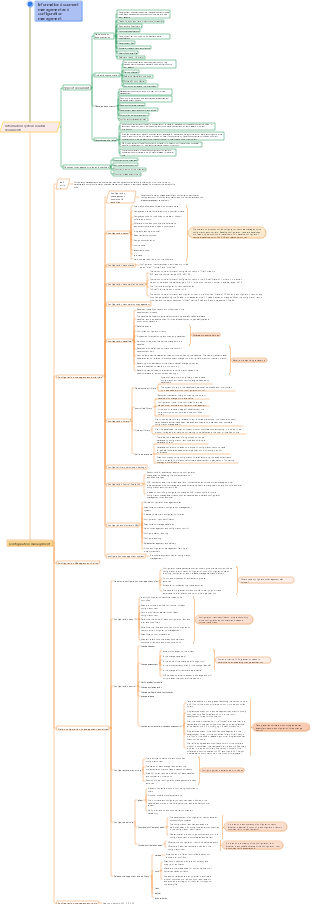
Information (documentation) and configuration management
information (documentation)
meaning
Refers to a certain data medium and the data recorded in it. Permanent and readable by humans or machines, usually used only to describe something human-readable.
In software engineering, documentation is often used to refer to any written or graphical information (including paper documents and electronic documents) that describes, defines, specifies, reports, or certifies activities, requirements, processes, or results.
type
Development documentation
meaning
Describe the development process itself
include
Feasibility study report and project mission statement, requirements specifications, functional specifications, design specifications, including program and data specifications, development plans, software integration and testing plans, quality assurance plans, security and testing information
Product documentation
meaning
Describe the products of the development process
include
Training manuals, reference manuals and user guides, software support manuals, product manuals and informational advertising
Manage documents
meaning
Record project management information
include
Records of progress and progress changes at each stage of the development process, records of software changes, and definition of responsibilities of the development team
Document quality is divided into four levels
Minimum Documentation (Level 1 Documentation)
Be applicable
Suitable for developers' own programs whose development workload is less than one person-month
include
Program listing, development records, test records and program introduction
Internal Documentation (Level 2 Documentation)
Be applicable
Can be used for dedicated programs that do not share resources with other users
include
In addition to the information provided by Level 1 documentation, it also includes sufficient comments in the program listing to help users install and use the program.
Working documents (Level 3 documents)
Applicable to programs jointly developed by several people within the same unit, or programs that can be used by other units
Formal Documentation (Level 4 Documentation)
Suitable for software products that are to be officially released for general use. Critical programs or programs with repetitive management applications must comply with the relevant provisions of GB8567
Standardized management
Document writing standards
Involving various types of text, graphics, tables, etc., no matter which type, unified writing standards should be followed, including the use of symbols, the meaning of icons, the use of comment lines in the program, indicating the document writer and writing date, etc.
Chart numbering convention
Document directory writing standards
Including document number, document name, format or carrier, number of copies, number of pages or pieces per copy, storage location, archiving time, custodian, etc.
Document management system
Depending on the specific circumstances of the organizational entity, it mainly includes the relevant specifications for establishing documents, the registration system for document borrowing records, and the control rules for document usage rights.
Configuration management
It is to control the configuration changes of the system and maintain the integrity and traceability of the configuration throughout the life cycle of the system. Officially defined in GB/T11457-2006 as the application of technical and management guidance and monitoring methods to identify and describe the functional and physical characteristics of configuration items, control the characteristics of these changes, record and report change processing and implementation status, and verify and comply with regulations compliance with requirements
concept
Configuration items
A collection of hardware, software, or both that is involved in configuration management and is treated as a single entity during the configuration management process
Including project plans, requirements documents, design documents, source code, executable code, test cases, and various data required to run the software, which will enter configuration management after review and inspection.
All configuration items should be numbered uniformly in accordance with relevant regulations, generated according to the corresponding template, and the identification information of the object should be recorded as specified in the document.
Classification
Baseline configuration items
Open read access to developers
Includes all design documents and source programs
Non-baseline configuration items
Open to PM, CCB and related personnel
Includes various plans and reports for the project
All configuration operation permissions should be strictly managed by the CMO configuration administrator
Configuration item status
draft
When the configuration item is first created
formal
After the configuration item passes the review
Revise
Change configuration items
Configuration item version number
draft
0.YZ, YZ range 01-99
formal
X.Y, X is the main version number, ranging from 1-9, Y is the minor version number, ranging from 0-9, the first official document version number is 1.0
Revise
X.YZ, generally only increases the Z value, while X and Y remain unchanged
Configuration item version management
The purpose is to save all versions of configuration items according to certain rules to avoid version loss or confusion, and to quickly and accurately find any version of the configuration item.
Configuration baseline
Consists of a set of configuration items
The configuration items in the baseline are "frozen" and cannot be modified by anyone at will.
Baselines usually correspond to milestones in the development process. A product can have multiple baselines or only one baseline.
Release Baseline—the baseline delivered to external customers
Construction Baseline—Baseline used for internal development
During project implementation, each baseline must be included in configuration control, and updates to these baselines can only be made using formal change control procedures.
benefit
(1) The baseline provides a fixed point and snapshot for development work.
(2) New projects can be established at fixed points provided by the baseline. The new project acts as a separate branch, isolated from subsequent changes to the original project (on the main branch).
(3) Baselining provides the team with a way to cancel changes when an update is deemed unstable or untrustworthy
(4) The baseline can be used to re-establish the configuration based on a specific release version to reproduce reported errors.
Configuration library
concept
Store configuration items and record all information related to configuration items
It is a powerful tool for configuration management. You can use the information in the library to answer many configuration management questions.
type
Development library (dynamic library, programmer library, working library)
Used to save configuration entities currently being developed by developers. The dynamic configuration items are placed under version management. The dynamic library is the developer's personal workspace and is controlled by the developer.
Controlled library (main library)
Contains the current baseline plus changes to the baseline. Configuration items in controlled libraries are placed under full configuration management. At the end of a certain work in information system development, the current work product is stored in the controlled library
Product library (static library, distribution library, software warehouse)
An archive containing various baselines for published use, placed under full configuration management. After developing information system products and completing system testing, the final product is stored in the product library, waiting to be delivered to the user or installed on site.
Database building mode
Build databases according to the type of configuration items
Suitable for general software development organizations. Products tend to have strong inheritance, relatively unified tools, and a certain need for parallel development.
Establish corresponding configuration libraries according to development tasks
Suitable for professional software development organizations. There are many types of development tools, and the development model is mainly linear development.
Configure library permission settings
Configuration Control Board
Responsible for evaluating, approving configuration changes and overseeing the implementation of approved changes
A CCB does not have to be a permanent establishment
When CCB establishes a project, its members include project managers, user representatives, product managers, development engineers, test engineers, quality control personnel, and configuration administrators.
CCB not only controls configuration changes, but is also responsible for more configuration management tasks, such as configuration management plan approval, baseline establishment approval, and product release approval.
For small projects, CCB can have only one person, or even a part-time person
Configure administrator
Responsible for configuration management activities throughout the project life cycle
Including writing configuration management plans, establishing and maintaining configuration management systems, establishing and maintaining configuration libraries, configuration item identification, establishing and managing baselines, version management and configuration control, configuration status reports, configuration audits, release management and delivery, and conducting inspections on project members Configuration management training.
configuration management system
Software system used for configuration management
the most fundamental requirement
No chaos allowed
6 activities
Develop a configuration management plan
The configuration management plan is a plan for how to carry out project configuration management work. It is the basis of the configuration management process and should be documented and controlled throughout the project life cycle. The Configuration Control Board is responsible for approving the plan.
content
Configuration management activities
The main activities covered include configuration identification, configuration control, configuration status reporting, configuration auditing, release management and delivery
Norms and processes for implementing these activities
Schedule for implementing these activities
The people and organizations responsible for implementing these activities, and their relationships with other organizations
Configuration ID
Also called configuration identification, it involves selecting configuration items for a system and recording the functional and physical characteristics of the configuration items in technical documentation.
Configuration identification is the function of the configuration administrator
step
Identify configuration items that need to be controlled
Specify a unique identification number for each configuration item
Define important characteristics of each configuration item
Determine the owner of each configuration item and their responsibilities
Determine the time and conditions for configuration items to enter configuration management
Establish and control baselines
Maintain relationships between document and component revisions and product versions
Configuration control
Configuration control is the change control of configuration items and baselines, including the following tasks: identifying and recording change requests, analyzing and evaluating changes, approving or rejecting requests, implementing, verifying and releasing modified configuration items.
step
Change Request
Change assessment
Impact of changes on the project
Is the change necessary?
Is the scope of the change well thought out?
Is the implementation plan for the change feasible?
Is the workload estimate for the change reasonable?
Notify evaluation results
Change implementation
Change verification and confirmation
Release of changes
Configuration repository-based change control
process
(1) Take the baseline to be upgraded (assuming the version number is V2.1) from the product library and put it into the controlled library
(2) The programmer checks out the code segment to be modified from the controlled library and puts it into his own development library for modification.
(3) The programmer checks in the modified code segment in the development library into the controlled library.
(4) After all the upgrade and modification work of the software product is completed, the new baseline in the controlled library is stored in the product library
Configure status reporting
Also known as configuration status statistics, it effectively records and reports the information required for configuration management. The purpose is to provide the current status of configuration items in a timely and accurate manner for relevant personnel to understand, so as to strengthen configuration management work.
content
The identity and status of each controlled configuration item
The status of each change request and the implementation status of approved modifications
Status of current and past versions of each baseline and comparison of versions
Records of other configuration management process activities
Configure auditing
Also called configuration audit or configuration evaluation
Functional configuration audit
Audit configuration item consistency
include
(1) The development of configuration items has been successfully completed
(2) The configuration item has reached the properties and functional characteristics specified in the configuration identification
(3) The operation and supporting documents of the configuration items have been completed and meet the requirements
Physical configuration audit
Audit the integrity of configuration items
include
(1) Whether the configuration items to be delivered exist
(2) Whether the configuration items include all necessary items
Release management and delivery
The mission is: to effectively control the issuance and delivery of software products and documents, and to properly preserve master copies of code and documents during the production period of software products.
step
storage
copy
Pack
deliver
reconstruction
Project plan, requirements documents, design documents, source code Executable code, test cases, various data required to run the software