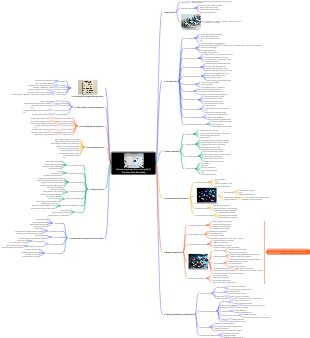
MindMap Gallery Key deep learning models
Multiple deep learning models are listed according to application classification, including image processing and computer vision, mobile and embedded device optimization, unsupervised learning and feature extraction, natural language processing, generative models and representation learning. It is for reference only. Corrections are welcome!
Edited at 2024-11-23 15:26:44Rumi: 10 dimensions of spiritual awakening. When you stop looking for yourself, you will find the entire universe because what you are looking for is also looking for you. Anything you do persevere every day can open a door to the depths of your spirit. In silence, I slipped into the secret realm, and I enjoyed everything to observe the magic around me, and didn't make any noise. Why do you like to crawl when you are born with wings? The soul has its own ears and can hear things that the mind cannot understand. Seek inward for the answer to everything, everything in the universe is in you. Lovers do not end up meeting somewhere, and there is no parting in this world. A wound is where light enters your heart.
Chronic heart failure is not just a problem of the speed of heart rate! It is caused by the decrease in myocardial contraction and diastolic function, which leads to insufficient cardiac output, which in turn causes congestion in the pulmonary circulation and congestion in the systemic circulation. From causes, inducement to compensation mechanisms, the pathophysiological processes of heart failure are complex and diverse. By controlling edema, reducing the heart's front and afterload, improving cardiac comfort function, and preventing and treating basic causes, we can effectively respond to this challenge. Only by understanding the mechanisms and clinical manifestations of heart failure and mastering prevention and treatment strategies can we better protect heart health.
Ischemia-reperfusion injury is a phenomenon that cellular function and metabolic disorders and structural damage will worsen after organs or tissues restore blood supply. Its main mechanisms include increased free radical generation, calcium overload, and the role of microvascular and leukocytes. The heart and brain are common damaged organs, manifested as changes in myocardial metabolism and ultrastructural changes, decreased cardiac function, etc. Prevention and control measures include removing free radicals, reducing calcium overload, improving metabolism and controlling reperfusion conditions, such as low sodium, low temperature, low pressure, etc. Understanding these mechanisms can help develop effective treatment options and alleviate ischemic injury.
Rumi: 10 dimensions of spiritual awakening. When you stop looking for yourself, you will find the entire universe because what you are looking for is also looking for you. Anything you do persevere every day can open a door to the depths of your spirit. In silence, I slipped into the secret realm, and I enjoyed everything to observe the magic around me, and didn't make any noise. Why do you like to crawl when you are born with wings? The soul has its own ears and can hear things that the mind cannot understand. Seek inward for the answer to everything, everything in the universe is in you. Lovers do not end up meeting somewhere, and there is no parting in this world. A wound is where light enters your heart.
Chronic heart failure is not just a problem of the speed of heart rate! It is caused by the decrease in myocardial contraction and diastolic function, which leads to insufficient cardiac output, which in turn causes congestion in the pulmonary circulation and congestion in the systemic circulation. From causes, inducement to compensation mechanisms, the pathophysiological processes of heart failure are complex and diverse. By controlling edema, reducing the heart's front and afterload, improving cardiac comfort function, and preventing and treating basic causes, we can effectively respond to this challenge. Only by understanding the mechanisms and clinical manifestations of heart failure and mastering prevention and treatment strategies can we better protect heart health.
Ischemia-reperfusion injury is a phenomenon that cellular function and metabolic disorders and structural damage will worsen after organs or tissues restore blood supply. Its main mechanisms include increased free radical generation, calcium overload, and the role of microvascular and leukocytes. The heart and brain are common damaged organs, manifested as changes in myocardial metabolism and ultrastructural changes, decreased cardiac function, etc. Prevention and control measures include removing free radicals, reducing calcium overload, improving metabolism and controlling reperfusion conditions, such as low sodium, low temperature, low pressure, etc. Understanding these mechanisms can help develop effective treatment options and alleviate ischemic injury.
Key deep learning models
natural language processing
Recurrent Neural Network (RNN)
for sequence data processing
Loop joins process time series information
Suitable for natural language processing and speech recognition
Application in speech synthesis
Generate natural speech output
For virtual assistants and voice interaction systems
Application in music creation
Generate new musical melodies
Provide creative materials for music production
Long short-term memory network (LSTM)
For processing sequence data
Particularly suitable for time series analysis
Effectively handle long-term dependencies
Applications in natural language processing
machine translation
speech recognition
Application in stock market prediction
Predict stock price trends
Risk assessment and investment decision support
BERT (Bidirectional Encoder Representations from Transformers)
Using Transformer's encoder
Provide bidirectional contextual information
Deep learning models for understanding natural language
Application in question and answer system
Provide accurate answers
Improve user experience and interaction quality
Application in text classification
Improve the performance of sentiment analysis and topic classification
Provide support for text mining and information retrieval
Transformer model
Based on self-attention mechanism
Parallel processing of sequence data
Improve the model's ability to capture long-distance dependencies
Application in machine translation
Achieve high-quality translation results
Promoted the development of neural machine translation
Application in text understanding
Improving the quality of question answering systems and text summarization
Provide powerful support for natural language understanding
Generative models and representation learning
Generative Adversarial Network (GAN)
For generating realistic images and data
Composed of generator and discriminator
The generator produces data and the discriminator evaluates the data
Application in artistic creation
Generate new works of art
Providing materials for game and film production
Applications in data enhancement
Expand the training data set
Improve the generalization ability of machine learning models
Variational Autoencoder (VAE)
For generation tasks and representation learning
Learn the underlying distribution of the input data
Generate new data samples
Application in image generation
Generate high-quality images
For image editing and content creation
Application in style transfer
Transfer one art style to another image
Create new works of visual art
Autoencoder (AE)
for unsupervised feature learning
Learn efficient representations of input data
Reconstruct input through encoder and decoder
Application in data denoising
Remove noise components from data
Extract pure features of data
Application in anomaly detection
Identify unusual patterns in data
For fraud detection and system monitoring
Unsupervised learning and feature extraction
Deep Belief Network (DBN)
It is composed of multiple restricted Boltzmann machines (RBM) stacked
Layer-by-layer pre-training for feature learning
For unsupervised learning and classification tasks
Application in image recognition
Improve image classification accuracy
Feature extraction for large-scale image databases
Application in data compression
Reduce data storage and transmission costs
Reduce data volume while maintaining data quality
Mobile and embedded device optimization
MobileNet
Optimized for mobile and embedded devices
Focus on efficiency and lightweight design
Reduce the computational resource requirements of your model
Application in mobile applications
Improving image recognition capabilities on mobile devices
For real-time image classification and object detection
Applications in edge computing
Data processing on the device side
Reduce dependence on cloud servers
Image processing and computer vision
Convolutional Neural Network (CNN)
for image recognition and classification
Feature extraction through convolutional layers
Use pooling layers to reduce the number of parameters
Applications in medical image analysis
Improve diagnostic accuracy
Speed up image processing
Application in autonomous driving technology
Real-time object recognition
Traffic analysis and decision making
UNet
Designed specifically for medical image segmentation
With special U-shaped structure
Able to pinpoint boundaries
Application in pathological image analysis
Assist pathologists in diagnosis
Improve efficiency and accuracy of medical image analysis
Application in satellite image segmentation
for land cover classification
Helps with environmental monitoring and resource management
Deep Residual Network (ResNet)
Solve the degradation problem in deep network training
Introducing residual connections to simplify the learning process
Allows training of very deep network structures
Application in image recognition tasks
Improve recognition accuracy
Achieve leading results in multiple benchmarks
Applications in medical image analysis
Assist disease diagnosis
Improve medical image analysis capabilities
YOLO (You Only Look Once)
for real-time object detection
Fast and accurate
Implement end-to-end object recognition
Application in video surveillance
Track and identify objects in videos in real time
Improve the efficiency of security monitoring systems
Application in autonomous driving
Identify road conditions and obstacles in real time
Enhance the safety of autonomous driving systems
Capsule Network (CapsNet)
Improve the model’s spatial level perception ability
Capturing hierarchical relationships of images through capsule structures
For image recognition and classification tasks
Application in image segmentation
Accurately identify different parts of an image
Image analysis for complex scenes
Application in face recognition
Improve recognition accuracy and robustness
Suitable for ever-changing face recognition environments