MindMap Gallery Physics (1)
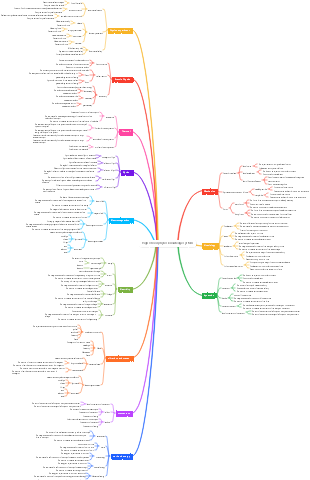
A summary of the physics part of high school. A picture will take you to fully understand the relevant content. The knowledge points are systematic and comprehensive, and there is no need to memorize rotely. The framework structure is clear and clear, so you can easily master the knowledge points.
Edited at 2025-02-23 03:01:03This template shows the structure and function of the reproductive system in the form of a mind map. It introduces the various components of the internal and external genitals, and sorts out the knowledge clearly to help you become familiar with the key points of knowledge.
This is a mind map about the interpretation and summary of the relationship field e-book, Main content: Overview of the essence interpretation and overview of the relationship field e-book. "Relationship field" refers to the complex interpersonal network in which an individual influences others through specific behaviors and attitudes.
This is a mind map about accounting books and accounting records. The main contents include: the focus of this chapter, reflecting the business results process of the enterprise, the loan and credit accounting method, and the original book of the person.
This template shows the structure and function of the reproductive system in the form of a mind map. It introduces the various components of the internal and external genitals, and sorts out the knowledge clearly to help you become familiar with the key points of knowledge.
This is a mind map about the interpretation and summary of the relationship field e-book, Main content: Overview of the essence interpretation and overview of the relationship field e-book. "Relationship field" refers to the complex interpersonal network in which an individual influences others through specific behaviors and attitudes.
This is a mind map about accounting books and accounting records. The main contents include: the focus of this chapter, reflecting the business results process of the enterprise, the loan and credit accounting method, and the original book of the person.
physics
Mechanics
Description of the motion process
Constantly variable speed linear motion
Evenly accelerated movement
Uniform speed reduction movement
a is not equal to 0 and is constant and unchanged
application
Chasing problem: One critical condition Two equal-quantity relationships
Physical analysis method
Function judgment method
Image analysis method
image
x-t image k at a certain point indicates the instantaneous velocity of this point
v-t image k at a certain point indicates the acceleration at this time
a-t image The rate of change of acceleration over time
Unconventional images
Exercise formula
formula
V=V. at
a=△V/△t
x=V. t ½at²
V²-V. ²=2ax
V average = (V. V)/2 V (average) = x/t
△x=aT²
Xm-Xn=(m-n)aT²
Basic physical quantity
Displacement: Directed line segments that point to the end position. Vector
Average speed: a certain velocity vector
Instant velocity: the speed of a certain point vector
Acceleration
Determined by F, m
Rate: The size of the instantaneous speed Scalar
The proportional formula with the initial velocity of 0
T same
v₁: v₂: v₃…Vn=1:2:3:…:n
X₁:X₂:X₃…Xn=1:4:9…:n²
XSame
V₁: V₂: V₃…Vn=1:√2:√3…√n
T₁: T₂: T₃…Tn=1:√2:√3…√n
Constant linear motion
a=0
Flat throwing movement
Constant linear motion in horizontal direction
formula
X=vt v=v.
Free fall movement in vertical direction
formula
X=½gt²
V=gt
The initial velocity is thrown in the horizontal direction
Two inferences
The reverse extension line of the instantaneous speed of an object that is flat-drafted at any time must pass through the midpoint of the horizontal displacement at this time.
At any position at any time, the relationship between the angle θ of the velocity direction and the angle α of the displacement direction and the angle α of the horizontal direction is: tanα=2tanα
Inclined throwing motion
The object is thrown up or down at the initial speed
Horizontal direction: uniform movement Vertical direction: uniform speed movement
V. x=V. cosθ V. Y=V. sinθ x=V. xt=(V.cosθ)t Vx=V. x=V. cosθ
Constant circumferential motion
Basic physical quantity
Linear speed
V=x/t v=2πr/T v=wr
Angular velocity
ω=θ/t ω=2π/T ω=v/r
cycle
T=2π/ω T=2πr/v
Speed/frequency
n=1/T
Centripetal acceleration
a=ωv a=v²/r a=ω²r a=4π²r/T²
Critical motion
Three types of conveying devices
Grass
Reference system
Free fall movement
a=g V. =0
V=gt
X=½gt²
Vertical upward throwing motion: contrary to free fall motion
Curve motion
condition
Kinematic angle: The acceleration direction and velocity direction of an object are not on the same line
Dynamic angle: The direction of the combined force is not in the same line as the velocity direction of the object.
Synthesis and decomposition
Orthogonal decomposition
triangle
Parallelogram Rules
Small river ferry
Minimum time t=d/V ship
Shortest route
V water <V ship l=d
V water > V ship l=dV water/V ship cosθ=V ship/V water
Related speed
Question type characteristics: The direction of movement of the object connected to the rope/rod is not in the same straight line
Speed
Speed of extension rod/rope V₁
Speed perpendicular to the rope rod v₂
Two adjacent sides of parallelogram
Interaction force
gravity
G=mg
Elasticity
F bullet = k△x (Hooker's Law)
Friction
F-motor = μmg
Newton's law of motion
Newton's first law
Inertia: only related to mass
Newton's Second Law
F-combination=ma
Newton's third law
Balance
Interaction force
Gravity and space navigation
The application of the law of gravity
F=Gm₁m₂/r²
Gravity constant G=6.67×10⁻¹¹
British scientist Cavendish experiment on twist scale
Consider rotation
Two poles: GMm/R²=mg The above two pieces, GMm/(R h)²=mg’
Equator: GMm/R²-mg erythrone=4π²mR/T²
Kepler's Three Laws
The first law (orbital law)
All planets move around the sun are ellipses, and the sun is in a focal point of the ellipse
The second law (the law of area)
For any planet, its connection to the Sun swept through the same area within the same time
The third law (period law)
The ratio of the cube power of the semi-major axis of all planetary orbits to the quadratic power of its orbit period is equal.
Calculate the mass and density of celestial bodies
M
4π²r³/GT²
GMm/r²=mr4π²/T²
rv²/G
GMm/r²=mv²/r
v³T/2πG
GMm/r²=mv²/r GMm/r²=mr4π²/T²
gR²/G
mg=GMm/R²
ρ
3πr³/GT²R³ When r=R=3π/GT²
GMm/r²=mr4π²/T² M=ρ4πR³/3
3g/4πGR
mg=GMm/R² M=ρ4πR³/3
Earth's satellite
For celestial bodies moving around the same center Suitable for circular orbits
Linear speed √GM/r
v=GMm/r²=mv²/r
Angular velocity ω=√GM/r³
GMm/r²=mv²/r
Period T=2π√r³/GM
GMm/r²=m (2π/T)²
Centripetal acceleration a=GM/r²
GMm/r²=ma
Geosynchronous satellite (stationary satellite) 36000km
The rotation period is the same as the geostatic
The orbital plane must coincide with the equatorial plane
Consistent with the direction of the earth's rotation
The same angular velocity as the earth's rotation
Linear speed is certain (3100m/s)
Satellite
The center of the orbit will return to the center of the earth
Polar satellite
Each circle passes through the north and south poles
Near-Earth satellite
r≈6400km v=7.9km/s
Cosmic speed
The first cosmic speed (6400km)
v=7.9km/s
mg=mv²/R v=√gR
GMm/R²=mv²/R v=√GM/R
Second Universe Speed (the minimum ground launch speed that breaks away from gravity)
v=11.2km/s
The third cosmic speed (the minimum ground emission speed that breaks free from the bondage of the sun's gravity)
v=16.7km/s
Multi-star movement
Track change movement
Relativity of space-time view
Time delay effect (clock slows down)
Length shrinkage effect (movement ruler shortens)
The law of conservation of mechanical energy
achievement
W=Pt
power
P=Fv
Kinetic energy theorem
E=½mv²
Conservation of mechanical energy
E=½mv₁²-½mv. ²
The law of conservation of energy
½mv₁² ½mv₂²=½mv₁’² ½mv₂’²
The law of conservation of momentum
Momentum Theorem
p=mv
The law of conservation of momentum
mv₁ mv₂=mv₁’ mv₂’
application
Elastic collision
Inelastic collision
Completely inelastic collision
Mechanical vibration Mechanical wave
Mechanical vibration
Mechanical wave
Electromagnetics
Electrostatic field
Circuits and their applications
magnetic field
Electromagnetic induction
Sudden current
Electromagnetic wave
sensor
Hot Learning
Molecular dynamic theory
Matter is made up of a large number of molecules
The molecule is doing non-stop unregulated movement
Diffusion (molecule)
Directly prove that the molecules are doing irregular movements
Different substances in contact with each other
Hot exercise
Brownian motion (particles (molecular clusters))
It is an indirect proof of irregular motion of molecules
In liquid or gas
Mechanical movement
Features
The smaller the particles, the more significant the Brownian motion
The higher the temperature of liquid (or gas), the more significant the Brownian motion
Only by using a microscope can you see 400 to 1000
Thermal Movement (Molecule)
In any substance
Hot exercise
All become more intense as the temperature rises
The force between molecules
Gas, liquids, and solids all have voids. The gravitational and repulsive force increase with the decrease of the distance between molecules, but the repulsive force changes rapidly, and the distance between molecules is not a monotonic relationship.
Internal energy
The probability of gas molecules moving in all aspects is equal at each moment
The temperature increases, the average rate of molecular movement increases, the number of molecules with a large rate increases, and the number of molecules with a small rate decreases
The greater the temperature, the peak will move to the right, but the boundary area is 1
Gas pressure
Determinants (micro)
The average rate of molecules
The larger the average rate of the molecule, the greater the force of the collision between the molecule and the instrument wall per unit area, the greater the pressure.
Number density of molecules
The greater the number density of molecules, the more molecules collide with the wall of the unit area within a unit time, the greater the force, the greater the pressure.
Molecular kinetic energy
Because molecular thermal movement never stops, molecular kinetic energy never reaches zero
The average kinetic energy of molecules increases
Average of kinetic energy of all molecules in an object
Temperature is the standard for the average kinetic energy of molecules
When the temperature is equal, the average kinetic energy of molecules must be equal.
Molecular total kinetic energy
factor
Average molecular kinetic energy (temperature)
Molecular Book Title
Molecular potential energy
r>r.
Gravity, r continues to increase, and we need to constantly overcome the gravity of the molecular and do work, and the molecular potential energy increases.
r<r.
Repulsion force, r continues to increase, and the molecular repulsion force needs to be continuously overcome to do work, and the molecular potential energy decreases.
r=r.
The molecular force is zero, and the molecular potential energy is the minimum value
Infinite distance, the molecular potential energy is 0
Related to volume (proportional)
Internal energy
The sum of the thermal motion of molecules in an object and the potential energy of a molecule is called the internal energy of an object.
factor
Macro
Temperature, volume, amount of substance
Microscopic
Molecular potential energy, average kinetic energy and number of molecules
The mechanical energy of an object in mechanical movement does not contribute to the internal energy of an object.
All objects have internal energy
Gas, solids and liquids
The law of thermodynamics
Optics
Geometric Optics
reflection
refraction
n=sinθ₁/sinθ₂
Refractive index represents the physical amount of the medium's ability to deflect light
Properties of media
The frequency of incident light
n=c/v
The incident angle is greater than the refractive angle
Total reflection
sinθ=1/n
application
Optical fiber
Fiber Optical Communication
The refractive index of the inner core is greater than that of the jacket
Physical Optics
Light interference
Interference pattern features
Film interference applications
Diffraction of light
Diffraction stripe pattern characteristics
Polarization of light
laser
Color and dispersion of light
Modern physics
Energy quantization
Photoelectric effect
Wave-particle duality
Matter wave
Atomic structure and Boer theory
Atomic nucleus
20 experiments
Mechanics
Explore the law of changing speed of small cars over time
Exploring the relationship between spring force and deformation variable
Explore the synthesis law of two forces that are at angles
Explore the relationship between acceleration and the force and mass of an object
Explore the characteristics of flat casting movement
Explore the relationship between centripetal force magnitude, angular velocity, and mass
Verify the law of conservation of mechanical energy
Measuring gravity acceleration with a single pendulum
Electromagnetics
Observe the charge and discharge phenomena of capacitors
Measurement of conductor resistivity
Measure the electromotive force and internal resistance of the power supply
Measure physical quantities in electricity with multi-meter
Explore the factors that affect the direction of induced current
Exploring the relationship between the primary and secondary coil voltages of transformers and the number of turns
Use sensors to create simple automatic control devices
Optics
Measure the refractive index of glass
Measure the wavelength of light with double slit interference
Hot Learning
Estimate the size of oleic acid molecules by oil film method
Exploring the relationship between pressure and volume of a certain mass gas under isothermal conditions