MindMap Gallery What is a Matrix
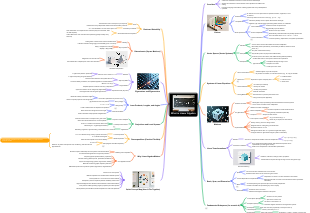
Discover the fascinating world of matrices and their role in transforming vector spaces! This introduction explores the core concepts of matrices as structured arrays of numbers that represent linear transformations, mapping input vectors to output vectors. We'll delve into the geometric and abstract interpretations of vectors, the significance of basis systems, and how matrices implement transformations through multiplication. Key topics include common transformations like scaling, rotation, and reflection, alongside essential properties such as invertibility, determinants, and eigenvalues. Understand why linear transformations matter, preserving shapes and structures while revealing the underlying dynamics of these mathematical tools. Join us in uncovering the power of matrices!
Edited at 2026-03-20 03:52:03Explore the rich tapestry of Iran's history, spanning from early civilizations to the Islamic era and beyond. This timeline highlights key periods, including the emergence of ancient societies around 10,000 BCE, the rise of the Achaemenid Empire under Cyrus the Great, and the cultural flourishing during the Sasanian Empire. The narrative continues through the Islamic conquest, showcasing the integration of Iran into the Caliphate, and the subsequent revival of Persian culture under various dynasties. The Mongol invasion marks a turning point, leading to fragmentation and the rise of local powers. Delve into a journey that captures the resilience and evolution of Iranian identity through the ages.

Discover the rich tapestry of Indonesia's history through its timeline, spanning from early settlements to modern independence. The journey begins with the Austronesian peoples and their maritime networks, followed by the rise of influential kingdoms like Srivijaya and Majapahit, which shaped culture and trade. The arrival of Europeans in the 16th century heralded colonial contestation, leading to Dutch consolidation and the emergence of nationalism in the early 20th century. The Japanese occupation during World War II further catalyzed the quest for independence, culminating in the proclamation by Sukarno and Hatta in 1945. This timeline encapsulates the dynamic forces that have shaped Indonesia into the diverse nation it is today.
Discover the fascinating world of Partial Differential Equations (PDEs), essential tools for modeling complex multivariable systems. This overview covers the definition of PDEs as equations involving unknown functions and their partial derivatives, alongside their significance in capturing spatial and temporal variations, interactions, and conservation laws. You'll learn about the components of a PDE, including independent and dependent variables, partial derivatives, and coefficients. Explore common PDEs like the Heat Equation and Navier–Stokes equations, as well as their classifications by order, linearity, and type. Finally, understand the conditions needed for solutions and the various methods used to solve these equations, both analytically and numerically. Join us in unraveling the complexities of PDEs!
Explore the rich tapestry of Iran's history, spanning from early civilizations to the Islamic era and beyond. This timeline highlights key periods, including the emergence of ancient societies around 10,000 BCE, the rise of the Achaemenid Empire under Cyrus the Great, and the cultural flourishing during the Sasanian Empire. The narrative continues through the Islamic conquest, showcasing the integration of Iran into the Caliphate, and the subsequent revival of Persian culture under various dynasties. The Mongol invasion marks a turning point, leading to fragmentation and the rise of local powers. Delve into a journey that captures the resilience and evolution of Iranian identity through the ages.
Discover the rich tapestry of Indonesia's history through its timeline, spanning from early settlements to modern independence. The journey begins with the Austronesian peoples and their maritime networks, followed by the rise of influential kingdoms like Srivijaya and Majapahit, which shaped culture and trade. The arrival of Europeans in the 16th century heralded colonial contestation, leading to Dutch consolidation and the emergence of nationalism in the early 20th century. The Japanese occupation during World War II further catalyzed the quest for independence, culminating in the proclamation by Sukarno and Hatta in 1945. This timeline encapsulates the dynamic forces that have shaped Indonesia into the diverse nation it is today.
Discover the fascinating world of Partial Differential Equations (PDEs), essential tools for modeling complex multivariable systems. This overview covers the definition of PDEs as equations involving unknown functions and their partial derivatives, alongside their significance in capturing spatial and temporal variations, interactions, and conservation laws. You'll learn about the components of a PDE, including independent and dependent variables, partial derivatives, and coefficients. Explore common PDEs like the Heat Equation and Navier–Stokes equations, as well as their classifications by order, linearity, and type. Finally, understand the conditions needed for solutions and the various methods used to solve these equations, both analytically and numerically. Join us in unraveling the complexities of PDEs!
What is a Matrix (Explains Linear Transformations)
Core Idea
A matrix is a structured array of numbers that represents a linear transformation between vector spaces
It provides a rule to map an input vector to an output vector via multiplication
It encodes how basis vectors are transformed, and thereby how all vectors are transformed
Vectors and Coordinate Systems
Vectors as objects
Geometric interpretation: arrows with magnitude and direction (in 2D/3D)
Abstract interpretation: elements of a vector space (can be higher-dimensional)
Coordinates depend on a basis
A basis is a set of independent vectors used to describe all vectors in the space
The same vector can have different coordinates under different bases
Standard basis
2D: e1 = (1, 0), e2 = (0, 1)
3D: e1 = (1, 0, 0), e2 = (0, 1, 0), e3 = (0, 0, 1)
Matrices as Linear Transformations
Definition (linear map)
A transformation T is linear if
Additivity: T(u + v) = T(u) + T(v)
Homogeneity: T(cu) = cT(u)
Matrix representation
A matrix A represents T in chosen bases such that
T(x) = A x
Multiplication A x produces a new vector that is the transformed version of x
Columns-as-images-of-basis principle
For an n×n matrix A in the standard basis
The i-th column equals A e_i
Any vector x = x1 e1 + ... + xn en transforms as
A x = x1 (A e1) + ... + xn (A en)
Practical meaning
Columns describe where the basis vectors land
The transformation of any vector is a linear combination of those transformed basis vectors
Matrix Multiplication (How It Implements the Transformation)
Dimension compatibility
If A is m×n and x is n×1, then A x is m×1
Row-dot-product viewpoint
Each output component is a dot product of a row of A with x
Linear-combination-of-columns viewpoint
A x is a weighted sum of the columns of A with weights from x
Example structure (2D)
If A = [[a, b], [c, d]] and x = (x, y)
A x = (a x + b y, c x + d y)
Geometric Interpretation (Common 2D/3D Transformations)
Scaling (dilation)
Uniform scaling: multiplies all lengths by the same factor
Non-uniform scaling: different factors along different axes
Diagonal matrices scale coordinate axes
Rotation (2D)
Rotates vectors around the origin while preserving lengths and angles
Rotation matrices are orthogonal with determinant +1
Reflection
Flips vectors across a line (2D) or plane (3D)
Often orthogonal with determinant -1
Shear
Slides points parallel to an axis proportional to the other coordinate
Preserves area in 2D for certain shears but changes angles
Projection
Maps vectors onto a subspace (line/plane)
Loses information (non-invertible unless projecting onto full space)
Stretch + rotate + shear combinations
Any linear transformation can be seen as a combination of basic geometric effects
Why “Linear” Matters
Preserves origin
Linear transformations always map 0 to 0
Preserves straight lines and parallelism
Lines remain lines (though may rotate/scale/shear)
Parallel lines remain parallel
Preserves vector addition structure
Shapes may distort, but gridlines remain straight and evenly parameterized
Matrix Properties as Transformation Properties
Identity matrix (I)
Represents “do nothing” transformation: I x = x
Zero matrix
Collapses all vectors to the zero vector
Invertibility
A is invertible if there exists A⁻¹ such that A⁻¹ A = I
Transformation is reversible (one-to-one and onto in equal dimensions)
Determinant (square matrices)
Measures area/volume scaling factor of the transformation
Sign indicates orientation flip (negative implies reflection-like behavior)
Determinant 0 implies non-invertible (collapses dimension)
Rank
Dimension of the output subspace (image) the transformation can reach
Lower rank means the transformation collapses space into a lower dimension
Trace (square matrices)
Sum of diagonal entries
Related to eigenvalues and certain dynamical behaviors
Norms (magnitude measures for matrices)
Quantify how much vectors can be stretched by the transformation
Eigenvectors and Eigenvalues (Special Directions)
Eigenvector concept
A nonzero vector v such that A v = λ v
Direction preserved; only scaled (possibly flipped if λ < 0)
Eigenvalue meaning
λ is the scaling factor along eigenvector directions
Why they matter
Reveal “natural axes” of the transformation
Useful for understanding repeated application (dynamics), stability, and diagonalization
Basis Changes and Similarity (Same Transformation, Different Matrix)
Dependence on basis
The same linear transformation has different matrices in different bases
Change-of-basis matrix
If P converts coordinates from new basis to old basis, then
A_new = P⁻¹ A_old P
This is a similarity transform
Interpretation
Similar matrices represent the same linear map under different coordinate systems
Types of Matrices and Their Transformation Roles
Square matrices (n×n)
Map n-dimensional space to itself
Determinant, eigenvalues, invertibility are central
Rectangular matrices (m×n)
Map n-dimensional inputs to m-dimensional outputs
Common in data transformation, linear models, and dimensionality change
Symmetric matrices
Often represent quadratic forms; have real eigenvalues and orthogonal eigenvectors
Orthogonal matrices
Preserve lengths and angles: Qᵀ Q = I
Represent rotations/reflections (no stretching)
Diagonal matrices
Pure scaling along coordinate axes (in that basis)
Triangular matrices
Useful for solving systems; represent transformations with sequential dependence
Matrix “types” hint at the geometry they preserve or simplify (lengths, axes, solvability).
Matrices as Systems of Linear Equations
Ax = b viewpoint
Finding x such that applying transformation A yields b
Solution interpretations
Unique solution: A invertible (in square case)
No solution: b not in the image (column space) of A
Infinitely many: nontrivial null space (dimension collapse)
Column space and null space
Column space: all reachable outputs A x
Null space: all inputs mapped to zero (A x = 0)
Practical Applications
Computer graphics
2D/3D transformations: rotate, scale, shear, project
Composition of transforms via matrix multiplication
Data science and machine learning
Linear models: predictions as matrix-vector products
Feature transformations and embeddings
Engineering and physics
Coordinate transforms, stress/strain relations, linearized systems
Signal processing
Filtering and transforms (e.g., discrete transforms as matrix operations)
Networks and Markov chains
Transition matrices mapping probability vectors forward
Composition of Transformations
Applying transformations sequentially
If first apply B then apply A, overall is A(Bx) = (A B) x
Order matters
Matrix multiplication is generally not commutative: A B ≠ B A
Interpretation
Product matrix encodes the combined effect of multiple linear steps
Key Takeaways
A matrix is best understood as a concrete representation of a linear transformation
Columns tell where basis vectors go; multiplication builds all results from those columns
Determinant, rank, and eigenvalues describe fundamental geometric and structural effects
Changing basis changes the matrix, not the underlying transformation