MindMap Gallery Brief History Trilogy A Brief History of the Future
Digitization based on drawings provided with official books
Edited at 2020-10-30 21:26:49Mappa mentale per il piano di inserimento dei nuovi dipendenti nella prima settimana. Strutturata per giorni: Giorno 1 – benvenuto, configurazione strumenti, presentazione team. Secondo giorno – formazione su policy aziendali e obiettivi del ruolo. Terzo giorno – affiancamento e primi task guidati. Il quarto giorno – riunioni con dipartimenti chiave e feedback intermedio. Il quinto giorno – revisione settimanale, definizione obiettivi a breve termine e integrazione culturale.

Mappa mentale per l’analisi della formazione francese ai Mondiali 2026. Punti chiave: attacco stellare guidato da Mbappé, con triplice minaccia (profondità, taglio, sponda). Criticità: centrocampo poco creativo – la costruzione offensiva dipende dagli attaccanti che arretrano. Difesa solida (Upamecano, Saliba, Koundé). Portiere Maignan. Variabili: gestione infortuni e condizione fisica dei big. Ideale per scout, giornalisti e tifosi.
Mappa mentale per il piano di inserimento dei nuovi dipendenti nella prima settimana. Strutturata per giorni: Giorno 1 – benvenuto, configurazione strumenti, presentazione team. Secondo giorno – formazione su policy aziendali e obiettivi del ruolo. Terzo giorno – affiancamento e primi task guidati. Il quarto giorno – riunioni con dipartimenti chiave e feedback intermedio. Il quinto giorno – revisione settimanale, definizione obiettivi a breve termine e integrazione culturale.
Mappa mentale per l’analisi della formazione francese ai Mondiali 2026. Punti chiave: attacco stellare guidato da Mbappé, con triplice minaccia (profondità, taglio, sponda). Criticità: centrocampo poco creativo – la costruzione offensiva dipende dagli attaccanti che arretrano. Difesa solida (Upamecano, Saliba, Koundé). Portiere Maignan. Variabili: gestione infortuni e condizione fisica dei big. Ideale per scout, giornalisti e tifosi.
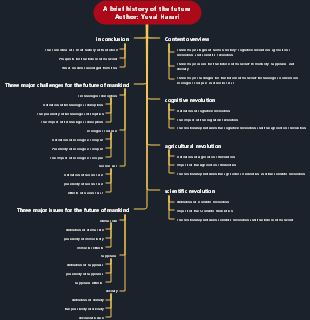
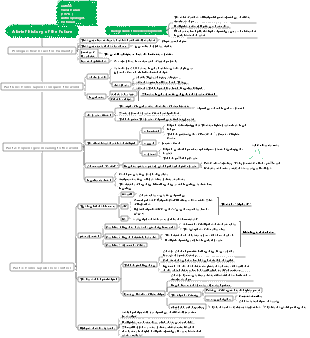
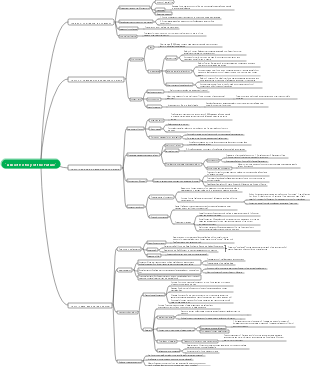
A brief history of the future
Preface: New Issues for Humanity
defeat death
The emergence of immortality will lead to fundamental inequality between people
eternal happiness
Biochemistry re-creates Homo sapiens to provide endless pleasure
man becomes god
path
Bioengineering: Human beings can fully exploit their potential under the existing organic body structure
Semi-mechanical engineering: integrating various non-organic devices, retaining the organic brain as the core
Non-organic bioengineering: intelligent software replaces neural networks, inorganic life replaces organic life
If the mind changes from carbon-based to silicon-based, the structure of the mind changes, Homo sapiens disappears, and human history comes to an end.
clarify
1. The above refers to "humanity as a whole", not most individual people.
2. This is a historical prediction, not a political goal
3. Pursuing may not necessarily result in getting
4. Predictions are not for the purpose of prophecy. Predictions can change the future after discussion.
Marxism didn't overthrow the regime, this prediction alone could make them change
The meaning of history: Historical knowledge will change our future behavior. Studying history is to liberate ourselves from old meanings.
The paradox of knowledge: knowledge (prediction) is useless if it cannot change behavior. Once behavior changes, the original knowledge (prediction) immediately loses its meaning.
On the road to becoming a god, there are no brakes
Each expert has his or her own specialty. No one understands the entire system. No one knows where the brakes are.
The modern economy can only grow endlessly, and braking will lead to collapse. It can only pursue sustainable goals: immortality, happiness, and divinity. (The three are inseparable)
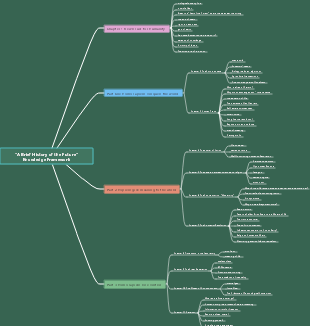
1. Homo sapiens conquered the world
How humans treat other animals (World)
fact
Humans have exterminated and conquered other large animals and dominated the world; humans, like other animals, are a set of biological algorithms for reproduction, and emotions and desires help us find a path quickly
idea
hunter gatherer
Hunter-gatherers do not feel that they are superior to other creatures. Whether humans can survive depends on understanding and respecting the desires of the animals around them.
Hunter-gatherers tended to be animistic and communicate with all living things
farmer
Farmers' quality of life depends on animals they can control
Reducing animals from beings with feelings and worthy of respect to human assets
People discipline animals according to their own needs and ignore the emotional needs of animals
Most agricultural societies viewed people of different classes as assets
Theism promises Homo sapiens to be dominant and exploit all other living things. Such as Christianity
Theism, God is responsible for mediating between humans and ecosystems. The gods were responsible for protecting agriculture, in exchange for human contributions, at the expense of the ecosystem
modern man
Theism uses the name of God as an excuse for traditional agriculture, while humanism uses the name of man as an excuse for modern industrialized agriculture.
Humanism is based on the belief that Homo sapiens possess certain unique and sacred human qualities that animals do not have, so nature is not important.
human traits
People have souls
If the soul evolved, then it would be contrary to the nature of evolution for it to be an indivisible, eternal entity.
If the soul suddenly appeared in a human being, it is unimaginable that there was no trace of soul before him or his parents.
People have souls
If everything is in our neuron network, why separate the mind?
If the mind is higher than the neural network, then where is it?
The web of human meaning
Animals can only imagine what actually exists
And people can imagine intersubjective things, which have real and powerful power, such as countries, companies, laws, etc.
People organize large-scale collaboration through fictional stories. This is the fundamental reason why human power is amplified and dominates the world.
If you want to decipher the future of mankind, you must decipher all kinds of fictional imaginations that fail to make sense of the world.
2. Homo sapiens gives meaning to the world
the power of fiction
Animals all live in two realities: objective test questions and subjective experience. The world of Homo sapiens has a third reality: stories about money, gods, countries, companies, etc.
70,000 years ago, the cognitive revolution allowed humans to start talking about things that only existed in human imagination, which could lead to the cooperation of hundreds and thousands of people.
5,000 years ago, people invented writing and money
Words allow people to organize society in an algorithmic way. Each person completes a small step, and the final important decision is judged by the entire algorithm. This is the essence of the bureaucracy.
The state issues a piece of paper and forces citizens to use this piece of paper to pay taxes. Citizens have no choice, but the market develops.
Story should be just a tool, not the goal
We should distinguish between reality and fiction. The status of reality is of course higher. The euro can depreciate but it is not painful.
In the future, there will be more powerful fictional concepts and more totalitarian organizations. It is particularly important to distinguish between reality and fiction.
Fictional stories make it easier for humans to cooperate, but the cost is that stories also determine the goals of our cooperation
The debate between science and religion
religion
Religion is not the same as superstition. What you believe must be the "truth", and what others believe will be superstition.
Religion is not supernatural, it is natural for people who believe in demons, gods, spirits
Religion is not a question of whether you believe in "God"
Religion does not equal spirituality
Religion is about consolidating the world order, spirituality is about escaping
The spiritual journey is only suitable for individuals, not for society. Human beings must cooperate and cannot have only problems and no norms.
Religion is an all-encompassing set of stories that lends superhuman legitimacy to human laws, norms, and values
Religion is defined by its social function rather than the existence of a god
Christianity, communism, and liberalism can all be regarded as a religion
The historical laws of communism are actually like the commandments of the Christian God
science and religion
If science wants to create a viable human system, it needs the assistance of religion; it studies facts but does not make ethical judgments
Religion is not just about ethical judgments, it also includes factual statements
Three parts of a typical religious story
1. Ethical judgments, such as “human life is sacred”
2. Factual statement, such as "Human life begins at the moment of conception."
3. A combination of ethical judgments and factual statements, with specific instructions, such as "You cannot have an abortion even if it is just one day old."
Science cannot refute the ethical judgments of religions, but it can refute the factual statements.
Science and religion are easier to compromise and cooperate than imagined
Religion cares most about order
Science cares most about power
Modern history is actually the process of reaching an agreement between science and a specific religion (humanism). Modern society believes in humanism, and science is not to question, but to realize its dogma.
Contract with "Modern"
Pre-modern humans believed they were living within some grand cosmic plan, which limited human power but also gave everything meaning
"Modern" is a contract, the essence of which is: people give up meaning in exchange for power
Without meaning, the reason why modern society is still developing is because of the rise of a revolutionary new religion: humanism
humanist revolution
The contract with modernity is to gain power and relinquish meaning. But there is a loophole clause, meaning and power can be had if humans find meaning outside of the overall cosmic plan. man finds humanism
dogma of humanism
Humanist Politics: Voters can make the best choices
Humanistic Economics: The customer is always right
Humanistic Aesthetics: The person who sees it thinks it is beautiful, it is beautiful
Humanistic Ethics: If it feels right, do it
Humanistic education: think for yourself
The split in humanism
Classical Orthodoxy: Liberalism
Everyone is a unique person with experiences that will never be repeated
Branch One: Social Humanism. Socialism blames liberalism for focusing too much on one's own feelings and ignoring the experiences of others.
Branch Two: Evolutionary Humanism. The conflict of various experiences and feelings is inevitable and the best one wins
3. Homo sapiens lost control
Time bomb in the laboratory
free will
The basis of liberalism is that people have free will. This is a statement of fact.
Fact statement science can intervene
Every electrochemical reaction is determined by the previous event, so the final decision reached is definitely not free will.
If the decision is caused by the random movement of atoms, of course this is randomness and not free will.
According to the theory of evolution, all so-called "selections" of animals are responses to genetic codes.
individualism
Liberalism believes that everyone has a single, indivisible self
Split-brain experiment, self is physically separable
Ice and fire experiment, people have two selves: experiencing self and narrative self
great separation
A scientific response to the insistence that people are irreplaceable
1. Biology is an algorithm. Every animal is a collection of algorithms that evolved
2. The function of the algorithm is not affected by the constituent substances
3. As long as the facts are calculated, there is no difference between silicon-based and carbon-based
Superhumans take over the world, and humans lose equality
Algorithms control the world and humans lose their sanctity
Humanity as a whole still has value, but individuals no longer have authority and most choices are governed by external algorithms
Human beings have absolutely no value
Algorithms become entities like companies and countries, controlling humans
What do useless people do? They can only live on drugs and playing games.
Humans are likely to be kept in captivity or exterminated because the system is smarter than people
Whether algorithms or superhumans take over the world, liberalism will collapse
New Religion: Technohumanism
We still believe that humans are the pinnacle of creation, and that Homo sapiens has upgraded to become the god of wisdom, fighting against the most complex unconscious algorithms.
Just like human intelligence sees a small segment of the spectrum, the channel in the heart is much wider than what we experience. Becoming a wise god can explore the new continent of the mind.
Technological thinking faces an unsolvable dilemma. It believes that human will is the most important thing in the universe, so it promotes human development and control. However, once the will can be controlled, human beings will lose their sanctity and cannot stand in the face of technology.
The New Religion: Dataism
Dataism believes that the universe is composed of data, and the value of any phenomenon or corpse lies in its contribution to data processing.
economic system
The mechanism of the economy is to collect data about desires and abilities and then translate them into decisions
Capitalism won the Cold War not because it was more ethical or because God was angry with the Soviet Union, but because decentralized data processing was better than centralized at this stage.
political system
Democracy and autocracy are essentially two opposing mechanisms for collecting and analyzing information.
If data cannot be processed effectively, the noble institutions of the past such as elections, political parties, and parliaments may become obsolete.
Authoritarian regimes are also unable to cope with the speed and volume of data flows
All mankind is a data system, and individuals are chips
4 ways to improve efficiency
1. Increase the number of processors. A city with a population of 100,000 has a capacity higher than a village with a population of 1,000
2. Add processor types. The dialogue between farmers, priests, and physicians produced ideas that would never have been discussed among hunter-gatherers.
3. Increase connections between processors. 10 cities with trade have higher output than 10 isolated cities
4. Increase the freedom of flow of existing connections. Just like getting rid of things like highway tolls
4 stages of human development
1. Cognitive revolution, a large number of homo sapiens can be connected into a single data processing network
2. The Agricultural Revolution, a massive increase in population, and an increase in human cooperation networks. Increased number of processors, types and connections
3. From the invention of writing and money to the beginning of the scientific revolution, various connections have become closer
4. The final stage, from the geographical discovery to the present, information flows freely in the global network, and the quantity and speed are getting faster and faster. The reason why today’s democracy and market win is not because they are “good”, but because they have improved. global data processing system
For dataism, freedom of information is the highest good
The first commandment of dataism: connect more and more media to generate more and more information
The second commandment of dataism: Connect everything to the system, even the heretics who don’t want to join
Dataism treats human experience as data patterns, thus destroying people’s authority and source of meaning.
Dataism believes that experience has no value if it is not shared, and people do not need (or even can) find meaning in their hearts. What we have to do is wait for the algorithm to figure out the meaning
As long as there are better algorithms and data, human biological algorithms will naturally be eliminated
The Internet of Everything itself has a sacred meaning
Dataism is as much a threat to humans as humans are to other animals. Data doesn’t care about our subjective needs
The three most important matters and corresponding questions
Science is converging on an all-encompassing dogma that all living things are algorithms and life is data processing
1. Are living things really just algorithms, and life really just data processing?
Intelligence is decoupling from consciousness
2. Which is more valuable, intelligence or consciousness?
Unconscious but highly intelligent algorithms may soon know more about us than we do
3. How will society, politics, and daily life change when unconscious but highly intelligent algorithms understand us better than we do?