MindMap Gallery World History Mind Map
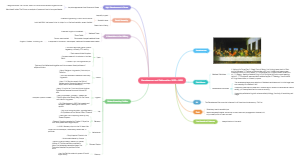
This is a mind map about world history (from Unit 9 to Unit 5), including the Renaissance (14th to 17th centuries), early colonial plunder, constitutional monarchy in Britain (1640 Revolution, "Bill of Rights"), etc.
Edited at 2023-11-07 20:06:19This is a mind map about bacteria, and its main contents include: overview, morphology, types, structure, reproduction, distribution, application, and expansion. The summary is comprehensive and meticulous, suitable as review materials.

This is a mind map about plant asexual reproduction, and its main contents include: concept, spore reproduction, vegetative reproduction, tissue culture, and buds. The summary is comprehensive and meticulous, suitable as review materials.
This is a mind map about the reproductive development of animals, and its main contents include: insects, frogs, birds, sexual reproduction, and asexual reproduction. The summary is comprehensive and meticulous, suitable as review materials.
This is a mind map about bacteria, and its main contents include: overview, morphology, types, structure, reproduction, distribution, application, and expansion. The summary is comprehensive and meticulous, suitable as review materials.
This is a mind map about plant asexual reproduction, and its main contents include: concept, spore reproduction, vegetative reproduction, tissue culture, and buds. The summary is comprehensive and meticulous, suitable as review materials.
This is a mind map about the reproductive development of animals, and its main contents include: insects, frogs, birds, sexual reproduction, and asexual reproduction. The summary is comprehensive and meticulous, suitable as review materials.
world history
Rental farms and handicraft workshops
The germ of capitalism
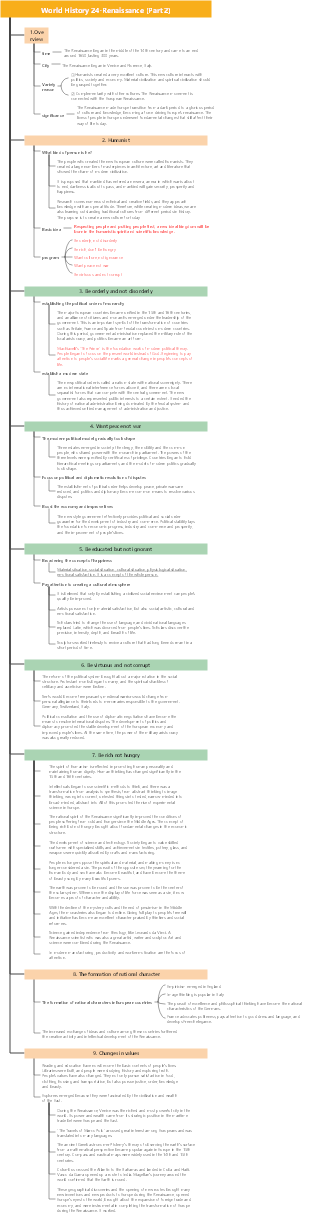
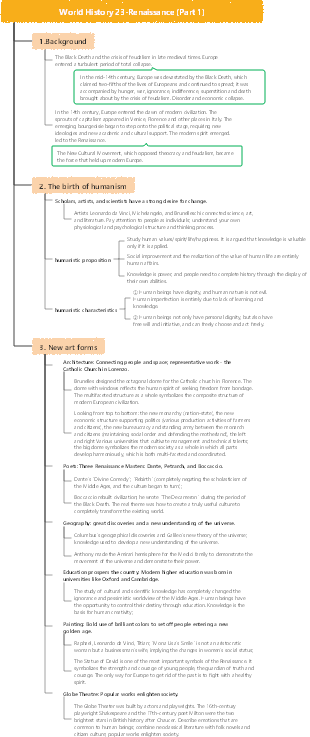
Renaissance (14th to 17th centuries)
Emphasis on "humanism"
Dante's "Divine Comedy", Shakespeare, Leonardo da Vinci
People-centered, pursuing the liberation of nature and enjoying happiness in this world
Promote ideological emancipation, cultural prosperity, and capitalist development
Explore new routes
Background: Capitalist development requires raw materials, markets, and commodities
figure
Dias 1487
Vasco da Gama 1497
Magellan's circumnavigation of the world in 1492: round earth theory
Columbus 1519: Discovered the New World
Influence
European trade center moves west to Atlantic coast
The world market begins to take shape, the world begins to establish direct commercial contacts, and the exchange of species begins
The world begins to be connected as a whole, and the concept of the world begins to be established
early colonial plunder
Triangle trade (barbaric, cruel)
Impact on Europe: Promoting primitive accumulation of capital and capitalist development
Impact on Africa: Massive outflow of labor, leading to long-term poverty and backwardness
Impact on the Americas: large amounts of cheap labor, promoting the development of large plantation economies
Influence
Europe: Promote the accumulation of European original capital
World: The world market gradually takes shape
Colonies: Bringing great suffering, European culture spread to the colonies
The emergence and development of capitalism/towards modern times
Constitutional monarchy of England (Revolution of 1640, Bill of Rights)
The battle between Parliament and royal power: “The royal power is limited” and “The king is under the law”
Revolution of 1640
Cromwell (dictatorship)
The Glorious Revolution of 1688, the end of the revolution
bill of rights
Protect parliamentary powers
Limitation of royal power (right to inherit the throne)
The gradual formation of a constitutional monarchy
revolutionary significance
opened the way for the development of capitalism
Have a profound impact on modern world history
American Independence (1773~1781)
process
Beginning: The Guns of Lexington 1775
"Declaration of Independence" 1776.7.4
"The world's first declaration of human rights"
Content: Natural human rights, sovereignty lies with the people, declaration of American independence
Limitations: Racial Discrimination and Slavery
Battle of Saratoga 1777
Battle of Yorktown 1781
Significance: It is both a national liberation war and a bourgeois revolution, overthrowing British rule, American independence, promoting the development of capitalism, and influencing the process of the French Revolution
"United States Constitution of 1787"
Content: Separation of executive, legislative and judicial powers, separation of powers between the federal government and local governments, president and members elected (separation of powers, checks and balances, establishment of a federal republic)
The world's first bourgeois written constitution
Limitations: Slavery, racial discrimination
The French Revolution
process
Enlightenment: Oppose the "old system" and use the light of reason to dispel the darkness of ignorance
The three-level meeting was held in 1789
Storming the Bastille1789.7.14
Declaration of the Rights of Man 1789
Natural human rights: freedom, equality, democracy, rule of law, property rights
"The birth certificate of the new society"
The First French Republic (Jacobin dictatorship, Robespierre)
First French Empire (Napoleon) 1804~1815
"Code Napoleon"
free and equal property rights
Safeguard the achievements of the great revolution
The blueprint of the French Civil Code
significance
Destroy the French monarchy
Spread bourgeois liberal democratic ideas
Has broad global influence
The initial establishment of the capitalist system
The first industrial revolution (1860s ~ 1840)
background
Establishment of the British constitutional monarchy
The commodity market expands and demand for commodities increases
Achievements
Jenny Machine (Hargreaves) 1765: Hand Production – Machine Production
Watt's improved steam engine 1785
Source of power (source of innovation power): effective and convenient, improving productivity
Stephenson invented the steam locomotive (train) in 1825: transportation is convenient, cheap and fast
Manual workshop-modern factory
significance
Technological Revolution: Improving the level of social productivity (Steam Age)
Social changes: accelerating urbanization, the East is advancing and the West is falling behind, the rise of the international communist movement (the gap between rich and poor is increasing)
Environmental pollution: London’s “smog city”
The birth of Marxism and the rise of the international communist movement
The birth of Marxism
Background: The miserable situation of workers and the failure of the three major labor movements in Europe
Symbol: The Communist Manifesto 1848
Provide scientific theoretical guidance
The rise of the international communist movement
Call on the working class to organize, use violence to overthrow bourgeois rule and establish proletarian power
America
Africa
Europe