MindMap Gallery Ten Essentials of Trout Marketing
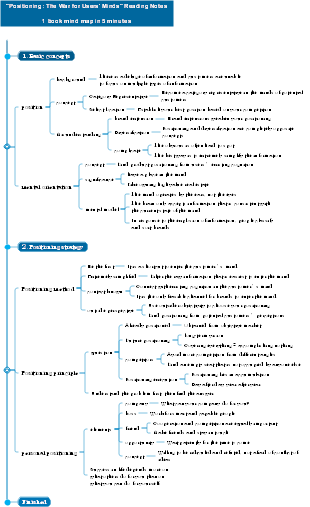
"Ten Essentials of Marketing by Trout" is a classic marketing book written by Jack Trout. The positioning series is the most basic underlying business logic. This book tells the basic concepts of marketing in a popular and interesting way.
Edited at 2024-01-13 02:04:16This Valentine's Day brand marketing handbook provides businesses with five practical models, covering everything from creating offline experiences to driving online engagement. Whether you're a shopping mall, restaurant, or online brand, you'll find a suitable strategy: each model includes clear objectives and industry-specific guidelines, helping brands transform traffic into real sales and lasting emotional connections during this romantic season.

This Valentine's Day map illustrates love through 30 romantic possibilities, from the vintage charm of "handwritten love letters" to the urban landscape of "rooftop sunsets," from the tactile experience of a "pottery workshop" to the leisurely moments of "wine tasting at a vineyard"—offering a unique sense of occasion for every couple. Whether it's cozy, experiential, or luxurious, love always finds the most fitting expression. May you all find the perfect atmosphere for your love story.
The ice hockey schedule for the Milano Cortina 2026 Winter Olympics, featuring preliminary rounds, quarterfinals, and medal matches for both men's and women's tournaments from February 5–22. All game times are listed in Eastern Standard Time (EST).
This Valentine's Day brand marketing handbook provides businesses with five practical models, covering everything from creating offline experiences to driving online engagement. Whether you're a shopping mall, restaurant, or online brand, you'll find a suitable strategy: each model includes clear objectives and industry-specific guidelines, helping brands transform traffic into real sales and lasting emotional connections during this romantic season.
This Valentine's Day map illustrates love through 30 romantic possibilities, from the vintage charm of "handwritten love letters" to the urban landscape of "rooftop sunsets," from the tactile experience of a "pottery workshop" to the leisurely moments of "wine tasting at a vineyard"—offering a unique sense of occasion for every couple. Whether it's cozy, experiential, or luxurious, love always finds the most fitting expression. May you all find the perfect atmosphere for your love story.
The ice hockey schedule for the Milano Cortina 2026 Winter Olympics, featuring preliminary rounds, quarterfinals, and medal matches for both men's and women's tournaments from February 5–22. All game times are listed in Eastern Standard Time (EST).
Trout Marketing Ten Essentials
1. What is the essence of marketing?
Marketing is selling products and making profits.
Marketing is like a movie and the product is the star of the movie. Everyone and everything in the movie tells a simple story. This story is about telling people, “Why my product is different, why you should buy my product instead of other products.
If your product can solve a problem, then you should first dramatize the problem, and then use your product to resolve the contradiction; if your product is a latecomer, then you should make an introduction to the existing products on the market. , and then dramatize the novelty and uniqueness of your product; if your product has a strong competitor, you should explain why your product is a better choice. Never “follow the trend”.
On budget
What should be your budget for marketing?
Don't plan what percentage of the total budget it is, put it first.
sufficient for the task.
The basic principle
The first step is to develop a marketing plan based on the marketing life cycle of each product. Analyze whether this is a new market, what is the degree of existing competition, where is the differentiation, and what is people’s perception of your product and that of your competitors.
The second step is to evaluate the product opportunity. If the work goes well, with this data, you will be able to determine: which product can provide more potential profits; whether this product or service can win a price advantage; whether this is a new generation concept that can help you become The leader in this market; this is not a product with strong competition. Let me give you a hint, you should carefully evaluate the intensity of each battle, the weaker the competition, the greater the chance of success, and it is not fun to fight against an entrenched enemy.
The third step is to arrange advertising work. Since advertising is often the most expensive part of a marketing plan, it's important to make sure your advertising budget is spent most effectively. Spend enough money to tell your story to your target market.
The fourth step is to stop immediately when there is insufficient funds. At this point, CEOs need to be strategic. Once you've prioritized your projects in order of profitability and effectiveness, you'll want to allocate your budget from high to low.
The importance of staying the course
Sticking to the end is the bridge between good plans and good results, and marketing efforts also require perseverance.
Staying the course also means, ‘Once you get your customers, hang on to them’.
At this point, you can use various methods to stay in touch with your customers and make them feel that you always care about them.
If you make a mistake, contact your customer immediately and apologize and offer them additional compensation.
Some call it ‘one-to-one marketing’, I call it ‘staying connected’.
Remember, it’s always more expensive to acquire a new customer than to retain an existing one. "
importance of distribution
“First of all, the more direct it is, the easier it is to control. In other words, if you have to go through a middleman, you are giving up part of your profits and control of your product.
Second, don’t compete with your customers. If you want your distributors to be loyal to you, don't cooperate with their competitors or open a direct store yourself.
Let them make money. This means that your job is to make your product more attractive to the distributor's customers (i.e. consumers).
a warning
Opportunities are hard to spot because they don’t look like opportunities, they look simple and obvious
Reading some stories about success or failure will be much more useful than reading those marketing monographs.
Wisdom of the Elf: Marketing is like making a movie, your product is the protagonist. Only good movies will have good box office.
2. How to build a brand
On brand names
A good name that's easy to remember will be a good start, but a bad name can cause a lot of trouble. "
The best brand names are those associated with the product's strong selling points.
Another tip is to use a name that sounds great.
In many cases, memories are formed by hearing, so you'll want to avoid names that sound weird
On brand building
Building a brand strategy is about establishing a brand and a concept of differentiation in the minds of potential customers. "
On concentration
In an effort to gain more business, organizations lose focus on what makes them unique
A brand is a promise that establishes expectations that a product must deliver.
On greed
So what can be done to avoid losing brand focus and preventing brand damage? --give up
There are three aspects to giving up
The first is product abandonment, which means focusing on one product.
The second is feature abandonment, which means focusing on one product feature.
The last step is to abandon the target market, which means to focus on a target market segment of a certain category. Only in this way can you become a highly favored product in this market segment.
Branding is about ingraining a specific brand, along with its differentiation, in the mind of the customer. The trick is to focus on the core features of your brand and not get too greedy.
Wisdom of the Elf: Building a brand means differentiating products and companies in the minds of customers.
3. What should my product strategy be?
On the first
What you need is the first or second brand, or a brand new sub-category brand.
If someone comes up with a product idea that might become a leader in a new category, you can approve it without hesitation.
On the second
If you maintain a strong substitution strategy, you can also become a very successful second product.
"What is the law of duality?"
"In the long run, every market is a two-horse race."
If you watch the market over a long period of time, you will find that every war usually ends up being two major competitions It’s an epic battle between the old reliables on one side and the up-and-comers on the other.
On new things
How can I make people like my brand more?
Forget the brand, consider the category first!
Potential customers always get defensive when it comes to brands because everyone says their brand is better.
But when it comes to categories, potential customers will keep an open mind. Everyone will be interested in new products, but few will be interested in better products. "
On brand extension
We elves look at the issue of brand extension from a psychological perspective. The more product types a brand extends, the easier it is for the mind to lose focus.
Summarize
I should first consider building a leadership brand. If we are the No. 1 brand, we want to make sure our people are constantly challenging themselves with newer, better products. "
Secondly, if we are not the leader, I should make sure that our second brand is committed to attacking the leading brand and becoming a strong alternative. "
"Finally, new products from established brands should aim to become sub-category leaders and focus on market segments. I should avoid bandwagon following and brand extensions at all costs."
Wisdom of the elves: A successful product should be one of the best in its category. Otherwise, you have to create a new subcategory.
4. How to price correctly
Guiding Principles
First, you have to make sure the product is reasonably priced.
If your product is priced too high, you incur risks.
Your customers will start to question themselves about paying too much, which opens the door for competitors to take away your business.
Second, people are willing to pay more for perceived value.
If your pricing is reasonable, as long as customers feel they are getting value for money, they will still choose a higher-priced ‘private room seat’.
People are willing to pay more for better products, but the high quality needs to be visible to some degree.
High-priced products should project prestige. The purpose of buying a Rolex is to let others see it and think that you are successful.
"High prices and high profits attract competitors."
New entrants often use price as bait to break into a certain field. If the competitor is strong and well-established, new competitors will often adopt a low-price strategy.
They cannot be allowed to build powerful networks and you should find a way to counter their price war as quickly as possible.
Smart companies will not charge high prices to make a profit; they will keep prices low in order to ultimately control the market and discourage new competitors.
Another important guiding principle
“It’s hard to win on the cheap.”
It's one thing to position yourself on a high-priced product, it's quite another to utilize a 'low-price' strategy.
Few companies can win on low prices.
This is because all competitors have a pen in their hands and they can mark down the price at any time, so your competitive advantage disappears.
Eventually, prices will drop.
As production increases, currencies depreciate, and competition intensifies, the old rules change and prices tend to fall, especially in commodity categories.
This requires a new strategy, such as finding unique ways to add value or finding unique ways to reduce costs. "
The key to setting a price is figuring out how much customers are willing to pay for your differentiation or added value.
Wisdom of the Elf: Price is the amount that customers are willing to pay for your differentiation and that your competitors allow you to ask for.
5. Is there a limit to growth?
Most bad marketing strategies are driven by this desire for growth, which is driven by Wall Street, which is driven by greed.
Another problem is that companies always try to produce everything to suit everyone. This growth strategy would focus on primary Business resources are wasted on meaningless secondary campaigns. Decision making is much easier if you focus on one business.
‘Big’ is the enemy of ‘cool’. "
‘Co-benefits’ are meaningless. "
Note | From the current perspective of Xiaomi Ecosystem, their ecological synergy is still quite good. I don’t buy Xiaomi mobile phones because I have used Xiaomi mobile phones and feel that they are not as good. Huawei is good. But I would still trust them with other products they make. How to explain Xiaomi’s synergistic benefits? Are times changing, causing positioning theory to begin to show its margins?
Focus on main business
Don’t stray too far from basic business.
Build on your existing business so you can leverage your credentials and expertise.
Focus on cognition
The existence of a brand is based on people's perception of it. Blindly following the pressure of Wall Street, ignoring the characteristics of the brand, and blindly expanding your business will only bring you trouble.
In "Two Cars", BMW always focuses on high-priced cars and emphasizes its super driving machines. This is not the case with Mercedes-Benz. DaimlerChrysler appeared in history.
face the reality
Set realistic goals, as Frank Tapp brilliantly defines them – ‘beyond your reach, within your reach’. "
You have to realize that the impossible is impossible. You can’t add unrealistic ideas to your marketing plan; you have to find ways to leverage existing perceptions to sell more products.
Mark Twain said it best: “I can’t give you a formula for success, but I can give you a formula for failure, and that is, try to please everyone.”
Summarize
If you want to enhance your brand, you have to build it around your expertise – constantly asking yourself ‘does it make sense to your customers’ and ‘does it fit with your reputation or image’.
You also have to be very realistic when making your plans and make sure it's something you can do.
Wisdom of the Elf: Successful companies never worry about growth, they only worry about how to succeed in the market.
6. What is good market research
First, let's think about some questions about humans themselves. In fact, the biggest problem is how to get useful information from people. Mark Twain had a brilliant insight into this, ‘I It is believed that people only show their true, complete and honest self after death. People should die in the first place so that they can become honest sooner’. "
All in all, that's the number one problem with surveys - people aren't very honest.
Words and deeds are inconsistent
People often don't mean what they say, and when you ask them why they bought something, their answers are often inaccurate and unhelpful.
herd consumption
One of the most interesting passages about conformity is from Robert Sciordino. He spoke of the powerful influence of the ‘Law of Social Proof’. This law says that we first understand what others think Why is right and then use that to decide what is right. This rule applies especially when people judge what behavior is right. When we judge our behavior in a certain situation When judging whether it is correct, it is based on what you see others doing in this situation.
In a way, buyers are like sheep following the herd—herd mentality plays a big role.
My conclusion is that from observing humans for thousands of years, I am convinced that people do not know what they want. If that's the case, why bother asking them?
Get a mental snapshot
“What you’re looking for is the perceived strengths and weaknesses of you and your competitors in the minds of your target customers. My favorite way to investigate is to list the basic attributes of a category and then ask people Score on a scale of 1 to 10. This approach is based on competitors and aims to understand the concepts and perceptions held by all parties in a certain category. You could also call it a ‘differentiation experiment’. "
So good market research doesn't waste time discovering what people want or probing their psychology. It's really about trying to figure out how to differentiate yourself in the minds of potential customers relative to your competitors. "
Thoughts about the future
Good market research doesn't waste time discovering what people want or probing their psychology. It's really about trying to figure out how to differentiate yourself in the minds of potential customers relative to your competitors.
Basic habits change slowly, and the media often exaggerates smaller changes. tend to exaggerate Equally bad is assuming that the future will see history repeat itself. Assuming that nothing will change is as certain as predicting the future with certainty as assuming that something will change.
Unexpected things happen all the time, and unexpected things cannot be investigated in the first place.
What I really want is a simple survey about the cognitive attributes of each category, which can be completed using a 1 to 10 scale using semantic differentiation.
Wisdom of the Elf: Good research is simple, not complex, about cognition, and has a strong sense of common sense.
7. How to evaluate advertising
First, advertising is needed because you can't be in person with potential customers.
Any advertising plan should start with the product differentiation you want to convey—why you should buy my product instead of someone else’s. Taste. What you are pursuing is not just a meaningless slogan, your plan must include differentiation and the benefits it can bring. "
Frank and honest news value
The more candid you are, the more people will perceive it as information rather than advertising.
Another important approach is to try to make your message sound like breaking news. people are always looking for Look for news. News can eliminate the hostility between advertisers and audiences. It can make people let go of their wariness about being 'sold'.
People are always looking for news. News can eliminate the hostility between advertisers and audiences. It can make people let down their guard against being "sold".
Vibrant visual materials, while attracting people's attention, can also distract from the message. And, in people When their attention is distracted, they stop listening and reading. Such advertisements do not have the effect of promotion, which is also called "attention diversion."
Simple, clear, Be patient
You can’t take up too much of people’s time, so you have to make your ads simple and easy to understand. One message is better than two, and simple visuals are better than rich visuals.
If possible, rhyme your words to make your slogan easier to remember.
Emerson once said it well - 'The ears are the windows to the soul'.
More importantly, you're looking for obvious concepts. It's often simple, commonplace, and unimaginative, but the most obvious concepts are also the most useful. "
Recommended book "Master Adams".
Advertising takes time to be remembered, so your message must be retained for a longer period of time for people to accept it.
When I evaluate advertising, I first want to avoid meaningless empty slogans and look for product differentiation. I should look to see if the ad dramatizes differentiation, How honest is the information? Is it presented simply? Does it provide my clients with interesting news that will benefit them in the future?
If an advertisement can achieve the above points or all of them, it is a good advertisement; otherwise, it is an ineffective advertisement. Then I should wait patiently for the ad to do its job. "
When you see an ad, it's recommended by the best advertising agencies in the world and designed by great creative geniuses , the entire marketing department is behind it, and you don’t know what to think about it, go home and ask your wife. "
Wisdom of the Elf: Good advertising dramatizes your product’s points of difference and gives potential customers a reason to buy.
8. How to choose Choose the right media
two languages
There are two forms of language - written language and spoken language. We often confuse the two, but there is a difference between them. The ears are always more sensitive than the eyes.
Not only is listening faster than seeing, but what you hear stays in your mind longer than what you see. visual image, whether a picture or Words will disappear within a second unless your brain engraves them into your mind, while the information you hear lasts four to five times longer in your brain.
This is why your train of thought can be easily interrupted when reading written text. You often have to review the meaning of certain information. Because sounds last longer in the brain, spoken words are easier to understand.
Listening is always more effective than reading. There are two differences - first, the brain stores spoken language for a longer period of time, which allows you to organize your thoughts more clearly; Secondly, people's voices and intonations will give language emotions, which is beyond the reach of simple written words. "
PR & Promotion
It would be better if you could leverage PR before running your ads. People are more receptive to information provided in the news than to information learned in advertisements. The fundamental reason is that they Don't like sales pitches but want to know what's going on. At the same time, relevant information in the news will also bring high credibility to your product. "
Some promotional methods are combined with s to produce some public relations effects. For example, using an elephant parade in a business center to launch a new product, Certain special offers can help entice consumers to try your product. But if the promotion is just a discount, the effect will be minimal.
Integrated Marketing
In integrated marketing, you want differentiated messages to be delivered through various media. Once you’ve identified your differentiated message, you can take advantage of a variety of different media to deliver it.
PR can help you launch new ideas, give them credibility, and create buzz;
Advertising can quickly build awareness of the idea;
Exhibitions can generate excitement within an industry or product distribution channel;
Direct mail can promote your concept to your best and most demanding customers;
Promotions can entice people to try new products. "
Summarize
This starts with ensuring we have differentiated information;
Second, if possible, push it out through PR;
Again, put our money into those media outlets that have a voice;
Finally, don’t take your promotion too far.
Wisdom of the Elf: The brain operates on the ears, and sound media is more powerful than silent media.
9. Company logo How important is ambition
The power of a brand lies in the name rather than the visual symbol.
The sea succubus in the center of the Starbucks logo has not attracted much attention to its meaning. As a product, Starbucks represents a lifestyle, and it does so without advertising.
Some research on logos
Exaggerated style or design must not come at the expense of legibility. No matter how beautifully designed the logo is, if it is difficult to understand, it must be abandoned.
On color
Warm colors like reds, oranges and yellows tend to be eye-catching and vibrant, which is good for retail;
Blue is a calm and conservative color, not too eye-catching, soft and easy to match;
Black and gold are considered upscale colors;
Bright colors are often thought of as freeing, happy...
Color can be a powerful way to differentiate your brand. Don’t choose a competitor’s color.
Summarize
When choosing a trademark, the most important thing is the name and making sure it is easily identifiable.
Colors and typography are much more important than meaningless symbols, unless those symbols are the company's nickname, and nicknames can only be used as nicknames.
Nicknames are given to you by the market and are what people take the initiative to call you. Don't try to force a nickname.
If people tend to use your full name, then that full name is your brand name and should become your trademark as well.
Wisdom of the Elf: Names are much more powerful than symbols. The logo should be designed around the name.
10. Seven fatal mistakes
arrogant
Arrogance is the first mistake people often make.
Success often leads to arrogance, and arrogance leads to failure. Self-righteousness is the number one enemy of successful marketing.
Smart marketers think like potential customers. They put themselves in the customer's shoes and do not impose their subjective understanding on the objective environment.
greedy
‘Greed’ is the second mistake people often make.
The manager does not focus on the company's operations, but always pays attention to the company's stock price.
This was when the company began to expand and its brand image began to suffer.
“Can one person’s unbridled greed bring down a company?”
While it won't bring down the company directly, greed can spread like a computer virus through management because everyone knows that top employees are making a lot of money and they start to feel like they should be making just as much.
Soon, they began making decisions to line their own pockets.
ignorance
‘Ignorance’ is another common mistake.
Many big companies get into trouble because they don't understand that strategy is a battle for the mind of the customer.
What matters is not better products, but better awareness.
“How to avoid ignorance?”
You have to study people's psychology first and keep learning.
If you don’t have time to learn, then it’s important to hire someone you can trust.
Delusion
The next mistake is delusion, which occurs when a company's plans are based on dreams rather than facts.
Most successful companies focus on facts rather than establishing so-called ‘goals’.
What matters is not ‘what you want to do’, but ‘what you can do’.
It is very dangerous to overestimate market potential.
lose focus
‘Losing focus’ is a very common mistake and is often caused by success.
After achieving success, CEOs stop focusing on the core business and expand into other areas.
Tinkering
‘Fixing’ is not actually a fatal mistake, but sometimes it can cause big trouble. "
Some people always want to make some better improvements and improve for the sake of improvement. The motivation for improvement is to prove that they are awesome.
Yes. It is indeed easy to see other people's mistakes, but I think it is very difficult to clearly see your own mistakes.
pride
Tinkering with mistakes is caused by "pride".
Once your company has established a presence in the market, you tend to underestimate your competitors because you feel powerful, wealthy, and well-informed.
You are no longer humble. You think everyone else will make mistakes, but you will not.
Wisdom of the Elf: Self-righteousness is the number one killer of successful marketing.