MindMap Gallery Mat Pilates
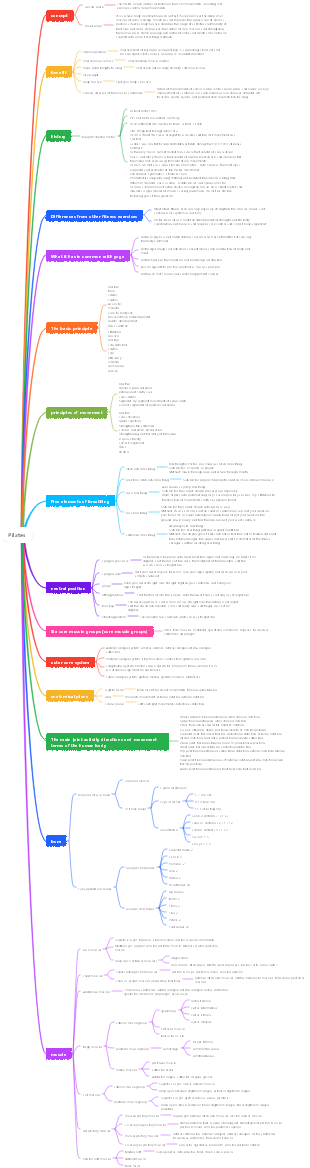
This is a mind map about mat Pilates, including: the key points of Pilates, the six principles of Pilates, Pilates lateral breathing, parallel stance, Pilates stance, and up and down rolls etc. content.
Edited at 2022-10-28 06:38:24This is a mind map about bacteria, and its main contents include: overview, morphology, types, structure, reproduction, distribution, application, and expansion. The summary is comprehensive and meticulous, suitable as review materials.

This is a mind map about plant asexual reproduction, and its main contents include: concept, spore reproduction, vegetative reproduction, tissue culture, and buds. The summary is comprehensive and meticulous, suitable as review materials.
This is a mind map about the reproductive development of animals, and its main contents include: insects, frogs, birds, sexual reproduction, and asexual reproduction. The summary is comprehensive and meticulous, suitable as review materials.
This is a mind map about bacteria, and its main contents include: overview, morphology, types, structure, reproduction, distribution, application, and expansion. The summary is comprehensive and meticulous, suitable as review materials.
This is a mind map about plant asexual reproduction, and its main contents include: concept, spore reproduction, vegetative reproduction, tissue culture, and buds. The summary is comprehensive and meticulous, suitable as review materials.
This is a mind map about the reproductive development of animals, and its main contents include: insects, frogs, birds, sexual reproduction, and asexual reproduction. The summary is comprehensive and meticulous, suitable as review materials.
Mat Pilates
The focus of Pilates
Core axis: It lies in the core group of the human body, below the shoulders and above the hips.
The core muscles refer to the important muscle groups located in the front and back of the abdomen surrounding the trunk and responsible for protecting the stability of the spine, including the transversus abdominis, pelvic floor muscles and lower back muscles.
Six Principles of Pilates
1 Breathing 2 Core 3 Control 4 Focus 5 Smooth 6 Precision
Pilates lateral breathing method
"Lateral breathing", also known as "intercostal breathing", is a classic breathing method commonly used in Pilates exercises. Use the method of inhaling through the nose and exhaling through the mouth to ensure that the lungs can absorb a large amount of oxygen during exercise, while keeping the deep abdomen in a state of contraction and inward curvature.
parallel stance
The adductors of the legs are working, the abdominal muscles are working, the back is straight, the back is relaxed, and the shoulders are relaxed.
Pilates stance
Spread your feet outwards, heels together, tighten your abdominal muscles and relax your shoulders
Scroll up and down
Inhale to lengthen your spine, lower your shoulders and lower your ribs. Exhale and lower your head to let your chin find your collarbone. Flex your spine, lower your spine joints to the lowest point, and relax your arms. Inhale without moving, exhale to contract the abdominal muscles and lift the spine downwards. 3-8 groups
Squat
Stand in a Pilates position, inhale without moving, exhale and squat with your hands upward, from the pelvis up vertically down to the knees until they reach the toes. Hand clip auxiliary tools Pilates rings and Pilates balls 10-15/group 2-3 groups
stand on one leg
Stand in a parallel position, bend your right leg and stretch your toes upward at 90° to the upper and lower legs, and raise to the side. Inhale without moving, exhale to contract the abdominal muscles, twist the upper body to the right, straighten the pelvis, inhale to return to the straight position, hold for 8-12 sets, and switch to the other side.
Press down hard on the foot of the supporting leg to keep your torso stable and keep your body in a straight line when twisting.
One-legged skating
Also called standing side-to-side sliding. Position your feet parallel, bend your knees and hips, lean forward about 30°, hold your hips with both hands, inhale to prepare, straighten your right leg to the right and point your toes on the ground, exhale and raise your leg, inhale to lower it. Keep your pelvis still and do 10-15 reps in 2-3 groups Back gliding: Prepare as above, exhale up and inhale down. Contract your abdominal muscles and gluteal muscles first.
Keep the supporting leg flexed at the knees and hips, contract the abdominal muscles, and stabilize the pelvis
crawl forward
Stand in a parallel position, roll your hands downwards and put your hands on the floor. Inhale without moving. Exhale and contract your abdominal muscles. Climb forward to the plank support. Hold for three breaths. Inhale and push your hands back to the floor. Do 8-12 reps.
Plank
Keep your torso stable while on the plank, contract your abdominal muscles and tighten your core, and keep your pelvis in a neutral position!
Defecation: 1 single leg lift 2. Open and retract your feet alternately 3. Alternately bend one leg forward 4 running 5 Legs open and return at the same time
Inclined plate support side bend
Side tilt plank, with the upper foot in front, inhale to prepare, exhale, contract the abdominal muscles, raise the buttocks upward, extend the hands along the ears and towards the center of the head. Inhale and land without dropping your hips, one set of 8-12
Inclined plate support side rotation
Inhale to prepare with the upper foot in front. Exhale and drive the body with your arms to rotate downwards. The pelvis is in a neutral position. Inhale to return to the straight position. Contact a group of 8-12.
Lie on your back and raise your legs
Lie on your back on the ground, with your lumbosacral position pressed against the ground, your legs bent at the knees 90° upward, and your feet down 30°/90°
Toilet: 1 Swing your legs up and down alternately 2 Open and retract the legs on both sides and cross them 3. Swing your legs together and swing left and right 4. Keep your legs still at 60 degrees downward and do abdominal curls.
Land tour
Practice on the basis of the four-point support position, keep the trunk stable, keep the force of lowering the hands and supporting the ground to extend to the back, hands and feet infinitely far away, inhale and stabilize the trunk, exhale with the right hand forward and point the ground forward, and extend the right leg backward Point your toes straight on the ground, exhale and contract your abdomen while raising your legs and hands upwards, inhale and lower your hands to lower your left leg and bend your knees without touching the ground.
Defecation: 1 Knee abduction 2 Bend the knees and lift back