MindMap Gallery Pilates Anatomy (Part 1)
The chemical composition of bones: Mainly found in the limbs, it is often tubular and can be divided into two ends of the body. The body is also called the backbone. The bone is dense in the peripheral part and the center can accommodate bone marrow, which is called the medullary cavity. The two ends are enlarged and are called epiphyseal ends. .
Edited at 2022-09-02 02:16:37This is a mind map about bacteria, and its main contents include: overview, morphology, types, structure, reproduction, distribution, application, and expansion. The summary is comprehensive and meticulous, suitable as review materials.

This is a mind map about plant asexual reproduction, and its main contents include: concept, spore reproduction, vegetative reproduction, tissue culture, and buds. The summary is comprehensive and meticulous, suitable as review materials.
This is a mind map about the reproductive development of animals, and its main contents include: insects, frogs, birds, sexual reproduction, and asexual reproduction. The summary is comprehensive and meticulous, suitable as review materials.
This is a mind map about bacteria, and its main contents include: overview, morphology, types, structure, reproduction, distribution, application, and expansion. The summary is comprehensive and meticulous, suitable as review materials.
This is a mind map about plant asexual reproduction, and its main contents include: concept, spore reproduction, vegetative reproduction, tissue culture, and buds. The summary is comprehensive and meticulous, suitable as review materials.
This is a mind map about the reproductive development of animals, and its main contents include: insects, frogs, birds, sexual reproduction, and asexual reproduction. The summary is comprehensive and meticulous, suitable as review materials.
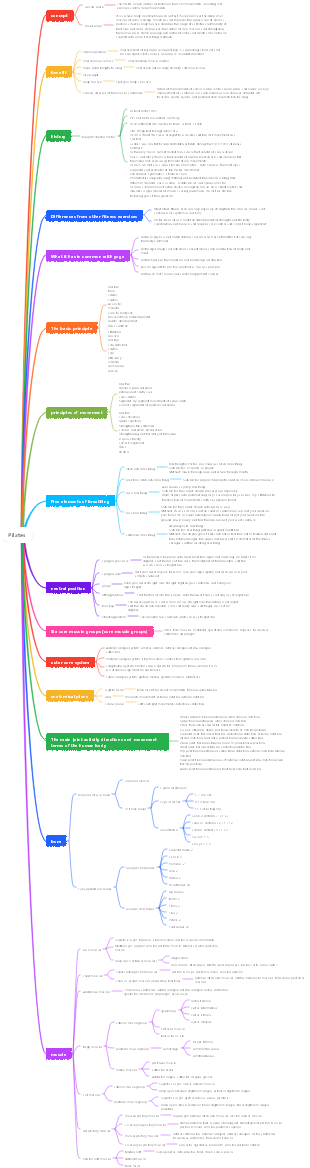
Pilates functional anatomy Anatomy is the most basic underlying logic of Pilates. Review knowledge every day and exercise every day.
Target
skeletal requirements
①What is the name of the most common skeleton? ②Where do the bones grow? ③What is the name of the joint of the skeleton?
Bone connection requirements
①What is the name of the most common joint in the body? ②What bones are joints made of? ③Common forms of movement of joints
Skeletal Muscle Requirements
①Common muscle names ②Where does it grow? ③What are the functions of muscles?
Simple movement analysis
Standard anatomical posture of the human body (from top to bottom, and from bottom to top in order)
Eye level
body upright
Upper limbs droop, palms forward
Feet together, toes pointed forward
Human body motion planes and axes
plane of human movement
Sagittal plane: divides the human body into left and right halves (a plane along the front and back diameter of the body, perpendicular to the horizontal plane)
Coronal plane: Divides the human body into two halves, front and rear (along the left and right diameters of the body, perpendicular to the horizontal plane)
Horizontal plane: Divide the human body into upper and lower halves (the cross-section of the human body is parallel to the ground)
The door moves horizontally around its axis Breast expansion is a horizontal exercise Vibrating the arms up and down on the side of the body is a coronal plane movement
kinematic and axial
Sagittal axis: The axis passing anteriorly and posteriorly through the center of a joint
Coronal axis: The axis passing through the center of the joint to the left and right
Vertical axis: the axis passing through the center of the joint above and below
Commonly used orientation terms (14)
Above: Near the top of the head (the nose is above the mouth)
Lower: near the sole of the foot (the mouth is below the nose)
Anterior: closer to the ventral side
Rear: Close to the dorsal side
Superficial: close to the surface of the body or organs (skin, intestinal surface)
Deep: away from the body surface or organs (muscles, inside organs)
Inner: (referring to the trunk) near the center of the body
External: (referring to the trunk) away from the center of the body
Proximal end: (referring to limbs) close to the connection part of the trunk
Distal end: (referring to the limbs) far away from the connecting part
ulnar side: inner ruler
Radial side: lateral radius
forearm
tibia: medial tibia
fibular side: external fibula
calf
exercise system Bones, joints and skeletal muscles account for 60% of human body weight
5 major functions
support
Keep the body in an upright position
Protect
protect internal organs
hematopoiesis
Bone marrow (red bone marrow → yellow bone marrow)
lever
The joints are the fulcrum and the limb bones are the levers, saving effort)
reserve
The body’s storehouse of calcium and phosphorus
Classification of bones
By location
Axial bones (80 pieces)
Skull (29 pieces
facial skull
brain skull
Skull (22 pieces)
Hyoid bone (1 piece)
Ossicles (6 pieces)
trunk bone
Spine/vertebrae (26 pieces)
constitute
Cervical vertebrae (7 pieces)
Thoracic vertebrae (a total of 7 upper and lower vertebrae)
sternum
manubrium sternum
sternal body
xiphoid process
Lumbar vertebrae (12 pieces)
Sacrum (5 pieces in infants and 1 piece in adults)
Tailbone (1 piece)
Vertebrae form the central axis of the human body
four physiological curvatures
Neck curvature (front curvature)
Chest Curve (Back Curve)
Lumbar curvature (front curvature)
Sacral curve (posterior curve)
Ribs (24 pieces)
True ribs (7 pairs)
False ribs (3 pairs)
Floating ribs (2 pairs)
Sternum (1 piece)
Limb bones (126 pieces)
Upper limb bones
Upper limb bones (4 pieces)
clavicle
shoulder blade
bony markers
Upper corner, lower corner, outer corner
upper edge, inner edge, outer edge
Scapular spine, acromion, supraspinal fossa, infraspinatus fossa
glenoid, supraglenoid tubercle, infraglenoid tubercle
coracoid process of scapula
Movement form
lift, drop
lead forward, retract
Upward rotation, downward rotation
Free upper limb bones (60 pieces)
humerus
greater tubercle
small nodule
intertubercular groove
Greater and lesser tubercles jí
Radius
radial tuberosity
radial head
ulna
olecranon
hand bones
carpus
Triangular beans, large and small head-shaped hooks
metacarpal bone
phalanges
Lower limb bones
Lower limbs with bones (2 pieces)
hip bone
Ilium
anterior superior iliac spine, posterior superior iliac spine
anterior inferior iliac spine, posterior inferior iliac spine
iliac fossa
pubic
pubic symphysis
ischium
ischial tubercle
Free lower limb bones (60 pieces)
femur
femoral head
femoral neck
Greater trochanter of femur (greater trochanter of femur)
Lesser trochanter of femur (lesser trochanter of femur)
medial/lateral condyle kē
medial/lateral epicondyle kē
The protrusions at both ends of the condyle bone
patella
tibia
tibial tuberosity
fibula
fibula head
foot bones
tarsus
metatarsal bone
phalanges
According to shape
long bone
short bone
They are short columnar or cubic bones of various shapes, usually distributed in groups on the wrists, the back half of the feet, or the spine, etc.
flat bone
It is plate-shaped and mainly forms the wall of the cranial cavity or chest cavity to protect internal organs, such as scapula and hip bone.
Irregular bones
Irregular in shape and diverse in function, common ones include the maxillary or sphenoid bones of the paranasal sinuses, etc.
sesamoid bones
Small and medium-sized bones formed within tendons that are under high stress, such as the patella - the largest sesamoid bone in humans
bone structure (Classified according to organizational functions)
periosteum
endosteum
It is a dense connective tissue membrane covering the surface of the bone (except the articular surface). Fresh endosteum is pink and contains abundant blood vessels, nerves and osteoblasts.
Epiosseous membrane
The periosteal membrane refers to the membrane surrounding osteoblasts and osteoclasts close to the bone compact.
Bone quality
Cancellous bone
Spongybone is spongy and is composed of intertwined bone trabeculae (trabeculae) arranged inside the bone. The arrangement of the bone trabeculae is consistent with the direction of the pressure and tension the bone bears, so it can bear greater weight.
bone mineral density
comPactbone has a dense texture and greater pressure resistance, and is distributed on the surface of the bone.
marrow
Bone marrow is a soft, blood-rich tissue that exists in the cancellous spaces of bones and the medullary cavities of long bones. It is composed of various types of cells and reticular connective tissue. It is divided into red bone marrow and yellow bone marrow according to its structure.
chemical composition of bones
organic matter
Mainly protein, which gives bones a certain degree of toughness
Inorganic matter
It is mainly calcium and phosphorus that give bones a certain hardness
ratio graph
Mainly found in the limbs, it is often tubular and can be divided into two ends of the body. The body is also called the backbone. The peripheral parts are dense in bone and the center can accommodate bone marrow. It is called the medullary cavity. The two ends are enlarged and are called epiphyseal ends.
Bone connections (joints)
Categories of links
No lacunar connection
fiber connection
ligament link
Such as the connection between vertebrae and the connection between bone edges
meet link
cartilage connection
Such as intervertebral disc, costal cartilage, etc.
bony connection
Such as sacrum, hip bones (pubic bone, ilium, ischium), etc.
lacunar connection
Joints are the most differentiated form of bone connection
transitional bone connection
The structure of joints
articular surface
Each joint has at least 2 articular surfaces
joint head and glenoid fossa
articular cartilage
joint cavity
The space between the articular surface and joint capsule
Synovial fluid, negative pressure, stability
joint capsule
Fiber layer (outer layer)
Synovial layer (inner layer)
Joint classification
Number of motion axes
single axis joint
Trochlear joint (finger joint), axle joint (radial ulnar joint)
biaxial joint
Elliptical joint (wrist joint), saddle joint (thumb joint)
multi-axis joint
Ball joints (hip joint, shoulder joint)
Number of components
single joint
Made up of 2 joints, such as hip joint and shoulder joint
complex joint
Composed of more than 2 joints, such as knee joints and elbow joints
The way to exercise power
single action joint
Joint that produces motion alone (hip joint)
Linkage joint
Structurally independent but must work together for movement (mandibular joint, ulna)
joint movement terms
Flexion and extension
adduction and abduction
maneuver
Swing left and right
Internal/external rotation
limbs
pronation/supination
forearm
circle around
Horizontal adduction and abduction
Main joint movements of the human body
Upper body strap
sternoclavicular joint
acromioclavicular joint
Head and Neck/Spine
Flexion, extension, lateral flexion, rotation, circumference
shoulder joint
Flexion/extension, adduction/abduction, internal rotation/external rotation, horizontal adduction/abduction, circumference
hip joint
Flexion/extension, adduction/abduction, internal rotation/external rotation, horizontal adduction/abduction, circumference
elbow joint
Flexion/extension, internal/external rotation
knee joint
Flexion/extension, internal/external rotation
LOL
Flexion/extension, adduction/abduction (ulnar deviation/radial deviation), rotation
shoulder blade
Dorsiflexion/plantar flexion, eversion/varus
pelvis
Forward/backward tilt, side tilt, swivel, circle rotation
skeletal muscle
Overview P21 Part 1
Muscle classification
smooth muscle
Not under volitional control, involuntary muscles
myocardium
Not under volitional control, involuntary muscles
skeletal muscle
Under the control of will, voluntary muscles
muscle assistance relationship
prime mover
Main muscles involved in movement
antagonist muscle
A muscle that produces the opposite action of a prime mover
assisting muscle
Muscles that assist the prime mover in completing movements
stabilizer muscles
Muscles used to stabilize a joint to ensure movement is completed
skeletal muscle shape
longus muscle
brevis muscle
latissimus
orbicularis muscle
structure of skeletal muscles
The main structure
tendon
Resistance to compression and torsion
muscle belly
elasticity
Blood vessel
nerve
Auxiliary structure
Fascia
Protect muscles and limit the spread of inflammation
tendon sheath
Physical properties of skeletal muscle
Contractibility
Stretch and elasticity
viscosity
Muscle contraction type
Isometric contraction
Muscle tone is produced but no joint angle changes
isotonic contraction
Muscle tension develops and joint angles change
concentric contraction
Muscle tension is produced while shortening
Eccentric contraction
Muscles develop tension and are lengthened
The origin and insertion points of muscles
starting point, ending point
Fixed point, moving point
Near fixed point, far fixed point
Upper fixed point, lower fixed point
No fixation
muscle tension line
Muscle distribution pattern
Both sides of the motion axis
Muscles distributed in pairs
Open chain/closed chain movement
open chain movement
Movement of distal limbs in the air
Single joint movement and no movement of nearby joints
There is movement at the distal end of the moving joint
agonist muscle contraction
closed chain motion
Distal limb remains immobilized
Multi-joint movement, movement of nearby joints
The proximal ends of the moving joints are movable
Contraction of multiple muscle groups distal and proximal to the moving joint
Common skeletal muscles
10 upper limbs
① Deltoid muscle
starting point
Lateral half of clavicle, acromion, scapular spine
stop point
deltoid tuberosity of humerus
effect
Front part: upper arm flexion
Middle part: upper arm abduction
Rear part: Upper arm extension, horizontal extension
Overall: Upper arm abduction
②Supraspinatus muscle
starting point
gangshangwo
stop point
greater tubercle of humerus
effect
shoulder abduction
③Infraspinatus muscle
starting point
gangxiawo
stop point
middle part of greater tuberosity of humerus
effect
Shoulder extension, adduction, external rotation
④Teres minor
starting point
dorsal surface of lateral edge of scapula
stop point
Lower part of greater tuberosity of humerus
effect
Shoulder extension, adduction, external rotation
⑤Subscapular muscle
starting point
subscapular fossa
stop point
lesser tubercle of humerus
effect
Shoulder adduction, internal rotation
⑥Teres major muscle
starting point
Back of inferior angle of scapula
stop point
lesser tuberosity ridge of humerus
effect
Shoulder adduction, extension, internal rotation
⑦Coracobrachialis muscle
starting point
coracoid process of scapula
stop point
medial middle humerus
effect
Flexion, adduction, and external rotation of the upper arm
⑧Biceps brachii
starting point
Long head: supraglenoid tubercle of scapula Short head: coracoid process of scapula
stop point
Radial tuberosity, forearm fascia
effect
Near fixation: shoulder flexion, forearm external rotation
Far fixed: the upper arm moves closer to the forearm
⑨Triceps brachii
starting point
Long head: subglenoid tubercle of scapula Lateral head: lateral superior aspect of humeral radial nerve groove Medial head: lateral superior aspect of humeral radial nerve groove
stop point
ulnar olecranon
effect
Shoulder extension (long head), elbow extension
⑩Brachialis muscle
starting point
anterior lower half of humerus
stop point
ulnofemoral tuberosity and coronoid process
effect
Near fixation: elbow flexion
Far fixed: the upper arm moves closer to the forearm
Postural assessment and mechanical analysis
I hope that my busy look will make me more confident