MindMap Gallery Biology-Nucleic Acids
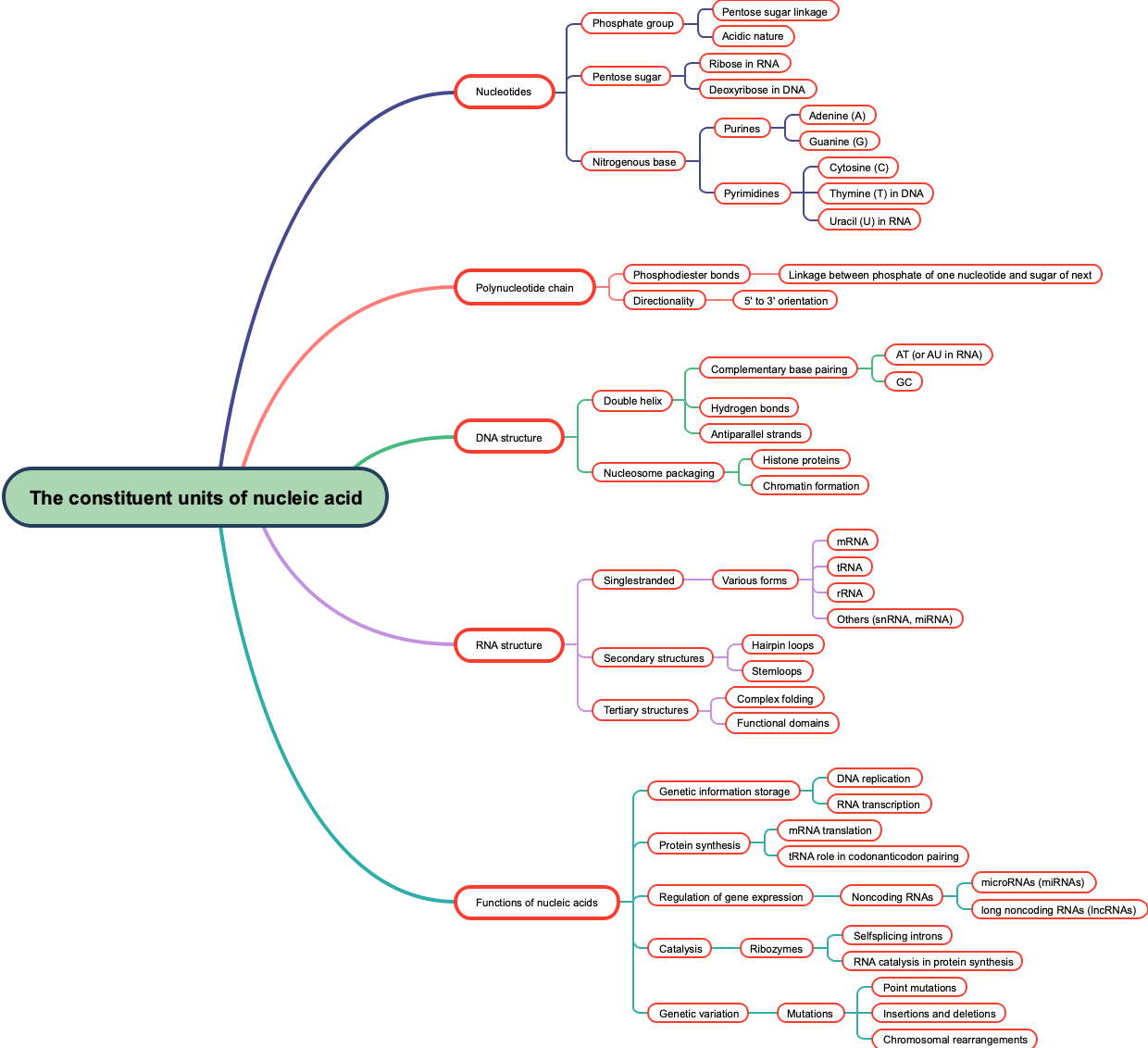
This is a mind map about biology - nucleic acids. Nucleic acids are biological macromolecular compounds polymerized from many nucleotide monomers and are one of the most basic substances of life.
Edited at 2023-11-12 16:08:59This is a mind map about bacteria, and its main contents include: overview, morphology, types, structure, reproduction, distribution, application, and expansion. The summary is comprehensive and meticulous, suitable as review materials.

This is a mind map about plant asexual reproduction, and its main contents include: concept, spore reproduction, vegetative reproduction, tissue culture, and buds. The summary is comprehensive and meticulous, suitable as review materials.
This is a mind map about the reproductive development of animals, and its main contents include: insects, frogs, birds, sexual reproduction, and asexual reproduction. The summary is comprehensive and meticulous, suitable as review materials.
This is a mind map about bacteria, and its main contents include: overview, morphology, types, structure, reproduction, distribution, application, and expansion. The summary is comprehensive and meticulous, suitable as review materials.
This is a mind map about plant asexual reproduction, and its main contents include: concept, spore reproduction, vegetative reproduction, tissue culture, and buds. The summary is comprehensive and meticulous, suitable as review materials.
This is a mind map about the reproductive development of animals, and its main contents include: insects, frogs, birds, sexual reproduction, and asexual reproduction. The summary is comprehensive and meticulous, suitable as review materials.
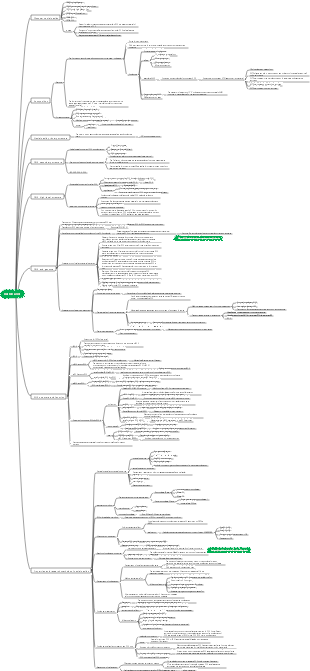
nucleic acid
4.5 Structure of RNA
structure
4.5.1 Primary structure of RNA
concept
Refers to the arrangement order and connection method of ribonucleotides in RNA molecules.
Connection method
3',5'-phosphodiester bond
sequence
method
Specific ribonuclease cleaves RNA
Chemical reagents cleave RNA
reverse transcribed from DNA
enzyme that hydrolyzes RNA
ribonuclease
bovine pancreatic ribonuclease
RNase T1
4.5.2 Secondary structure of RNA
4.5.3 Tertiary structure of RNA
The structure of different RNAs
mRNA
precursor
hnRNA
structure
Mature mRNA molecules in most eukaryotes
5′-terminal 7-methylguanosine triphosphate (m7G5’ppp) cap structure
effect
subtopic
Resistant to exonuclease
3′-end polyadenylic acid (polyA, 20-250A) tail structure
It may be related to the transfer of mRNA from the nucleus to the cytoplasm, and also related to the half-life of the mRNA
Free mRNA can form a local double helix secondary structure
tRNA
Features
The molecule contains more modified components, which increases recognition and hydrophobicity. The 3′-end all have the structure of CpCpAOH. Have certain conserved sequences
Secondary structure: "Clover" structure
Amino acid accepting region, DHU region, anti-code region, Variable region and TψC region
Tertiary structure: inverted L shape
The amino acid arm and the TψC arm form a continuous double helix region, forming a horizontal axis of L.
The dihydrouracil arm, the anti-crypto arm and the anti-crypto ring form the vertical axis of L.
Certain bases in the DHU loop form base pairs with the TψC loop and additional loops to maintain the structure of tRNA.
rRNA
type
In prokaryotes, there are three types of rRNA: 5S, 16S, and 23S.
In eukaryotes, there are four types of rRNA: 5S, 5.8S, 18S, and 28S
Secondary structure: trilobal, the molecular structure is composed of part of a double helix and part of a single-stranded protruding ring arranged alternately.
4.6 Properties of nucleic acids
4.6.1 Properties and solubility
Properties: DNA is white fibrous solid, RNA is white powder
Solubility: Both are slightly soluble in water. Its sodium salt has greater solubility in water and is insoluble in organic solvents. DNP and RNP are slightly soluble in water, and have different solubility under different salt concentrations.
4.6.2 Molecular size
RNA tens of thousands to millions
DNA 1.6×10⁶~2.2×10⁹
4.6.3 Hydrolysis
Acid or alkaline hydrolysis
Glycosidic and phosphodiester bonds
enzyme
4.6.4 Acid-base properties
Hermaphroditic nature
Nucleic acid molecules contain phosphate groups and bases, which are amphoteric in nature. Phosphate is a moderately strong acid and base is a weak base.
Isoelectric point
The isoelectric point of nucleic acids is relatively low. For example, the isoelectric point of DNA is 4 to 4.5, and that of RNA is 2 to 2.5.
dissociate
base
The nitrogen of the pyrimidine and purine rings and each substituent on the ring have the ability to combine and release protons
nucleoside
The dissociation of bases in nucleosides is affected by the presence of pentose sugars. Generally, the pK’ value decreases, indicating that the presence of sugar enhances the acidic dissociation of bases
Nucleotide
Due to the presence of phosphoric acid, nucleotides are highly acidic. In addition to the dissociation of the base part, two additional dissociation constants are added.
In polynucleotides, except for the terminal phosphate group, there are only pK1’=1.5 in the phosphodiester bonds
4.6.5 Absorption spectrum
Purine bases and pyrimidine bases are conjugated Double bond system with unique purple color External absorption spectrum, usually in There is a maximum absorption peak around 260nm. Can be identified as nucleic acids and their components basis for qualitative and quantitative determination.
4.6.6 Denaturation, renaturation and hybridization
transsexual
A process in which the hydrogen bonds in the double helix region of nucleic acids are broken and transformed into a single-stranded structure, resulting in changes in physical, chemical and biological properties.
Denaturation of nucleic acids does not involve the cleavage (degradation) of phosphodiester bonds, and its primary structure (base sequence) remains unchanged.
Denaturing factors include temperature rise, pH changes, formaldehyde, and urine The role of hormones, etc.
DNA
Denaturation temperature of DNA: Tm
The higher the content of G C, the higher the Tm
Changes in the properties of DNA after denaturation
① Color enhancement effect: refers to the phenomenon that the light absorption of 260nm ultraviolet light increases after DNA is denatured;
② Optical rotation decreases;
③Viscosity decreases;
④ Loss or change of biological function
Restoration
Denatured DNA, under appropriate conditions, reassociates two separated single strands into for the double helix structure process
hybridization
Thermal denatured DNA single strands can be heterologous with complementary sequences in certain regions during renaturation. Single strands of DNA form a double helix structure, a phenomenon called molecular hybridization of nucleic acids.
homologous sequence
Nucleic acid fragments from different sources with approximately the same complementary base sequence
hybrid technology
In situ hybridization, dot blot hybridization, Southern hybridization and Northern hybridization
4.6.7 Settlement
4.6.8 Degradation