MindMap Gallery Nucleic acid mind map
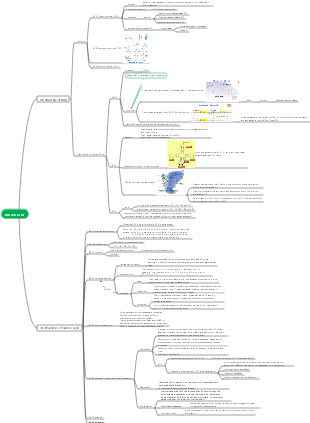
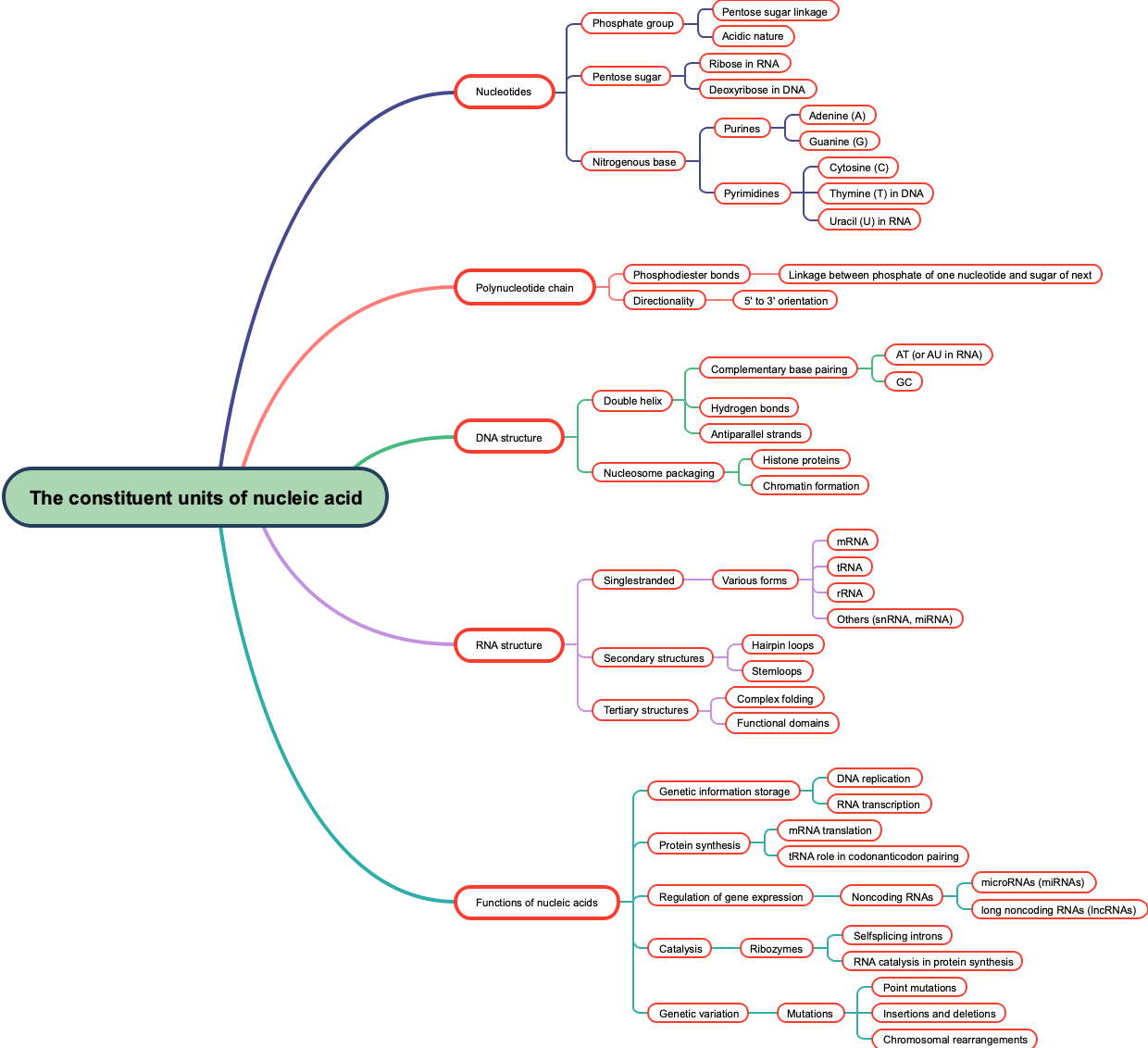
This is a mind map about nucleic acids, including its components, primary structure of nucleic acids, advanced structure of DNA, etc. Hope this helps!
Edited at 2023-11-06 11:18:23This is a mind map about bacteria, and its main contents include: overview, morphology, types, structure, reproduction, distribution, application, and expansion. The summary is comprehensive and meticulous, suitable as review materials.

This is a mind map about plant asexual reproduction, and its main contents include: concept, spore reproduction, vegetative reproduction, tissue culture, and buds. The summary is comprehensive and meticulous, suitable as review materials.
This is a mind map about the reproductive development of animals, and its main contents include: insects, frogs, birds, sexual reproduction, and asexual reproduction. The summary is comprehensive and meticulous, suitable as review materials.
This is a mind map about bacteria, and its main contents include: overview, morphology, types, structure, reproduction, distribution, application, and expansion. The summary is comprehensive and meticulous, suitable as review materials.
This is a mind map about plant asexual reproduction, and its main contents include: concept, spore reproduction, vegetative reproduction, tissue culture, and buds. The summary is comprehensive and meticulous, suitable as review materials.
This is a mind map about the reproductive development of animals, and its main contents include: insects, frogs, birds, sexual reproduction, and asexual reproduction. The summary is comprehensive and meticulous, suitable as review materials.
nucleic acid
Discover nucleic acids
1869 Nuclide Miescher
1944 Pneumococcal transformation Avery
1953 Double Helix Watson Crick
1958 Central Dogma Crick
1960s RNA
1970s DNA
to date
Except for a few viruses whose genetic material is RNA, the genetic material of most organisms is DNA.
Prokaryotic "chromosomes" are composed of a circular DNA molecule and a small amount of protein
Eukaryotic chromosomes are composed of DNA and approximately equal amounts of protein
Composition
Pentose
The first carbon atom forms a glycosidic bond with the base - nucleoside
Purine forms cis and trans
Only the trans structure of pyrimidine is stable, and the cis structure has steric hindrance.
Nucleotide
Phosphate ester of nucleoside
effect
1. Nucleic acid structural unit
2. Energy carrying
3. Enzyme cofactors
4. Energy conduction
adenylate AMP
Combined with a molecule of phosphate =ADP
Add another phosphate = ATP (adenosine triphosphate)
1.Biological energy metabolism
2.ATP plays a key role in the conversion and utilization of chemical energy in all biological systems
3.UTP participates in the mutual conversion of sugars and polysaccharide synthesis
4.CTP participates in phospholipid synthesis
5.GTP participates in protein synthesis
Deoxynucleotide dAMP
The mediator of the action of 3',5'-cyclic adenosine monophosphate (cAMP) hormone in mammalian cells - the second messenger
260nm absorption peak
The four atoms of the sugar ring are in the same plane, and the protruding atoms are biased towards the C-5' side - internal formula (on the contrary - external formula)
Nitrogenous base
RNA Main Cytosine C Uracil U
DNA contains cytosine thymine T
Both contain adenine A and guanine G
Modified pyrimidines (trace bases/rare bases)
Chemically modified products
isomer
keto form
Under normal physiological pH, the main
enol form
Nucleic acid primary structure
The order in which each nucleotide residue is arranged along a polynucleotide chain
3',5'-phosphodiester bond
DNA secondary structure
Helical spatial structure of DNA double strands
X-ray diffraction data
Base pairing (Chargaff's law)
DNA titration curve
Key points of the double helix structure model
Complementary relationship between bases (base pairing)
The Π electron cloud between the paired base planes forms the base stacking force—propeller twisting
Narrow angles form minor grooves Wide angles form major grooves - specificity and protein interaction
B-DNA Z-DNA A-DNA
DNA high-level structure
Superhelical structure of circular DNA
Further twisted into supercoiled DNA (covalently closed circular DNA)
One strand breaks to form open circular DNA
linear DNA
Negatively supercoiled DNA
Positive supercoiled DNA
significance
1. Form a highly dense state to be packed into the core
Promote the transformation of DNA structure to meet functional needs
eukaryotic chromosome structure
Nucleosome (nuclear particle): a double-helical DNA molecule coiled with histones
Autosomes: The less compressed genetic material in the interphase nucleus and higher transcriptional activity
heterochromosome: vice versa
Non-histone proteins (sequence-specific DNA binding proteins): high mobility proteins, transcription factors, DNA polymerases, chromosome skeleton proteins - involved in the regulation of DNA replication and gene expression
DNA and genome
Transcription: Organisms can use base pairing to synthesize RNA that corresponds to the nucleotide sequence of DNA.
Messenger RNA (mRNA): guides protein synthesis
Translation: mRNA directs the process of protein synthesis
Ribosomal RNA (rRNA)
Gene: Genetics is the smallest functional unit of the DNA molecule
Spacer sequences: There are some sequences between genes that neither transcribe RNA nor regulate gene expression.
Genome: The complete set of genetic material contained in a species
Characteristics of viral and bacterial genomes
Operator: Genes with the same function are often strung together and controlled by common regulatory elements and transcribed into the same mRNA molecule, which can guide the synthesis of multiple proteins.
Positive strand virus: After RNA enters the host cell, it can directly guide protein synthesis.
Negative strand virus: After entering the host cell, it must first synthesize RNA that is complementary to its base sequence before it can synthesize the corresponding protein.
Bipartite virus: After entering the host cell, it uses the negative strand of the double-stranded RNA as a template to synthesize positive-stranded RNA to guide protein synthesis, and then synthesizes the negative-stranded RNA to form a double-stranded RNA and assemble it with the protein to form a new virus.
Retrovirus: After entering the host cell, it needs to synthesize DNA complementary to its base sequence under the action of reverse transcriptase, which is called complementary DNA. The cDNA is then transcribed into mRNA to guide protein synthesis.
Overlapping genes: A nucleic acid sequence can encode multiple peptide chains
Plasmid: small circular DNA contained in bacteria
Characteristics of eukaryotic genomes
The genome is larger
No operator substructure exists
Gene clusters: Functionally closely related genes can be arranged together
There are a lot of repetitive sequences
Highly repetitive sequences: repetition rates as high as 10 raised to the sixth power - known as satellite DNA
Moderately repetitive sequences: tens to hundreds of thousands of copies
Walking repeats: spaced apart from other sequences
Short walking element SINE
Long walking element LINE
Transposons: Some sequences can move around on a chromosome
Tandem repeats: arrayed in a sequence
Minisatellite sequences (minisatellite sequence DNA is distributed within autosomes)
Microsatellite sequence (microsatellite DNA/short tandem repeats STR/simple tandem repeats SSR)
rDNA
low repeat sequence
Pseudogene: Some genes lose their expression activity due to mutations
Single sequence/non-repeating sequence
There is a broken gene
Intron: intervening sequence in a gene that is not coded
Make eukaryotic genes discontinuous genes or broken genes
Exon: coding segment
RNA structure and function
tRNA
Accounting for 15% of the total
Transport amino acids to the corresponding location in the ribosome-mRNA complex for protein synthesis
Clover secondary structure/four-ring four-arm structure
Three-level structure inverted L shape
rRNA
Accounting for 80% of the total
mRNA and hnRNA
mRNA accounts for 3-5% of the total amount
Metabolically active, shorter lifespan
The precursor is synthesized in the nucleus, and the entire gene, including introns and exons, is transcribed to form nuclear heterogeneous RNA (hnRNA) with extremely heterogeneous molecular sizes.
Splicing and processing into mature mRNA
snRNA and snoRNA
small nuclear RNA (snRNA)
are linked to proteins and exist in the form of ribonucleoprotein RNP
small nucleolar RNA (snoRNA)
Involved in the processing of rRNA precursors and the methylation modification of certain nucleotides in some snRNA and tRNA
asRNA and RNAi
Antisense RNA (asRNA)
Inhibits mRNA translation, DNA replication and transcription
RNA interference (RNAi)
Double-stranded RNA inhibits specific gene expression
Diversity of noncoding RNAs (ncRNAs)
by function
Catalytic RNA (cRNA)/ribozyme
Mostly involved in RNA processing and maturation
mRNA-like RNA
It is a regulatory factor closely related to cell growth and differentiation, embryonic development, tumor formation and suppression.
Guide RNA (gRNA)
Know the process of adding U to the mRNA transcript product
tmRNA
It can be used as a transporter of amino acids during translation and as a template for the synthesis of peptide chains.
telomerase RNA
eukaryotic chromosome telomere replication template
Signal Recognition Particle (SRP)
Related to intracellular protein transport
MicroRNA (miRNA)
Plays an important role in the regulation of gene expression, cell cycle and individual development
small interfering RNA (siRNA)
Mediates target mRNA degradation in the RNAi pathway
within the cell
Cytoplasmic small RNA (scRNA)
Cytoplasmic protein synthesis
Cajal bodies (CBs) small RNAs
Involved in ribose methylation and pseudouracil formation
size
21-25nt ncRNA
Important regulator of gene expression in eukaryotic cells
100-200nt smallRNA
Translational regulators of bacterial cells
ncRNA larger than 10000nt
Involved in gene silencing in higher eukaryotes
Can be used as genetic material to perform tasks normally performed by proteins
Properties and research methods of nucleic acids
General physical and chemical properties
physical properties
Both are usually acidic
Pure DNA is a white fibrous solid
Pure RNA is white powder
Slightly soluble in water
Insoluble in common organic solvents, use ethanol to precipitate nucleic acids
sexual dissociation properties
Denaturation, renaturation, color increase and decrease effects, molecular hybridity
melting temperature
centrifugation
Sequence determination
enzymatic hydrolysis
The substrate on which the enzyme acts
Ribonuclease RNase
bovine pancreatic ribonuclease
RNase T1
RNase T2
Deoxyribonuclease DNase
Bovine pancreatic deoxyribonuclease Ⅰ
bovine spleen DNAse
hydrolysis site
Endonuclease
exonuclease
non-specific nuclease
Both RNA and DNA can be hydrolyzed
RNA dilute alkaline hydrolysis
Determine the base composition of RNA or remove RNA impurities in solution
UV absorption properties
Color enhancement effect
Hydrolyze nucleic acids into nucleotides, increasing UV absorption by 30% to 40%
application
Calculating quantitative analysis and purity identification A260/A280
Pure RNA=2.0
Pure DNA=1.8
Protein or phenol contamination <1.8
Degradation>2.0
The same DNA has different absorption properties max=260
Bases act as absorbers
A260 rises after denaturation (base exposure)
Stability of nucleic acid structures
hydrogen bonding between base pairs
Important factors for the stability of tertiary structure
base stacking force
The collective name for van der Waals forces and hydrophobic forces between base planes
Positive ions in the environment
Eliminate electrostatic repulsion
Denaturation of nucleic acids
Denaturation of double-stranded nucleic acids
The process of breaking the hydrogen bonds in the double helix region, destroying the spatial structure, and forming a single-chain random coil state.
Only changes involving secondary keys
Melting temperature Tm
The temperature at which the increase in UV absorption reaches half of the maximum increase
Influencing factors
The less complex the DNA sequence, the smaller the Tm
Proportional to G-C content
In media with lower ionic strength, Tm is lower
As alkalinity increases, Tm increases
Increased hydrogen bonding and increased Tm
After denaturation, biological functions are lost, UV absorption increases, solution viscosity decreases, and buoyant density increases.
Nucleic acid renaturation
Restoration
The process by which complementary strands of denatured nucleic acids reassociate into double helices under appropriate conditions
annealing
Slow cooling is required during renaturation of denatured nucleic acids
subtractive color effect
After renaturation, the UV absorption of nucleic acids decreases
Influencing factors
Refolding temperature Tm-25°
Concentration of single-stranded fragments
length of single-stranded fragment
Complexity of single-stranded fragments (the more, the harder)
ionic strength of solution
Nucleic acid molecule hybridization and DNA chip
molecular hybridization
Under annealing conditions, the complementary regions of DNA from different sources form double strands, or the complementary regions of a single strand of DNA and a single strand of RNA form a DNA-RNA hybrid double strand.
probe
Natural or synthetic DNA or RNA fragments are usually labeled with radioactive isotopes or fluorescent
Southern blotting/Southern hybridization
Electrophoretically separated DNA fragments are transferred from the gel to an appropriate membrane (nitrocellulose membrane or nylon membrane)
Northern blotting/Northern hybridization
A technique in which the denatured RNA separated by electrophoresis is blotted onto an appropriate membrane and then molecular hybridization is performed.
DNA chip technology/DNA microarray
Sequencing of nucleic acids
F.Sanger proposed the chain termination method
1. Use gel electrophoresis to separate DNA single-stranded fragments
2. The complementary strand of the single-stranded DNA template can be synthesized in a test tube using a suitable polymerase.
Newly developed high-throughput sequencing technology (PCR)/polymerase chain reaction
cycle chip sequencing
Breakage of phosphodiester bonds is called nucleic acid degradation
Many small RNA molecules have important regulatory and catalytic functions