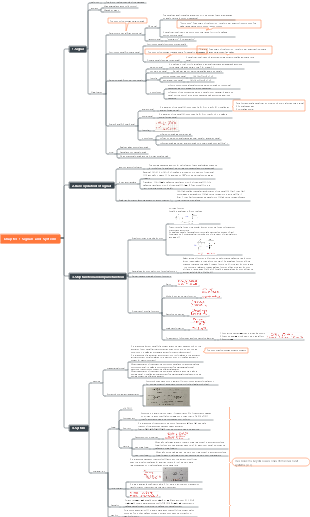
MindMap Gallery Chapter 4 Aromatic Hydrocarbons
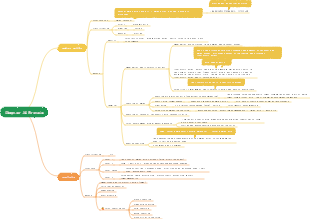
"Organic Chemistry" Final Review Chapter 4 Aromatic Hydrocarbons Mind Map, with clear context and comprehensive content. It is a good helper for review. Welcome to use it! The other chapters are on the homepage. It’s not easy to make. Please give it a like! 🥰
Edited at 2023-10-22 21:14:26This is a mind map about bacteria, and its main contents include: overview, morphology, types, structure, reproduction, distribution, application, and expansion. The summary is comprehensive and meticulous, suitable as review materials.

This is a mind map about plant asexual reproduction, and its main contents include: concept, spore reproduction, vegetative reproduction, tissue culture, and buds. The summary is comprehensive and meticulous, suitable as review materials.
This is a mind map about the reproductive development of animals, and its main contents include: insects, frogs, birds, sexual reproduction, and asexual reproduction. The summary is comprehensive and meticulous, suitable as review materials.
This is a mind map about bacteria, and its main contents include: overview, morphology, types, structure, reproduction, distribution, application, and expansion. The summary is comprehensive and meticulous, suitable as review materials.
This is a mind map about plant asexual reproduction, and its main contents include: concept, spore reproduction, vegetative reproduction, tissue culture, and buds. The summary is comprehensive and meticulous, suitable as review materials.
This is a mind map about the reproductive development of animals, and its main contents include: insects, frogs, birds, sexual reproduction, and asexual reproduction. The summary is comprehensive and meticulous, suitable as review materials.
Chapter 4 Aromatic Hydrocarbons
benzene aromatic hydrocarbons
Classification
Monocyclic aromatic hydrocarbons
Contains only one benzene ring
polycyclic aromatic hydrocarbons
Containing two or more independent benzene rings (eg. biphenyl)
Condensed aromatic hydrocarbons
naphthrine
Are solid at room temperature
Naphthalene
physical properties
Colorless shiny flaky crystals
special smell
Insoluble in water, easily soluble in organic solvents
Melting point 80℃, highly volatile and easy to sublime
Chemical properties (more active than benzene)
Substitution reaction
Electrophilic substitutions are mostly at the α position
addition reaction
Easier than benzene, more difficult than alkenes (P73)
Anthracene and phenanthrene (P74)
C14H10, isomers of each other
anthracene linear fusion
Philippine angle fusion
Representative compounds of aromatic hydrocarbons
C60
Benzopyrene
The structure of benzene
The six Cs are all sp2 hybridized
plane regular hexagon
Six σ bonds and one large cyclic π bond form a closed conjugated system, recorded as
Upper "6": the number of electrons in the p orbital Next "6": the number of p orbitals participating in bonding
Properties of benzene
physical properties
Colorless volatile liquid
Denser than water
Melting point 5.5, boiling point 80.1
Has a special smell
Hardly soluble in water, easily soluble in organic solvents (alcohol ether ketones)
Flammable and explosive
chemical properties
Characteristics: Generally stable, prone to electrophilic reactions
toxicity
Highly toxic, long-term exposure can cause cancer
reaction
Electrophilic substitution (see diagram for mechanism)
Halogenated
Conditions: catalyzed by iron powder or iron halide, water bath 50-60℃
Halogen substitution activity: F>Cl>Br>I
Product: Dihalogenation: mainly ortho-para position
nitration, sulfonation
Conditions: concentrated nitric acid, concentrated sulfuric acid, 50-60℃
Nitrobenzene and fuming nitric acid can produce meta-dinitrobenzene at 100℃
Alkylbenzenes are more easily nitrated
Sulfonation reaction is reversible
Friedel-Crafts reaction
Under the catalysis of anhydrous AlCl3, aromatic hydrocarbons react with halogenated hydrocarbons, acid halides, acid anhydrides, etc., and the hydrogen on the ring is replaced by an alkyl group or an acyl group to form an alkylbenzene or aromatic ketone.
Alkylation and acylation
Notice
The difference between acylation and alkylation is that acylation does not undergo isomerization
When there are electron-withdrawing groups such as nitro, sulfonate, acyl and cyano groups attached to the ring, Friedel-Crafts reaction generally does not occur, while electron-repelling groups on the benzene ring facilitate the reaction.
addition
Hydrogen reduction
Add chlorine to get (666)
Oxidation
Side chain oxidation
For homologues containing α-H, the side chains can be oxidized to carboxyl groups by acidic potassium permanganate or acidic potassium dichromate at higher temperatures.
Must have α-H
Benzene epoxidation
The benzene ring is converted into butenedic anhydride under V2O5 and O2 (400-500℃)
Side chain halogenation
Conditions: light or high temperature (160-180℃) → free radical reaction mechanism
Mainly occurs on α-H
non-benzene aromatic hydrocarbons
Huckel's rule (4n 2 rule)
Planar monocyclic conjugated polyenes containing 4n 2 π electrons formed by SP2 hybrid atoms are aromatic.
π electron calculation method
A double bond has 2 π electrons
The number of pi electrons in a carbocation is 0
There are 2 carbanions
Single electron free radicals have 1
The rules of electrophilic substitution positioning of benzene ring
The first type of positioning base (adjacent positioning base)
Reactivating group (electron donating)
Single bond or negatively charged
Amino>hydroxy>methyl>halogen atom
The second type of positioning base (meta positioning base)
Blunting group (electron withdrawing)
Double bond or triple bond or positively charged
Nitro group>Aldehyde group>Carboxyl group
Positioning rules
The first and second types of contradictions are dominated by the first type
Similar groups, consistent positioning, mutual reinforcement
Groups of the same type have conflicting positions, with the stronger ones being the main ones.
Pay attention to steric effects
Ferric chloride, zinc chloride, boron fluoride, sulfuric acid, etc. can also be used, but the activity is not high.