MindMap Gallery High math
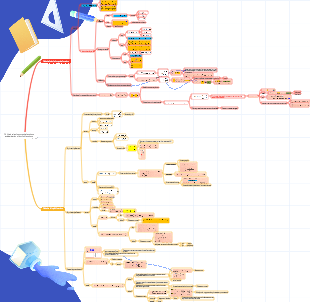
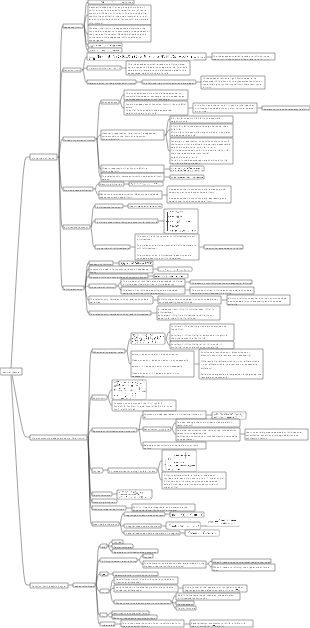
This is a mind map about advanced mathematics, which summarizes derivatives, functions, Limits and continuity, etc. Hope this mind map helps you!
Edited at 2024-01-16 13:29:59This is a mind map about bacteria, and its main contents include: overview, morphology, types, structure, reproduction, distribution, application, and expansion. The summary is comprehensive and meticulous, suitable as review materials.

This is a mind map about plant asexual reproduction, and its main contents include: concept, spore reproduction, vegetative reproduction, tissue culture, and buds. The summary is comprehensive and meticulous, suitable as review materials.
This is a mind map about the reproductive development of animals, and its main contents include: insects, frogs, birds, sexual reproduction, and asexual reproduction. The summary is comprehensive and meticulous, suitable as review materials.
This is a mind map about bacteria, and its main contents include: overview, morphology, types, structure, reproduction, distribution, application, and expansion. The summary is comprehensive and meticulous, suitable as review materials.
This is a mind map about plant asexual reproduction, and its main contents include: concept, spore reproduction, vegetative reproduction, tissue culture, and buds. The summary is comprehensive and meticulous, suitable as review materials.
This is a mind map about the reproductive development of animals, and its main contents include: insects, frogs, birds, sexual reproduction, and asexual reproduction. The summary is comprehensive and meticulous, suitable as review materials.
High math
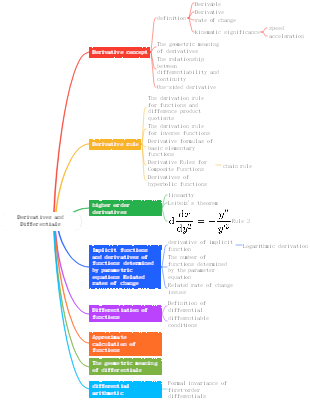
Derivative
Definition of derivative
The geometric meaning of derivatives
The physical meaning of derivatives
Calculation of derivatives
Basic derivative formula
c’ = 0, where c is a constant
(x^n)’ = nx^(n-1), where n is a real number and n ≠ 0.
(a^x)’ = a^x * ln(a), where a is a positive constant.
(log_a(x))’ = 1 / (x * ln(a)), where a is a positive constant
(sin(x))’ = cos(x)
(cos(x))’ = -sin(x)
(tan(x))’ = sec^2(x) = 1/cos^2(x)
(arcsin(x))’ = 1 / √(1 - x^2), where |x| < 1
(arccos(x))’ = -1 / √(1 - x^2), where |x| < 1
(arctan(x))’ = 1 / (1 x^2)
Four Arithmetic Rules for Derivatives
Addition rule (sum rule): If there are two differentiable functions f(x) and g(x), then the derivative of their sum (or difference) is equal to the sum (or difference) of their respective derivatives: (f(x) ) ± g(x))' = f'(x) ± g'(x)
Multiplication rule (product rule): The derivative of the product of two differentiable functions f(x) and g(x) is equal to the derivative of the first function times the second function, plus the second function times the first Derivative of a function: (f(x)g(x))' = f'(x)g(x) f(x)g'(x)
Division rule (quotient rule): The derivative of the quotient of two differentiable functions f(x) and g(x) is equal to the derivative of the numerator times the denominator minus the derivative of the numerator times the denominator, and then divided by the square of the denominator: (f (x)/g(x))' = (f'(x)g(x) - f(x)g'(x)) / [g(x)]^2
Chain rule (composite function rule): If there is a composite function h(x) = f(g(x)), where f(x) and g(x) are both differentiable, then the derivative of this composite function is equal to The derivative of the outer function with respect to the inner function is multiplied by the derivative of the inner function: h'(x) = f'(g(x))g'(x)
Derivative Rules for Composite Functions
Implicit function derivation rule
Applications of Derivatives
monotonicity of a function
Extreme value and maximum value of function
L'Obitat's Law
Curve concavity and inflection point
function
Functions and their properties
Function: Suppose A and B are non-empty sets. If according to a certain corresponding relationship f, for any element x in set A, there is a unique element f(x) corresponding to it in set B, Then it is called a function from set A to set B, denoted as f: A → B, x → f(x).
Independent variable: the value of the independent variable in the function, usually represented by x
Dependent variable: a variable that depends on the independent variable, usually represented by y or f(x)
Domain: the set of all possible values of the independent variable x in the function
Range: the set of all possible function values within the domain of a function
Basic properties of functions
Boundedness: If there is a constant M > 0 such that |f(x)| ≤ M for all x belonging to the domain, the function is said to be bounded.
Monotonicity: If for any two numbers x1 and x2 in the domain, when x1 < x2, f(x1) ≤ f(x2), the function is said to be monotonically increasing; if both f(x1) ≥ f( x2), then the function is said to be monotonically decreasing.
Parity: If f(-x) = -f(x) exists for any x in the domain of definition, the function is called an odd function; if f(-x) = f(x) exists, the function is called an odd function. even function.
Periodicity: If there is a non-zero constant T such that f(x T) = f(x) for any x in the domain of definition, then the function is said to be periodic, and T is called the period of the function.
elementary functions
constant function
Power function
exponential function
Logarithmic function
Trigonometric functions
Sine function: f(x) = sin(x)
Cosine function: f(x) = cos(x)
Tangent function: f(x) = tan(x)
Cotangent function: f(x) = cot(x)
Secant function: f(x) = sec(x)
Cosecant function: f(x) = csc(x)
inverse trigonometric function
Arcsine function: f(x) = arcsin(x) or sin^(-1)(x)
Arccosine function: f(x) = arccos(x) or cos^(-1)(x)
Arctangent function: f(x) = arctan(x) or tan^(-1)(x)
Inverse cotangent function: f(x) = arccot(x) or cot^(-1)(x)
Arcsec function: f(x) = arcsec(x) or sec^(-1)(x)
Inverse cosecant function: f(x) = arccsc(x) or csc^(-1)(x)
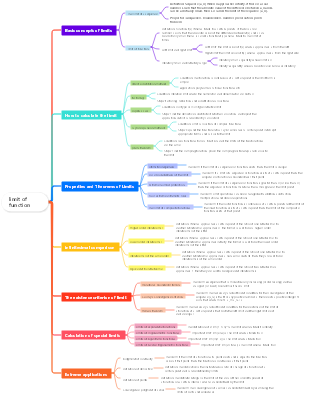
limit and continuity
The limit of a sequence
Uniqueness: If the limit of a sequence exists, then this limit is unique.
Boundedness: If a sequence converges, then the sequence must be bounded.
Sign preservation: If lim (n→∞) a_n = L, and L > 0 (or L < 0), then there is a positive integer N such that a_n > 0 (or a_n < 0) for all n > N.
Pinch theorem: If there are two convergent sequences {b_n} and {c_n}, and for all n, b_n ≤ a_n ≤ c_n, and lim (n→∞) b_n = lim (n→∞) c_n = L, Then the sequence {a_n} also converges to L.
limit of function
Two important limits
continuity of function
54 Jiang Shuo