MindMap Gallery limit of function
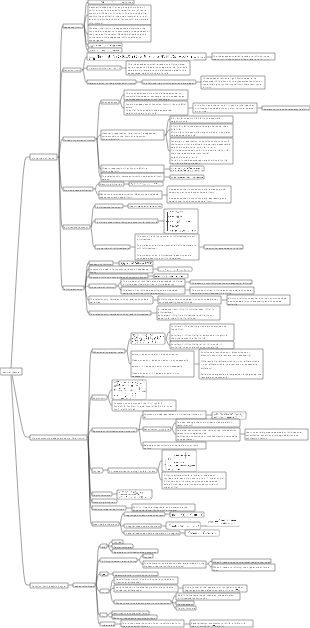
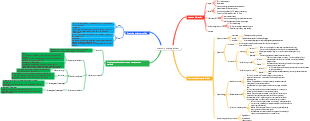
It includes the basic concepts of limits, calculation methods of limits, properties and theorems of limits, comparison of infinitesimals, existence criteria of limits, and calculation of special limits.
Edited at 2024-10-18 09:06:36이것은 곤충학에 대한 마인드 맵으로, 곤충의 생태와 형태, 생식 및 발달, 곤충과 인간의 관계를 연구하는 과학입니다. 그것의 연구 대상은 곤충으로, 가장 다양하고 가장 많은 수의 동물이며 생물학적 세계에서 가장 널리 분포되어 있습니다.
이것은 어린이의 내부 동기를 육성하는 방법에 대한 마인드 맵입니다. 기업가를위한 실용적인 가이드, 주요 내용 : 요약, 7. 정서적 연결에주의를 기울이고, 과도한 스트레스를 피하십시오.
이것은 자동화 프로젝트 관리 템플릿, 주요 내용에 대한 마인드 맵입니다. 메모, 시나리오 예제, 템플릿 사용 지침, 프로젝트 설정 검토 단계 (What-Why-How), 디자인 검토 단계 (What-Why-How), 수요 분석 단계 (What-Why-How)에 대한 마인드 맵입니다.
이것은 곤충학에 대한 마인드 맵으로, 곤충의 생태와 형태, 생식 및 발달, 곤충과 인간의 관계를 연구하는 과학입니다. 그것의 연구 대상은 곤충으로, 가장 다양하고 가장 많은 수의 동물이며 생물학적 세계에서 가장 널리 분포되어 있습니다.
이것은 어린이의 내부 동기를 육성하는 방법에 대한 마인드 맵입니다. 기업가를위한 실용적인 가이드, 주요 내용 : 요약, 7. 정서적 연결에주의를 기울이고, 과도한 스트레스를 피하십시오.
이것은 자동화 프로젝트 관리 템플릿, 주요 내용에 대한 마인드 맵입니다. 메모, 시나리오 예제, 템플릿 사용 지침, 프로젝트 설정 검토 단계 (What-Why-How), 디자인 검토 단계 (What-Why-How), 수요 분석 단계 (What-Why-How)에 대한 마인드 맵입니다.
limit of function
Basic concepts of limits
The limit of a sequence
Definition: Sequence {a_n} When n approaches infinity, if there is a real number L such that the absolute value of the difference between a_n and L can be arbitrarily small, then L is called the limit of the sequence {a_n}.
Properties: uniqueness, boundedness, number preservation, pinch theorem
limit of function
Definition: Function f(x) When x tends to a certain point a, if there is a real number L such that the absolute value of the difference between f(x) and L can be arbitrarily small, then L is called a function f(x) when x tends to The limit at time a.
Left limit and right limit
Left limit: the limit value of f(x) when x approaches a from the left
Right limit: the limit value of f(x) when x approaches a from the right side
Infinitely Small and Infinitely Large
Infinitely small: a quantity whose limit is 0
Infinity: A quantity whose absolute value increases infinitely
How to calculate the limit
direct substitution method
Condition: The function is continuous at a certain point or the limit form is simple
Application: polynomials, rational functions, etc.
factoring
Condition: Infinitive limit where the numerator and denominator are both 0
Steps: factoring, reduction, and substitution calculations
Lópida's Law
Condition: 0/0 type or ∞/∞ type infinitive limit
Steps: Find the derivative, substitute it into the calculation, and repeat the application until it can be directly calculated.
Taylor expansion method
Condition: Limit calculation of complex functions
Steps: Expand the function into a Taylor series near a certain point, intercept appropriate terms, and calculate the limit
pinch theorem
Condition: Two functions force a function, and the limits of the two functions are the same
Steps: Find the clamping function, prove the clamping relationship, and calculate the limit
Properties and Theorems of Limits
ultimate uniqueness
Theorem: If the limit of a sequence or function exists, then the limit is unique
Local boundedness of the limit
Theorem: If a limit of a sequence or function exists at a certain point, then the sequence or function is bounded near that point.
Extreme number protection
Theorem: If the limit of a sequence or function is greater than 0 (or less than 0), then the sequence or function maintains the same sign near the limit point
Four extreme arithmetic rules
Theorem: Limit operations can be exchanged with addition, subtraction, multiplication and division operations.
The limit of composite functions
Theorem: If the outer function is continuous at a certain point and the limit of the inner function exists at a certain point, then the limit of the composite function exists at that point.
infinitesimal comparison
Higher order infinitesimal
Definition: When x approaches a certain point, if the ratio of one infinitesimal to another infinitesimal approaches 0, the former is said to be a higher-order infinitesimal of the latter.
Lower order infinitesimal
Definition: When x approaches a certain point, if the ratio of one infinitesimal to another infinitesimal approaches infinity, the former is said to be the lower-order infinitesimal of the latter.
infinitesimal of the same order
Definition: When x approaches a certain point, if the ratio of one infinitesimal to another infinitesimal approaches a non-zero constant, then they are said to be infinitesimals of the same order.
Equivalent to infinitesimal
Definition: When x approaches a certain point, if the ratio of two infinitesimals approaches 1, then they are said to be equivalent infinitesimals.
The existence criterion of limit
monotonic bounded criterion
Theorem: A sequence that is monotonically increasing (or decreasing) and has an upper (or lower) bound must have a limit.
Cauchy's Convergence Criterion
Theorem: The necessary and sufficient condition for the convergence of the sequence {a_n} is that for any positive number ε, there exists a positive integer N such that when m,n>N, a_m a_n < ε
Heine's theorem
Theorem: The necessary and sufficient condition for the existence of the limit of a function at a certain point is that both the left limit and the right limit exist and are equal.
Calculation of special limits
Limits of exponential functions
The definition of e: lim (1 1/n)^n The limit when n tends to infinity
Limits of Trigonometric Functions
Important limit: lim (sinx)/x The limit when x tends to 0
Limits of logarithmic functions
Important limit: lim (ln(1 x))/x The limit when x tends to 0
Limits of inverse trigonometric functions
Important limit: lim (arctanx)/x The limit when x tends to 0
Extreme applications
Judgment of continuity
Theorem: If the limit of a function at a point exists and is equal to the function value at that point, then the function is continuous at that point
Definition of derivative
Definition: The derivative is the instantaneous rate of change of a function at a certain point and can be defined by limits
Definition of points
Definition: The definite integral is the limit of the area of the curved trapezoid of a function on a certain interval, which can be defined by the limit.
Convergence judgment of series
Theorem: The convergence of a series can be determined by examining the limits of parts and sequences