 Wondershare EdrawMind
MindMap Gallery Deliberate Practice Mind Map
- 34
- 1
Deliberate Practice Mind Map
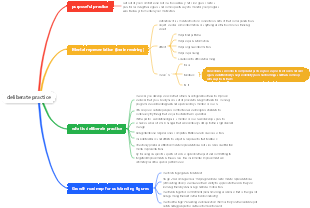
The book "Deliberate Practice" provides us with a new way of learning and thinking. It emphasizes the importance of goals, focus and feedback, and encourages us to constantly challenge ourselves and exceed our limits during practice.
Edited at 2024-02-15 21:33:43
- bacteria
This is a mind map about bacteria, and its main contents include: overview, morphology, types, structure, reproduction, distribution, application, and expansion. The summary is comprehensive and meticulous, suitable as review materials.
- Plant asexual reproduction
This is a mind map about plant asexual reproduction, and its main contents include: concept, spore reproduction, vegetative reproduction, tissue culture, and buds. The summary is comprehensive and meticulous, suitable as review materials.
- Reproductive development of animals
This is a mind map about the reproductive development of animals, and its main contents include: insects, frogs, birds, sexual reproduction, and asexual reproduction. The summary is comprehensive and meticulous, suitable as review materials.
Deliberate Practice Mind Map
- bacteria
This is a mind map about bacteria, and its main contents include: overview, morphology, types, structure, reproduction, distribution, application, and expansion. The summary is comprehensive and meticulous, suitable as review materials.
- Plant asexual reproduction
This is a mind map about plant asexual reproduction, and its main contents include: concept, spore reproduction, vegetative reproduction, tissue culture, and buds. The summary is comprehensive and meticulous, suitable as review materials.
- Reproductive development of animals
This is a mind map about the reproductive development of animals, and its main contents include: insects, frogs, birds, sexual reproduction, and asexual reproduction. The summary is comprehensive and meticulous, suitable as review materials.
- Recommended to you
- Outline


deliberate practice
Recommended order
Beyond the 10,000-hour rule
There has never been a 10,000-hour rule; it is simply a less rigorous interpretation of psychological research by a best-selling author.
The importance of independent thinking ability and feedback on one’s own actual situation
The nature of deliberate practice
Long-term memory is an important ability that distinguishes outstanding people from ordinary people. It is the direction and essence of deliberate practice.
The task difficulty of deliberate practice should be moderate, feedback can be received, and the practice should be repeated enough times so that learners can correct their mistakes.
Memory partition, this is very similar to the Java virtual machine model, different storage areas are distinguished according to the length of time
Key points for cultivating long-term memory:
◆Assign meaning and finely encode: (quasi) experts can quickly understand the words and terms in their own field, and can consciously adopt various metacognitive processing strategies when storing information.
◆Extract structures or patterns: It is often necessary to store knowledge in professional fields and extract structures or patterns in a better way. For example, expert developers make good use of design patterns.
◆Accelerate speed and increase connections: Through a large number of repeated deliberate practices, experts are much faster than novices in the encoding and retrieval process, increasing the various pathways between long-term memory and working memory
tacit knowledge
The difference between learning activities with high cognitive complexity and low cognitive complexity is largely reflected in the amount and proportion of tacit knowledge.
cognitive complexity
The ability to deconstruct the objective world
How to improve this ability?
bounded rationality situational rationality
Human learning is restricted or promoted by the situation. In what situation will the things you want to learn actually be applied, then in what situation should you learn these things.
Combining learning and application
cognitive apprenticeship
◆Find a learning community: Because a large amount of knowledge exists in the practice of the learning community, not in books, effective learning is not about practicing hard behind closed doors, but about finding your own small learning group. For example, programmers practice programming on websites like GitHub.
◆Make tacit knowledge explicit: Tacit knowledge is knowledge that enables people to use concepts, facts and procedures to solve real-life problems. It is also generally called strategic knowledge.
◆Imitate role models: Role models can be real-life mentors or online mentors.
◆Cultivation of diversity: Practice in a variety of situations to emphasize the broad application scope of learning. For example, becoming a tailor does not mean that you have practiced for 10,000 hours, but that you can sew good enough clothes.
Deliberate practice of long periods of time with patience and humility.
Introduction Does genius exist?
Questions about geniuses are further extended to ordinary people, looking beyond the superficial to see the truth.
Mozart's perfect pitch
The key to perfect pitch
Everyone can be Mozart
derived
Genius is the product of training
Geniuses are better at leveraging the brain's adaptability
This book will explain
The ability to create with the right training and practice.
We have greater power over our lives that we never realized before.
Learning is no longer a way to discover someone's potential, but a way to develop that potential. We can create our own potential.
The first half of the book describes what deliberate practice is, why it works, and how great people use it to develop great abilities
The limitations of objective conditions make it clear that the ceiling in a certain field can be reached
The final part of the book gives us the benefit of studying great people, gaining an in-depth understanding of deliberate practice in particular, and explaining what this means for the rest of us.
Chapter 1 Purposeful Practice
Steve's great memory
Our brains have a strict limit on how many things can be held in short-term memory at once, this limit is usually around 7 things
Limitations of short-term memory
long term memory
How to better achieve long-term memory/increase possibilities
Keep practicing and break through your limits
The cycle repeats. This is very similar to compound interest. It is a process of cyclical advancement.
Great people in every field rely on a lot of practice
They practice, lots of practice
The most effective form of practice
The most effective and powerful types of practice in any industry or field take full advantage of the adaptability of the human body and brain to gradually shape and improve their skills to do things that were previously impossible. things.
summary
Building the foundation, giving examples with facts, and establishing arguments
Start with purposeful practice
General methods for learning new skills
First, get a general idea of what we want to do, get some guidance from a mentor, coach, book or website, then start practicing until we reach an acceptable level, then let the skill become automatic and natural of. There is nothing wrong with this approach. Many of the things we do in life only require us to reach an intermediate level.
Once someone's performance reaches an "acceptable" level and can be automated, a few more years of "practice" will not make any improvement. It is even said that doctors, teachers or drivers who have worked in the industry for 20 years may be slightly worse than those who have only worked for 5 years. The reason is that if there is no deliberate improvement, these automated abilities will slowly degrade. .
Purposeful practice vs naive practice
The so-called "naive practice" is basically just doing something repeatedly and hoping that just by relying on that repetition, you can improve your performance and level.
An innocent exercise: just keep your head down and do it!
Four Characteristics of Purposeful Practice
Purposeful practice has specific, well-defined goals
Transformation and dismantling of goals
Purposeful practice is focused
To make progress, you must focus completely on your task.
Purposeful practice includes feedback
No matter what you're working on, you need feedback to identify exactly where you're falling short and how you're falling short.
Purposeful practice requires stepping out of your comfort zone
It's a basic truth with any type of practice: If you never push yourself outside of your comfort zone, you'll never improve.
What to do if you encounter a bottleneck
Try doing something different, not something harder
First make progress, then hit a bottleneck, get stuck, look for different ways to overcome the obstacle, finally find that way, then steadily improve again until the next obstacle appears.
It’s not that you’ve reached your limit, it’s that you’re not motivated enough.
While we can always move forward and improve, doing so is not always easy. Staying focused and continuing to work hard is hard to do and often not fun. So the question of motivation inevitably arises: Why do some people want to engage in this kind of practice? What keeps them going?
internal and external feedback
summary
Get out of your comfort zone, But set clear goals in a focused way, Make a plan for reaching those goals and come up with ways to monitor your progress. Oh, and find ways to keep you motivated.
Purposeful practice is not enough
where is the difference
importance of method
Create search structure
summary
Although we can generally improve our ability to do something to some extent through focused training and stepping out of our comfort zone, that's not all. Hard work is not enough. It’s not enough to push yourself beyond your limits. People often overlook some other equally important aspects of training and practice. Academics have conducted research on a specific practice and training method that has been proven to be the most powerful and effective way to improve people's abilities in various industries or fields.
Chapter 2 The Adaptability of the Brain
The Brain of a London Taxi Driver
The hardest test in the world
The brain is like a muscle, the more you practice it, the bigger it becomes
Most compelling evidence yet that the human brain develops and changes in response to intensive training
The brain has unlimited adaptability
body's ability to adapt
How the blind brain is rewired
The importance of getting out of your comfort zone
Individual cells and tissues are doing their best to keep everything the same.
The body prefers stability
There is also an overview in the human panorama, but that one is more systematic and detailed.
After being forced out of the comfort zone
Work out hard enough, and for long enough, and the body will change in ways that make that effort easier.
To make change happen, you have to keep pushing: run farther, faster, and run uphill. If you don't continue to put some pressure on yourself, your body will maintain homeostasis, and even though the homeostasis is different at this time than before, you will stop improving.
The greater the challenge, the greater the change, but don’t go too far
On the one hand, recent research shows that if people can trigger changes in brain structure when learning a new skill, then this kind of learning is much more efficient than when people just continue to practice a skill they have already learned.
On the other hand, pushing yourself too hard for too long can lead to burnout and ineffective learning. The brain, like the body, changes most rapidly to challenges that lie outside its comfort zone but not too far away in the "sweet spot."
Practice changes brain structure
A way to take full advantage of the adaptability of the brain and body to develop and enhance new abilities
How music training changes the brain
The most effective forms of training are actually not just those that help you learn a certain instrument, but deeper and more advanced training that actually enhances your ability to play the instrument. When you play music, these exercises change parts of your brain, in a way that improves your own musical "gift."
The relationship between training and talent
From purely intellectual skills to purely physical skills
Develop, not only intellectual training, but also sports
Three important details
Effects of training on the brain
There may be a price to pay for developing certain parts of the brain through extended training.
balance
High IQ but low EQ?
Cognitive and physiological changes induced by training need to be maintained.
Potential can be built
Most people can't do these things, not because they don't have the ability to do these things, but because they are content to live in their comfort zone and never try to get out of it.
If you want to get better at something, you can do it.
Our goal is not just to discover our potential, but to build it so that things that were once impossible become possible. This requires challenging homeostasis, which means stepping out of your comfort zone and forcing your brain or body to adapt. Once you do this, learning is no longer just a way to carry out some genetic destiny; it becomes a way to control your own destiny and to build your potential in the way you choose.
Chapter 3 Mental representation
The accidental blind chess master
What makes a master better than a novice?
Meaningful memories are more efficient
Create linked relationships
50,000 data blocks
In the example of chess, you can think of it this way: the more complex the chess game, the more the pieces' power is mobilized, and the more complex the cooperation between the pieces' forces is; the more simple the chess game, the less the pieces' power is mobilized, and the pieces' cooperation is more complicated. The interaction between forces is also simpler.
See both trees and forest
broader psychological characteristics
What exactly is this introduction expressing? Or is it simply setting up questions?
What is the mental representation?
A mental representation is a mental structure, concrete or abstract, that corresponds to an object, an idea, some information, or anything else that our brain is thinking about.
First impression?
Deliberate practice involves creating mental representations
Want a preset?
Industry or domain specificity
Basically, these representations are pre-existing patterns of information (such as facts, pictures, rules, relationships, etc.) that are stored in long-term memory and can be used to adapt to certain types of situations efficiently and quickly. One thing is the same for all mental representations: despite the limitations of short-term memory, they allow people to process large amounts of information quickly. In fact, one might define a mental representation as a conceptual structure designed to circumvent the general limitations that short-term memory imposes on mental processing.
Mental representation creates outstanding performance
The main thing that separates great people from the rest of us is this: through years and years of practice, they have changed the neural circuits in their brains to create highly specialized mental representations that, in turn, make people Incredible memory, pattern recognition, problem solving, etc. are made possible, and they are also able to cultivate and develop various advanced abilities in order to excel in specific professional fields.
The best way to understand what these mental representations are and how they operate is to create good mental representations of the concept. As we mentioned earlier with the dog example, the best way to create mental representations for mental representations is to spend a little time getting to know them.
Isn’t meditation just such a process?
Mental representation helps find patterns
Outstanding people see "a forest" while everyone else only sees "a tree."
Fortune-telling
Anticipate and make decisions
unconscious decision-making
Subconscious behavior, in fact, the purpose of many trainings, ultimately becomes conditioned reflexes to ensure accuracy.
Mental representations help interpret information
It helps us process information: understand and interpret it, store it in memory, organize it, analyze it, and use it to make decisions.
Mental representations help organize information
relevance
How knowledge can better guide practice and solve corresponding problems
See the problem comprehensively and see the forest
One major advantage of carefully created mental representations is that you can absorb and consider more information at once.
It can be directly understood as having seen a lot and having rich experience.
Mental representations help with planning
Mental representations can be used to plan for many industries and fields. The better the representation, the more efficient the plan will be.
loose approach to writing
Give a counterexample
How to Write a Book: Creating a Mental Representation
1. Purpose of this book 2. What important points need to be introduced? 3. Help for readers
How to Write This Book: Tuning Mental Representations
The cycle of presupposition, evaluation, reflection, and adjustment
Mental representations facilitate efficient learning
Reflection and perceived mistakes
Imagine the best and achieve it
Sharpening skills can improve mental representations, and changing mental representations can also help sharpen skills.
Chapter 4 The Gold Standard
deliberate practice
Start in the field of music
Industries and fields that can be practiced deliberately
First, there is always an objective aspect to measuring performance;
Second, these industries or fields are often competitive enough that practitioners have strong incentives to train and improve.
Third, these industries or fields are usually already established and the relevant skills have been cultivated for decades or even centuries.
Fourth, some practitioners in these industries or fields also serve as mentors and coaches. Over time, they have developed an increasingly complex set of training methods, which has steadily improved the skill level in this industry or field.
Excellent research opportunity
Learn what separates truly great violinists from those who are just great.
One is excellence, the other is excellent
What’s so difficult about learning the violin?
Difficulties in learning a type of thing
The fixed model that has been accumulated for hundreds of years does not actually require more exploration, because predecessors have gone a long way and tested many methods, and finally settled into the existing fixed model. Can this experience be transferred to some traditional industry
The most outstanding people practice the longest
Improving is hard, and they don't like the hard work of doing it. Simply put, no student loves to practice, and therefore no student is more motivated than another. The reason why these students practice intensively and with passion and concentration is because they find that such practice is an indispensable factor in improving their playing.
Practice time is the most important difference
The most outstanding people are those who spend the most time in a variety of purposeful exercises.
Evidence from a ballet dancer
What is deliberate practice?
More than just purposeful practice
It requires an industry or field that has been reasonably developed, that is, within that industry or field, the most outstanding practitioners have reached a level of performance that sets them apart from others who have just entered the industry or field. clearly distinguished.
Second, deliberate practice requires a tutor who can assign practice assignments to help the student improve his skills. The instructor must have reached a certain level and have some beneficial practice methods that can be passed on to others.
Characteristics of deliberate practice
Skills developed through deliberate practice are skills that others have figured out how to improve and skills that have a set of proven training methods
Deliberate practice occurs outside one's comfort zone and requires the student to continually try things that are just outside his or her current capabilities.
Deliberate practice involves well-defined specific goals and often some aspect of target performance; it is not directed toward some vague general improvement. Once the overall goal is set, the mentor or coach will develop a plan to achieve a series of small changes that will eventually add up to the larger desired change. Improving some aspect of the target's performance allows the practitioner to see that his performance has improved through practice.
Deliberate practice is intentional, that is, it requires one's complete attention and conscious action. Simply following the instructions of a mentor or coach is not enough. The student must stay close to the specific goals of his practice in order to be able to make appropriate adjustments and control the practice.
Deliberate practice involves feedback and the effort to adjust in response to that feedback. Early in the practice process, a great deal of feedback comes from the instructor or coach, who monitors the student's progress, points out problems, and provides ways to resolve them. Over time, students must learn to monitor themselves, spot errors on their own, and adjust accordingly. This kind of self-monitoring requires efficient mental representation.
Deliberate practice both produces and relies on effective mental representations. Improving levels and improving mental representations are complementary to each other, and the two cannot be neglected; as people's levels improve, representations become more detailed and effective, which in turn makes it possible for people to achieve greater improvements. Mental representations allow people to monitor how well they are doing in practice and on the actual job. They show the correct way to do something and draw attention to when something is done incorrectly and how to correct it.
Deliberate practice strives to improve specific aspects of skills acquired in the past by focusing on those aspects, and almost always involves building or modifying skills that have been acquired in the past; this gradual improvement over time Improvements ultimately lead to superior performance. Since the learning of new skills builds on existing skills, tutors provide beginners with the correct basic skills so that students can later relearn those basic skills at a higher level.
How to use the principles of deliberate practice
Maximizing the use of deliberate practice principles
Begin by identifying great people, then speculate on what made them great, and then suggest training methods that will enable you to perform as well as they did.
Determine who is outstanding
The ideal situation would be to find objective, replicable measures that can consistently select the best practitioners from the average. If this ideal situation is impossible to achieve, try to get as close to the ideal as possible.
Find out what separates great people from everyone else
Once you have identified outstanding people, identify what makes that person behave differently from other people. Those differences may explain his or her outstanding achievements. Although many of the things people do may have nothing to do with their outstanding achievements, at least this aspect can be explored.
Keeping all of this in mind will inform you about purposeful practice and point you in a more effective direction. If you find something works, keep doing it; if it doesn't, stop immediately. The more you can tailor your practice to emulate the best in your industry or field, the more effective your practice is likely to be.
The best way is to find a good mentor
What’s wrong and what’s right about the 10,000-hour rule
What's wrong
right where
In any industry or field with a long history, it takes many years of hard work to achieve a career and become an outstanding figure in the industry. Maybe it doesn’t take exactly 10,000 hours of practice, but it takes a long time to practice.
Chapter 5 Applying the Principle of Deliberate Practice to Your Work
Ace training plan
Introduction
All walks of life need "ace training plan"
Make practice a part of your daily routine
Reject three wrong ideas
The first misconception is our old friend, the idea that someone's abilities are often limited by genetic traits. This kind of thinking often manifests itself in various "I can't" or "I'm not" statements: "I'm not a very creative person."
The second misconception is that if you do something long enough, you will get better at it. We know exactly where this thinking is wrong. Doing something the exact same way over and over again is not a recipe for improved performance and performance; it causes people to stop in their tracks and slowly decline.
The third misconception is that to improve, you just need to work hard. If you work hard enough, you will become better. If you want to become a better manager, work harder. If you want to sell more products or services, work harder. If you want to optimize your team collaboration, go the extra mile. But the reality is that all of these things, management, sales, and teamwork, are all specialized skills, and unless you use some exercises designed to improve those specific skills, no matter how hard you work harder, you won't get better at it. Big progress.
Learn by doing
What you need to pay attention to
Does this approach force people out of their comfort zone and force them to try something that is not easy for them?
Does it provide immediate feedback on performance and performance, and on what can be done to improve performance and performance?
Did those who developed this approach identify the best minds in their particular industry or field?
Have you ever identified what separates outstanding people from the rest?
Is the training designed to improve those specific skills possessed by those who excel in the industry or field?
If the answer to all questions is yes, while there may not be a guarantee that the method will work, there is at least a much greater chance that it will.
Train doctors using ace training methods
Accurately determine what the most outstanding people have done to make them stand out from ordinary people.
The Dilemma of Radiologist Training
Ask a question
Create training tools with feedback
Simply put, this type of practice, reinforced with immediate feedback (either from a tutor or provided by a carefully designed computer program), can be an incredibly powerful way to improve performance. Furthermore, I think that radiology training would be more effective if we could try to identify the types of problems that may cause new radiologists to make diagnostic errors and design exercises that focus more on those problems, basically. The top is understanding more about the role mental representations play in making accurate diagnoses, and applying those understandings to design exercises.
Modifying the surgeon’s mental representation
Traditional methods dedicated to imparting knowledge
Difference Between Knowledge and Skills
Don't pay attention to skills and pay too much attention to knowledge. The main reasons are tradition and convenience: it's much easier to introduce knowledge to a large group of people than to create conditions in which people can improve their skills through practice.
The failure of traditional medical education
Viewing medical education from the principle of deliberate practice
As in many cases, once you've figured out how to ask the right question, you already know half the right answer.
When it comes to improving performance and performance in a professional or business context, the right question is "how do we improve relevant skills" rather than "how do we impart relevant knowledge".
Working on new ways to improve skills
Training should focus on doing rather than knowing, and especially on bringing the skills of each individual in a given trade or field as close as possible to the level of the best.
Identify who is an expert
The importance of immediate feedback
Feedback facilitates timely corrections
The psychological process of an outstanding doctor
Chapter 6 Applying the Principles of Deliberate Practice to Your Life
Deliberate practice is for everyone who has a dream
First, find a good mentor
How to find a good mentor
Key Points: Look for comments that provide specific descriptions of the progress students have made and obstacles they have overcome.
It is particularly important to inquire about the potential mentor's training. No matter how many classes you take with your instructor each week, you mainly have to train yourself and complete the exercises assigned to you by your instructor. You want your instructor to guide you as much as possible during the class, not only teaching you how to practice, but also telling you what specific aspects to pay attention to, what mistakes you make, and how to recognize excellent performance. Remember: The most important thing a mentor can do is help you create mental representations so that you can monitor and correct your own performance.
You may need to change mentors as you change
Focus and commitment are crucial
It is important to engage in purposeful practice and not just aimlessly repeat the same movements without setting clear goals for improvement and progress.
If your mind is wandering, or you're taking it easy and doing it just for fun, you probably won't make progress.
Without concentration, practice will have no effect
Shorter exercises, better focus
Focus and commitment are crucial, so setting clear goals and shortening practice sessions is the best way to reach new skill levels more quickly. Putting 100% effort into practice in a shorter period of time will produce better results than putting in only 70% effort in practice over a longer period of time. Once you find that you can no longer focus effectively on your practice, stop. Be sure to get enough sleep each day so that you can maximize your concentration on your practice.
What should I do if I don’t have a mentor?
How Franklin improved his writing
Design your own practice methods
In order to improve, we have to create our own opportunities.
They paid attention to where they were wrong each time and corrected them. This is a purposeful practice. Doing the same thing over and over again without any purpose is not a good idea; the purpose of doing something over and over again is to find out where you are lacking, and focus on making progress in those areas, and try to use different methods to do it. Improve until you finally find what works for you.
Create Effective Psychographics with the “Three Fs”
focus
fix it
feedback
Break down a skill into its component parts so you can practice it over and over again, and effectively analyze, identify your shortcomings, and then come up with ways to fix them.
Overcoming the stagnation stage
Challenge yourself in new ways
Overcome specific weaknesses
stay motivated
Staying motivated is perhaps the biggest problem that everyone who invests in purposeful training or deliberate practice ultimately faces.
new year resolution effect
Willpower does not exist
First, there is little scientific evidence that there is a general "willpower" that can be used in any situation.
Second, there is a larger problem with the concept of willpower, involving the mistaken idea of innate talent.
Two components of staying motivated
Reasons to keep going and reasons to stop.
Weaken the reasons for stopping Get things done better
Set aside a regular time to practice, uninterrupted by all other obligations and distractions.
Good planning can help you avoid the many distractions that take up a lot of your time, leaving more time for practice.
Basic knowledge
For purposeful practice or deliberate practice to be effective, you need to push yourself outside of your comfort zone and stay focused, but these are mentally and physically draining activities.
Extended to mean not to have high psychological expectations
eventually tend to nature
Increase tendency to move on
inner
external
Another important motivational factor in deliberate practice is the belief that you can succeed.
Gather together everyone who is interested in the same thing, or attract them to an existing group, and use the camaraderie and shared goals of the group as additional motivation to reach your own goals.
Set goals carefully
Break down the long journey into a series of manageable goals and focus on one of them at a time. You can even give yourself a small reward every time you reach a goal.
Chapter 7 Roadmap to Become an Outstanding Task
Introduction
Three female chess masters
One of the hallmarks of great people is that even when they become the best in the world in their industry or field, they still work on their practice skills and keep improving. It's when they arrive at the forefront of an industry or field that we'll find those brave trailblazers who have gone beyond anyone else and shown us what's possible.
The first stage: generate interest
For future greats, this playful interaction as a child with whatever interests them is the first step toward eventually becoming passionate about it.
The three stages of growth of outstanding figures
What factors did those who became outstanding people have in their childhood that could explain why they cultivated and developed those outstanding abilities that made them stand out from ordinary people?
In the first stage, adults introduce children to the field or industry they will eventually work in in a playful way.
The second stage is the guidance and encouragement of adults. In fact, children can get feedback, because children do not have social standards, and some of them come from feedback from their natural parents.
The third stage is about industries that parents are interested in, conduction, and further what children subconsciously like to do.
The motivational effect of siblings
When a child sees his brother or sister engaged in a certain activity and receiving attention and praise from his father or mother, he will naturally want to join in and receive the same attention and praise from his parents.
Be gregarious and not isolated
Stage 2: Get serious
Self-fuelled, self-motivated motivation to do the hard work
The third stage: full commitment
The relationship between age and adaptability
Physical adaptability is greatly affected by age
Mental adaptability is stronger than physical fitness
As we age, our physical adaptability may become much worse, but our mental adaptability is still very strong.
The fourth stage: Pioneering and innovative
Innovation is inseparable from deliberate practice
Greater heights achieved through deliberate practice.
The process of innovation is always a long, slow and iterative process.
Pioneers' transcendence and drive
Creation is making something that people haven’t seen or experienced yet.
Those who are creative, restless, and enterprising are never satisfied with the status quo. They look for ways to move forward and do something that no one else has done.
Chapter 8 How to explain natural talent
Outstanding people have finally developed their outstanding abilities through deliberate practice year after year and step-by-step improvement in a long and arduous process. There are no shortcuts.
Cracking the "Miracle of Paganini"
The secret of one string playing
Cracking the "Mozart Legend"
The Secret of the "Children's Composer"
family skating rink
Cracking the miracle of "genius high jumper"
The secret of "jumping 2 meters the first time"
Cracking the "autism wizard"
The Secret of the "Calendar Calculation Genius"
People who “lack” natural talent
tone deaf
not good at math
Training vs. "Genius"
Is there any relationship between IQ and chess skills?
Training time is more important than IQ
In the long run, those who practice harder will prevail, not those who initially have a slight advantage in IQ or other talents.
Looking at genetic differences from another angle
Evidence from all walks of life
Unpredictable
The real role of genetic differences
The dangers of believing in innate talent
self-fulfilling prophecy
The “advantages” of being born early
Advantages of high IQ
Chapter 9 Use deliberate practice to create a new world
Teaching Physics Using Deliberate Practice Principles
best teaching effect
The prospect of deliberate practice
Change exercise training
Transform education and learning
The importance of helping students create mental representations
Create a whole new world
Become a "practitioner"