MindMap Gallery Fundamentals of Analog Electronics Technology
Knowledge of molded electrical semiconductors. A semiconductor is a material whose conductivity is between that of a conductor and an insulator. Its conductivity can be controlled through doping, temperature changes, and electric field effects.
Edited at 2024-10-27 09:08:42Diese Vorlage zeigt die Struktur und Funktion des Fortpflanzungssystems in Form einer Mind Map. Es führt die verschiedenen Komponenten der internen und externen Genitalien ein und sortiert das Wissen eindeutig aus, um Ihnen dabei zu helfen, mit den wichtigsten Wissenspunkten vertraut zu werden.
Dies ist eine Mind Map über die Interpretation und Zusammenfassung des Beziehungsfeldes E-Book, des Hauptinhalts: Überblick über die Essenzinterpretation und Übersicht über das Feld E-Book. "Relationship Field" bezieht sich auf das komplexe zwischenmenschliche Netzwerk, in dem ein Individuum andere durch spezifische Verhaltensweisen und Einstellungen beeinflusst.
Dies ist eine Mind Map über Buchhaltungsbücher und Buchhaltungsunterlagen.
Diese Vorlage zeigt die Struktur und Funktion des Fortpflanzungssystems in Form einer Mind Map. Es führt die verschiedenen Komponenten der internen und externen Genitalien ein und sortiert das Wissen eindeutig aus, um Ihnen dabei zu helfen, mit den wichtigsten Wissenspunkten vertraut zu werden.
Dies ist eine Mind Map über die Interpretation und Zusammenfassung des Beziehungsfeldes E-Book, des Hauptinhalts: Überblick über die Essenzinterpretation und Übersicht über das Feld E-Book. "Relationship Field" bezieht sich auf das komplexe zwischenmenschliche Netzwerk, in dem ein Individuum andere durch spezifische Verhaltensweisen und Einstellungen beeinflusst.
Dies ist eine Mind Map über Buchhaltungsbücher und Buchhaltungsunterlagen.
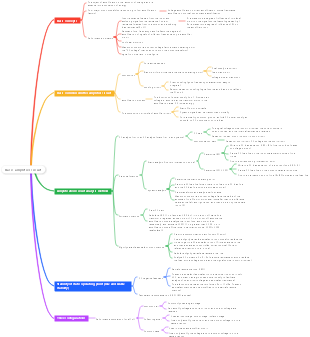
semiconductor
Basic knowledge
intrinsic semiconductor
crystal structure
Two types of carriers (electrons, holes)
impurity semiconductor
N-type semiconductor (electrons are many electrons)
P-type semiconductor (holes are majority carriers)
carrier concentration
Thermal equilibrium conditions (majority carriers * minority carrier concentration = square of carrier concentration); electrical neutrality conditions (majority carriers = doped minority carriers)
The majority carrier concentration is approximately equal to the dopant concentration and has nothing to do with temperature; the minority carrier concentration increases significantly as the temperature increases.
When the temperature rises, impurity semiconductors turn into intrinsic semiconductors
PN junction
Two conductive mechanisms
Diffusion movement (concentration difference)
Drift motion (electric field force)
Formation of PN junction
Concentration difference, multi-carrier diffusion, generation of space charge region, built-in electric field (hinders multi-carrier diffusion and facilitates minority carrier drift), dynamic balance
One-way conductivity
Forward voltage, the direction of the external electric field is opposite to the internal electric field, the depletion layer becomes narrower, the diffusion movement intensifies (the polyon concentration increases), and the conductivity increases
When T=300K, UT=26mv, which is the voltage equivalent of temperature
Voltampere characteristics
Forward conducting, reverse blocking
reverse breakdown
Zener breakdown (high impurity)
Avalanche breakdown (large reverse voltage)
Capacitance characteristics
Barrier Capacitance (Varactor Diode)
Diffusion capacitance
Temperature characteristics
diode
structure
Point contact type, surface contact type, planar diode
Voltampere characteristics
Figure, turn-on voltage, reverse current (both are temperature sensitive)
Main parameters
Maximum rectified current (average) IF, maximum reverse operating voltage UR=0.5UBR, reverse current IR (saturated IS), maximum operating frequency
Model
Mathematical modeling (computer-aided analysis)
curve model
DC simplified model
ideal model
Constant voltage (drop) model
polyline model
Slightly variable equivalent model
At the static operating point, the diode is equivalent to a dynamic resistance (AC resistance), rd = UT/ID. The higher the Q point, the smaller rd
special diode
Zener diode
Volt-ampere characteristics (breakdown area is very shaking)
Main parameter
Stable voltage UZ (reverse breakdown voltage)
Stable current IZ (IZmin, IZmax)
Rated power consumption PZM, dynamic resistance rz=DUZ/DIZ
Solve problems
Assume that the diode is open circuit and calculate the voltage U across it. If U>UZ, it may be in a stable voltage state; then calculate the diode I (U=UZ). If I<Imax, it may be in a stable voltage state.
photodiode
Using PN junction to be sensitive to light
light emitting diode
Forward bias conduction characteristics (LED lights, display screens)
varactor diode
Barrier Capacitance Characteristics
triode
structure
Three poles, three zones, two knots
Three working modes and main features
Cutoff mode, amplification mode (emitter junction forward biased, collector junction reverse biased) (forward controlled characteristics), saturation mode.
Amplification principle
internal carrier movement
Current transfer equation
Three configurations
Common base cb, common emitter ce, common collector cc
Current amplification coefficient: common emission b, common base a
Two equations (IE=IB IC,IC»bIB)
Volt-ampere curve (co-emission)
Input properties
Output characteristics
Cutoff area, saturation area, amplification area
Ideal output characteristics
Main parameters
DC, AC, extreme parameters
Effect of temperature on parameters
As the temperature increases, the UBE(on) turn-on voltage decreases, the reverse saturation current of the ICBO collector junction increases, and b increases
Equivalent model
Mathematical model, curve model
DC simplified model
magnification mode
saturation mode
cutoff mode
Slightly variable equivalent model
h parameter equivalent model (mixed Π type small signal model), rbe=rbb` (given in the question stem) bUT/ICQ