 Wondershare EdrawMind
MindMap Gallery 1. What is Sociology
- 95
- 1
1. What is Sociology
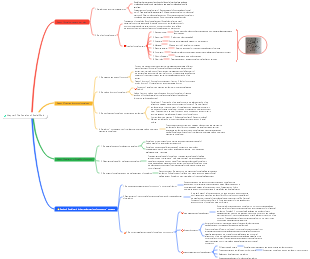
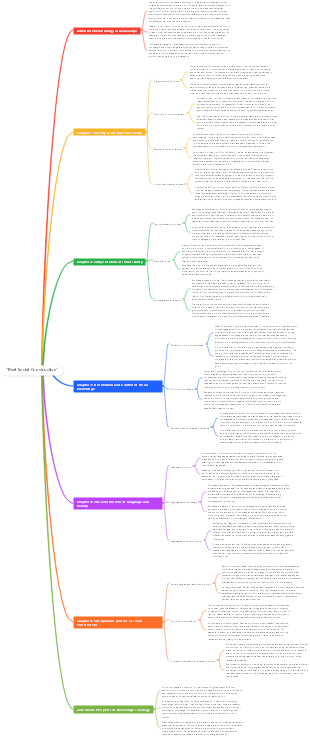
This is a mind map about 1. What is sociology. The main content includes: the status and significance of sociology as a subject, sociological research methods, the relationship between sociology and other social sciences, the main theories and schools of sociology, society The origin and development of sociology, sociological concepts and research objects.
Edited at 2024-11-27 14:42:55
- 12. L'ascesa della democrazia nazionale in Asia, Africa e America Latina
Lezione 12 della storia, l'ascesa della democrazia nazionale in Asia, Africa e America Latina, questa mappa del cervello ti aiuta a familiarizzare con i punti chiave della conoscenza e rafforzare la memoria. Gli studenti bisognosi possono aggiungere un segnalibro.
- Chat gpt che inizia a padronanza
Questa è una mappa mentale sull'introduzione alla competenza di Chat GPT.
- SUGGERIMENTI DI UTILIZZO DI CHEAT
Questa è una mappa mentale sulla condivisione di profonde abilità di utilizzo.
1. What is Sociology
- 12. L'ascesa della democrazia nazionale in Asia, Africa e America Latina
Lezione 12 della storia, l'ascesa della democrazia nazionale in Asia, Africa e America Latina, questa mappa del cervello ti aiuta a familiarizzare con i punti chiave della conoscenza e rafforzare la memoria. Gli studenti bisognosi possono aggiungere un segnalibro.
- Chat gpt che inizia a padronanza
Questa è una mappa mentale sull'introduzione alla competenza di Chat GPT.
- SUGGERIMENTI DI UTILIZZO DI CHEAT
Questa è una mappa mentale sulla condivisione di profonde abilità di utilizzo.
- Recommended to you
- Outline








1. What is Sociology?
Sociological concepts and research objects
Concept: Sociology is a comprehensive and specific social science about the conditions and mechanisms for the healthy operation and coordinated development of society.
Objects: 1. Social phenomena; 2. Social forms; 3. Social organizations; 4. Human culture; 5. Social progress; 6. Social relations; 7. Social processes; 8. Relationships between social phenomena; 9. Social behavior.
Origin and Development of Sociology
Sociology was born out of social upheavals. The success of natural science promoted the development of sociology.
develop
19th century positivist sociology
The word "sociology" was first proposed by the French thinker Comte. In Comte's view, sociology is a new academic category spanning politics, economics, anthropology, psychology, and history. Known as the "Father of Sociology". The positivist doctrine he founded is one of the important symbols of Western philosophy's transition from modern times to modern times. Comte believed that the way out of crisis and social reconstruction is to introduce a new system of knowledge and belief, which is a science about society. Applying scientific empirical methods to social, political, moral, religious and other issues is Talk about establishing sociology as a science.
Spencer and Social Darwinism
Durkheim (1858-1917): Social Facts, Social Division of Labor, "On Suicide"
Tönnies (1855-1936), one of the founders of modern German sociology
Simmel (1858-1918), German sociologist and philosopher It takes social interaction as its subject matter and focuses on studying the forms of social interaction.
Max Weber (1864-1920), German sociologist, philosopher, and political scientist. understanding sociology
Main theories and schools of sociology
functional theory
definition
Functional theorists believe that the entire society is like a living organism, and each department of this organism exists to maintain the survival and continuation of this organism. They emphasize that society is an overall system composed of interdependent parts, and the purpose of each department is to maintain social stability.
core idea
Society is a whole composed of various parts that are interconnected and work together. The primary concern of Ergan sociology is the unity of society as a whole. He believed that various social organizations exist only to meet specific social needs.
Representative scholars
Radcliffe-Brown (1881-1955), whose main works include "The Andaman Islanders", "The Structure and Function of Primitive Society", and "Radcliffe-Brown's Social Anthropology"
He suggested replacing the word "needs" with the words "necessities for survival". He believes that one of the necessary conditions for the existence and development of society is the minimum integration of its components; the word function means the process of this minimum integration; a social system is the integration of the entire social structure of a society and social habits. , forming a "functional unity".
Since culture is a unified whole, if we want to explain any beliefs, norms, customs and systems, we must link them with the cultural structure as a system and analyze them from a functional perspective.
Malinowski (1884-1942), "Voyager of the Western Pacific"
There are three different levels of the system: biological level, social structure level and symbolic level.
Each level has its irreplaceable uniqueness and unique process to meet its own unique needs; at the same time, the system level also presents a hierarchy of levels.
Talcott Parsons (1902-1979), "The Structure of Social Action", "Social Systems"
The entire society is a huge network formed by interconnected departments. Each department participates in and assists in maintaining the work of the entire social system.
Human beings live in an action system composed of multiple "unit actions". The action system is a multi-level structural system. Each level has four basic functional requirements, namely: Adaptation, Goal Attainment, Integration, and Latency.
Robert King Merton (1910-2003), "Social Theory and Social Structure"
Three assumptions: the first basic assumption is the functional unity of society, the second basic assumption is universal functionalism, and the third basic assumption is indispensability.
"Function" refers to the beneficial consequences of people's actions: functions help to keep a group (society, social system) in balance, whereas counter-functions or dysfunctions are the consequences that harm society: they destabilize the system.
From the perspective of functionalist analysis, a group is a functional operating unit, and each part is related to the whole. When we study a smaller part, we need to look for its functions and anti-functions to see how it relates to the larger unit. This basic method can be used with any group, whether it is a society as a whole, an organization, or even as small as a family.
conflict theory
origin
Hobbes' Leviathan The founder of conflict theory is Marx. Marx was in the era of great changes in Europe. He witnessed the drastic changes brought about by the Industrial Revolution in Europe and thought about and analyzed the reasons behind this.
definition
Marx believed that the core of human history lies in class struggle. In every society, there are small groups that control the means of survival and exploit those who have no control.
representative figure
Dahrendorf, a German sociologist whose representative works are "Class and Class Conflict in Industrial Society" and "Out of Utopia"
The stability of social order is based on value sharing; Social order is based on repression. These two positions respectively form two different basic models for examining society: the social equilibrium model and the social repression model. Structural functionalism is a typical representative of the social equilibrium model.
The substantive elements of the social equilibrium model are summarized as: stability, integration, functional coordination and value sharing,
Conflict is not an accidental historical event, it arises from the structure of social status.
Coser's representative works "The Function of Social Conflict" and "Revisiting the Study of Social Conflict"
It is believed that every component and department within the social system is related to each other. When the interconnected social system operates, due to the inconsistent degree of integration and adaptation of various departments, problems such as poor operation and imbalance will occur, and further problems such as contradictions, tensions, imbalances, and conflicts will occur.
Conflict is a struggle over values, beliefs, and the scarce distribution of status, power, and resources in which one party seeks to neutralize, harm, or eliminate the other. Material causes of conflict refer to power imbalances. Non-material causes of conflict refer to inconsistencies in values and beliefs.
He believed that conflict was not entirely harmful, but could also be beneficial.
The contribution and role of Coser’s conflict theory
External conflicts help clarify the boundaries between groups and strengthen intra-group integration.
The role of internal conflict: 1. Conflict within a group can lead to unity and balance again. 2. Internal conflict can "avoid the disintegration of the group by excluding opponents in a state of stress."
Cosse’s “Social Safety Valve” System
Extended from the internal conflicts of the group, the safety valve can allow excess steam to be continuously discharged without destroying the entire structure. Conflict can also help a turbulent group "purify the air." Safety valves allow excess steam to be continuously vented without destroying the entire structure, and conflicts can help a turbulent group "clear the air."
The more rigid the social structure, the more important the safety valve system becomes. Secondly, one of Coser's most important points is that he emphasizes that the safety valve system must be institutionalized in the social structure.
Mills, representative works "White Collar: The American Middle Class", "The Power Elite" and "The Sociological Imagination"
His main contributions to conflict theory are the study of the white-collar class as the middle class in the United States after the 20th century, and the study of power, that is, the theory of power elites.
He proposed a new class, the middle class.
study of power
Power refers to the ability to realize one's will in the face of opposition; the so-called power elite refers to those who are in a position to make important decisions.
The American government is an autonomous institution, regulated by the balance created by competing interests. This balance is reflected at the highest level of the U.S. government, the so-called Congress supervising the president, and the Supreme Court making the final balance among the three separate powers.
symbolic interactionism
definition
Society is composed of interacting individuals, and explanations for various social phenomena can only be found from this interaction. After the Second World War, especially from the 1960s to the 1970s, it became quite popular in the United States and Western sociology circles.
Theoretical background
Symbolic interactionism is very popular in the United States. Interactionism was first influenced by some European empiricist philosophers and theorists (not referring to philosophers who specialize in ethics and morality).
When discussing the influence of people's interconnectedness, Adam Smith said, "Bring a man into society and he immediately has the mirror of his desire in the expressions and actions of those with whom he lives. . This is the only mirror in which we can see, to some extent, through the eyes of others.
Hume also emphasized the importance of human sympathy, believing that sympathy is a tendency to understand the feelings of others acquired through interaction with others.
Interactionists believe that human beings live in a world composed of many meaningful entities. These "entities" may be substances, behaviors, people, relationships between people, or even just a symbol. The symbols here refer to the means of human communication, which originate from language and have cultural significance, and the symbols shared by members of society have strong symbolic meaning.
Representative figures·and their thoughts
Cooley’s “looking-glass-me” theory
definition
“A person has a certain clear imagination about himself—that is, he has a certain idea—that emerges in his mind. This sense of self that a person has is determined by other people’s thoughts and other people’s attitudes toward him. Determined, this type of society I can call the 'reflected self' or the 'looking-glass self'."
triple meaning
First, the image we imagine in front of others is the feeling stage, which is how we imagine others feeling. Second, we imagine others' evaluation of our image. This is the stage of explanation or definition, that is, the judgment of others we imagine. Third, a certain sense of self arising from the above imagination.
William Isaac Thomas - Situation Definition and Situation Analysis
definition
The task of sociology is to analyze people's behavior and those behaviors that occur in the process of mutual adjustment between people and groups.
Situation definition and situation analysis
Thomas asserts that subjective factors play an important role in human life, which also has an impact on symbolic interaction theory. He believes that the situation itself and the definition of the situation must be combined to explain people's behavior. Losing either side is incomplete.
"Polish Peasants in Europe and America"
People's behaviors and concepts are deeply affected by the situations in which they live. How an individual defines the situation he encounters and how he responds will be greatly affected by the group he belongs to.
(1) The objective conditions for individuals or society to carry out activities, that is, the entirety of various values, economy, society, religion, knowledge, etc., which directly or indirectly affects the consciousness of individuals or groups at a specific time; (2) The pre-existing attitude of an individual or group, which exerts a practical influence on people's behavior at a specific time; (3) Situation definition, that is, a relatively clear concept of conditions, situations and attitude awareness.
Mead's symbolic interaction theory
Symbolic interactionism analyzes how people in society behave in ways that are dependent on certain definitions and others. Study face-to-face interactions to understand how people relate to each other and draw meaning from life and their place in it. Even the self is a symbol because it contains the idea we have about who we are.
Goffman’s research on interpersonal interaction and “Dramatism”
Goffman's "drama theory" uses the dramatic performance system to explain various interpersonal and social interactions in daily life. Compare daily life and society to a stage for performance, where everyone performs. This kind of performance is composed of the activities of all participants in social interaction. It includes not only self-performance, expression of emotions, and sending of information, but also the understanding of these actions and symbols by the people around you. The area where people perform is divided into front stage and back stage. The front stage is where people are performing, and the back stage is the place where people prepare for the front stage performance and don't want the audience to see it.
Sociological research methods, the relationship between sociology and other social sciences
Quantitative researchers often emphasize objective facts, the correlation between phenomena, and the causal connections between variables. It can be said that the main goal of quantitative research is to "determine" the relationships, mutual influences, and causal connections between variables. Qualitative researchers, on the other hand, pay more attention to the relationship between the phenomenon and the background, the change process of the phenomenon, and the significance of the phenomenon and behavior to the behavioral subjects. It can be said that the main goal of qualitative research is to "understand" deeply. social phenomenon.
In the process of differentiation from philosophy, sociology gradually got rid of the speculative color of philosophy and increasingly increased the proportion of empirical research and applied research, thus becoming a modern social science discipline.
The main theories of this discipline, such as social cognitive theory, psychoanalytic theory, symbolic interaction theory, humanistic theory, etc., are constantly evolving, arising and developing in the mutual penetration and complementation of sociology and psychology.
Economic life is an important part of social life, and economic life is social. It is this sociality that gives rise to the similarities in thinking methods between economics and sociology. On the basis of the interaction between the two disciplines, economic sociology was born.
Core research in political science: the generation, distribution and use of power, as well as the process of legitimation of power, that is, the emergence of authority, especially the emergence of authority embodied in formal organizations. Combined with sociology, there is the study of rural governance, and rural governance has gradually become a research hotspot in sociology.
The status and significance of sociology discipline
1. Helps to understand the relationship between individuals and society; - understand oneself and adapt to society 2. Helps to correctly understand the laws of social operation and social development; - Obtain objective knowledge and master cognitive tools 3. Help promote social construction and social governance - understand the laws and contribute to society
Sociology provides a perspective, a perspective on the world. Social perspective, or sociological imagination, opens a window for us and allows us to re-see the familiar world.