MindMap Gallery Seven methods of QC A powerful tool for objective analysis of data on quality management activities
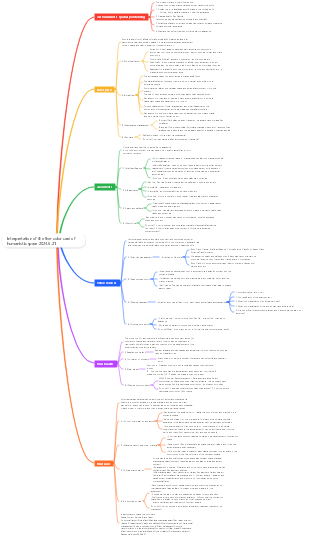
This is a mind map about the seven major methods of QC: a set of powerful tools for objective analysis of data on quality management activities. The main contents include: 5. Related tools, 4. Example analysis, 3. Content analysis, 2. Main content, 1. Conceptual meaning.
Edited at 2025-02-04 13:07:56In order to help everyone use DeepSeek more efficiently, a collection of DeepSeek guide mind map was specially compiled! This mind map summarizes the main contents: Yitu related links, DS profile analysis, comparison of DeepSeek and ChatGPT technology routes, DeepSeek and Qwen model deployment guide, how to make more money with DeepSeek, how to play DeepSeek, DeepSeek scientific research Application, how to import text from DeepSeek into MindMaster, the official recommendation of DeepSeek Wait, allowing you to quickly grasp the essence of AI interaction. Whether it is content creation, plan planning, code generation, or learning improvement, DeepSeek can help you achieve twice the result with half the effort!
This is a mind map about DeepSeek's 30 feeding-level instructions. The main contents include: professional field enhancement instructions, interaction enhancement instructions, content production instructions, decision support instructions, information processing instructions, and basic instructions.
This is a mind map about a commercial solution for task speech recognition. The main content includes: text file content format:, providing text files according to the same file name as the voice file.
In order to help everyone use DeepSeek more efficiently, a collection of DeepSeek guide mind map was specially compiled! This mind map summarizes the main contents: Yitu related links, DS profile analysis, comparison of DeepSeek and ChatGPT technology routes, DeepSeek and Qwen model deployment guide, how to make more money with DeepSeek, how to play DeepSeek, DeepSeek scientific research Application, how to import text from DeepSeek into MindMaster, the official recommendation of DeepSeek Wait, allowing you to quickly grasp the essence of AI interaction. Whether it is content creation, plan planning, code generation, or learning improvement, DeepSeek can help you achieve twice the result with half the effort!
This is a mind map about DeepSeek's 30 feeding-level instructions. The main contents include: professional field enhancement instructions, interaction enhancement instructions, content production instructions, decision support instructions, information processing instructions, and basic instructions.
This is a mind map about a commercial solution for task speech recognition. The main content includes: text file content format:, providing text files according to the same file name as the voice file.
Seven methods of QC: A powerful tool for objective analysis of data on quality management activities
1. Conceptual meaning
1.1. Basic Concept
The seven major methods of quality control are commonly used statistical management methods, also known as primary statistical management methods, mainly including control charts (regulated charts), fishbone charts (causal charts), scatter charts (related charts), and arrangement charts (Pareto charts ), checklist (statistical analysis table), data stratification method, histogram and other so-called QC seven tools.
2. Main content
2.1. Arrange the chart
2.1.1. Tool Description
The arrangement chart is a cumulative bar chart drawn after classifying the causes or conditions of the problem, and arranges the obtained data from large to small. It was proposed by Italian economist Pareto and later promoted by American management master Julan. In the 1960s It was used by Japanese quality control master Ishikawa when promoting the QCC quality control circle.
2.1.2. Use of arrangement diagrams
The procedures for drawing an arrangement chart include determining the classification basis, time period, measurement objects, collecting data, determining the scale and marking, drawing bars, and analyzing the arrangement chart.
2.1.3. Key points of arrangement diagram application
Based on the layering method, arrange the layering items from large to small and add the accumulated value graph.
Suitable for counting statistics, helping to grasp the key few.
Keep an arrangement of before and after improvement to evaluate the improvement effect.
When analyzing, just grasp the first 2-3 items.
Classified items 5-9 are more suitable.
The allocation ratio of each project should be reasonable, otherwise the arrangement of the chart will lose its meaning.
Arrangement diagrams are management means rather than purpose.
If other items are larger than the previous items, the reasons need to be analyzed.
You can choose whether to start from the second item according to the actual situation.
2.1.4. Application Example
A wine glass manufacturer conducted statistics on 120 defective products in a certain day and made arrangements, indicating that the main factors of the quality problems of the wine glass are scratches and bubbles.
2.1.5. The role of arrangement diagram
As a basis for reducing adverse effects.
Determine the target of the attack that improves.
Confirm the improvement effect.
Discover important problems at the scene.
Organize reports or records.
Evaluation of different conditions.
2.2. Fish bone diagram
2.2.1. Tool Description
The fishbone diagram is a graph that uses results as characteristics, causes as factors, and uses arrow connections to represent causal relationships. It was proposed by Japanese Dr. Kinishi Ishikawa and is suitable for democratic management of quality in the working group.
2.2.2. Production steps
Making fish bone diagrams is divided into two steps: analyzing the cause/structure of the problem and drawing fish bone diagrams, including selecting the layer method, finding out all possible causes, classifying and sorting, analyzing and selecting important factors, checking and describing methods, etc.
2.2.3. Use steps
Find the problem to be solved, write the problem on the fish head, convene colleagues to discuss, find out possible causes, mark them in groups, solicit opinions, ask in-depth questions, and list solutions.
2.2.4. Application Example
The fishbone diagram of HP ink cartridge quality problems shows that the reasons for the return of ink cartridges include HP's return policy, customer problem-solving ability, unauthorized filling, etc.
2.2.5. Conclusion
It can fully reflect the causal relationship of product quality.
The graphics are simple, but require a certain level of technical level and production experience.
2.3. Spread chart
2.3.1. Tool Description
A scatter plot is to dot the data of two possible related variables on the coordinate chart to indicate whether there is any correlation between a combination of data.
2.3.2. Classification of scatter charts
Including strong positive correlation, strong negative correlation, uncorrelation, weak positive correlation, and weak negative correlation.
2.3.3. Use of scatter diagrams
Investigate related relationships.
Find the best value for control management.
2.3.4. Drawing steps of scattered drawings
Collect data, find the maximum and minimum values of the data, prepare coordinate paper, draw the vertical and horizontal scales, mark the data points, and fill in the relevant items.
2.3.5. Observation method of scattered charts
Observe whether there are any correlations, abnormal points, the necessary layering, false correlations, and whether it can be extrapolated.
2.3.6. Application Example
The working group checked the degree of correlation between the mileage run by business personnel and the sales reached, indicating that the two were significantly correlated.
2.3.7. Application points
When the relationship between the two factors is unclear, it can be confirmed through the spread chart, and other influencing factors should be fixed when used.
2.4. Histogram
2.4.1. Tool Description
Histograms are the main tool for representing data changes. By grouping data, analyzing the regularity of data with histograms, and intuitively displaying the distribution status of product quality characteristics.
2.4.2. Common histogram shapes
Including normal type, biased type, bimodal type, serrated type, flat top type, and island type.
2.4.3. Drawing steps of histogram
Collect and record data, group, calculate group distance width, calculate the limit values of each group, count the frequency, and make a histogram.
2.4.4. Issues to note when making histograms
The group distance h should be an integer multiple of the measurement unit.
The unit of the determination of the data is confirmed.
The boundary value of the group should be taken 1/2 of the measurement unit.
The method of determining the number of groups should be determined based on the amount of data.
The scale ratio of horizontal and vertical axes should be appropriate.
There are two scaling methods for the horizontal axis to draw the square column first, then mark the center value, and then mark the characteristics first, then draw the square column.
The maximum and minimum data values should be located in the symmetrical positions of both end groups.
Do not deliberately require group boundaries to be consistent with standards.
2.4.5. Application Demonstration
The histogram of compressive strength data drawn from 10 groups of test blocks of a certain project can be used to analyze the quality status.
2.4.6. Functions and uses
Observe the data distribution status.
Understand the center value and discreteness of the data.
Statistical types of investigations of distribution.
Find improvement points for distribution process.
Compare the process capabilities to achieve compared with tolerances and standards.
The histogram control process is performed according to the time series.
Used for data collation reports.
2.5. Checklist
2.5.1. Tool Description
Checklists are tools that use statistical tables to organize data and initially analyze causes. They are structural tables prepared in advance for collecting and analyzing data.
2.5.2. Types of checklists
Including inspection tables for unqualified items, process distribution checklists, defect location checklists, and operation checklists.
2.5.3. Use steps
Determine the observation content, determine the time and time to collect data, design the table, leave space, test the checklist, and record the data.
2.5.4. Application timing
When it is necessary to record events, understand the number of events, and collect information.
2.5.5. Precautions for use
Try to obtain layered information.
Easy to obtain data.
Immediately combine with measures.
Inspection items should be revised in a timely manner.
Usually "other problem classes" cannot appear.
2.5.6. Application Example
An analysis of the checklist for product packaging problems of a company showed that the most problems were not qualified on Friday.
2.5.7. Application points
Be cautious when using it and use your imagination first.
The contents of the checklist can be used optionally.
2.5.8. Special reminder
The checklist should be based on the spirit of "hypothesis" to liberate thinking ability and avoid blockage of thinking.
2.6. Layering method
2.6.1. Tool Description
The hierarchical method is a method that summarizes data of the same properties for comparative analysis, and is often used in combination with other statistical methods.
2.6.2. Layered logos
Including personnel, machines, materials, methods, measurements, time, environment, etc.
2.6.3. Layering steps
Consider data source information, collect data in layers, analyze subsets separately, and draw hierarchical classification diagrams.
2.6.4. Application Example
The oil leakage problem between the cylinder block and the cylinder head is analyzed layer by layer according to the operator and manufacturer.
2.6.5. Application points
Layer method should be used before collecting data.
Using layering methods is the basis for grasping other QC techniques.
The layered method should also be used in management work.
2.7. Control chart
2.7.1. Tool Description
Is the control diagram used to distinguish whether the cause of mass fluctuations is accidental or the system has control boundaries, which can determine whether the production process is controlled.
2.7.2. Control chart classification
According to the purpose, it is divided into analytical control chart and a management control chart, according to the control object, it is divided into a steady-value control chart and a variable-value control chart, and according to the nature of the data, it is divided into a measurement control chart and a count-value control chart.
2.7.3. Drawing steps of control chart
Sample samples, measure sample quality characteristic values, calculate statistical values, draw points on the control chart, and judge whether the production process is parallel.
2.7.4. Observation and analysis of control charts
If the process is in the control state, the points must be met at the same time that the points do not exceed the control limit and are arranged randomly. If the points continuously exceed the control limit or the points within the limit are arranged defectively, it indicates that the process is abnormal.
2.7.5. Precautions for using the control chart
Specification lines cannot be used instead of control lines.
The control object should have quantitative indicators and the process is repetitive.
The sampling interval should be considered reasonably.
The control chart should be analyzed in a timely manner.
The control chart should be re-verified when production conditions change.
Control charts cannot solve the problem of optimization of production conditions.
It cannot be used when the process capability index does not meet the requirements.
2.7.6. How to use control charts to determine abnormal phenomena
Anomalies include sample points exceeding the control limit and abnormal arrangement, such as more than seven consecutive points deviating from the above or below the center line, two of the three consecutive points enter the area near the management limit, and the points show a trend or periodic change.
3. Content analysis
3.1. Detailed description and application of each technique
The principles, usage methods, application points and practical applications of arrangement diagrams, fishbone diagrams, scatter diagrams, histograms, checklists, hierarchical methods, control diagrams, usage methods, key points and practical applications are explained in detail.
3.2. The relationship between techniques
Although each technique focuses on function, it is related and complementary to each other, and jointly provides support for quality management.
4. Case Study
4.1. Case: Application of QC seven techniques in property management service links
In property management services, data collection, information layering, various methods are used to analyze problems, formulate countermeasures and preventive measures, and use control charts to verify the effect to improve service quality.
5. Related tools
5.1. The seven new QC methods
5.1.1. Conceptual meaning
In 1972, a set of quality control techniques summarized by Professor Kazushi Nagu, Japan's Science and Technology Alliance was used to manage the P stage of the PDCA cycle in total quality management.
5.1.2. Main content
Including arrow graph method, correlation graph method, system graph, KJ method, matrix graph method, matrix data analysis method, and PDPC method.
5.1.3. Content Analysis
A detailed introduction to the tool description, application examples, drawing steps and main uses of each new QC seven methods is given.
5.1.4. The benefits of the seven new QC methods
Be able to quickly grasp the key points, attach importance to the planning and resolution process, understand the key goals, and strengthen participation of all employees. [Picture: Relationship diagram of the seven new QC techniques] shows the relationship and application fields between the seven new QC techniques.