 Wondershare EdrawMind
MindMap Gallery Notes on reading Cognitive Awakening
- 61
- 1
Notes on reading Cognitive Awakening
When your awareness awakens, why fear anxiety and confusion? See the rules and truth clearly, and know the methods and paths. A first-class life is not about wealth, but about awareness!
Edited at 2024-03-13 12:05:49
- bacteria
This is a mind map about bacteria, and its main contents include: overview, morphology, types, structure, reproduction, distribution, application, and expansion. The summary is comprehensive and meticulous, suitable as review materials.
- Plant asexual reproduction
This is a mind map about plant asexual reproduction, and its main contents include: concept, spore reproduction, vegetative reproduction, tissue culture, and buds. The summary is comprehensive and meticulous, suitable as review materials.
- Reproductive development of animals
This is a mind map about the reproductive development of animals, and its main contents include: insects, frogs, birds, sexual reproduction, and asexual reproduction. The summary is comprehensive and meticulous, suitable as review materials.
Notes on reading Cognitive Awakening
- bacteria
This is a mind map about bacteria, and its main contents include: overview, morphology, types, structure, reproduction, distribution, application, and expansion. The summary is comprehensive and meticulous, suitable as review materials.
- Plant asexual reproduction
This is a mind map about plant asexual reproduction, and its main contents include: concept, spore reproduction, vegetative reproduction, tissue culture, and buds. The summary is comprehensive and meticulous, suitable as review materials.
- Reproductive development of animals
This is a mind map about the reproductive development of animals, and its main contents include: insects, frogs, birds, sexual reproduction, and asexual reproduction. The summary is comprehensive and meticulous, suitable as review materials.
- Recommended to you
- Outline
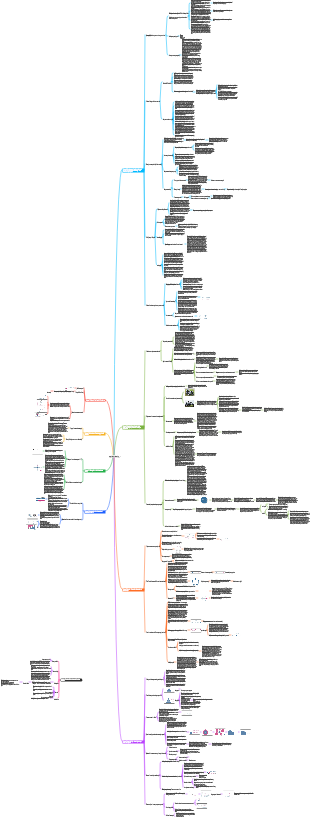
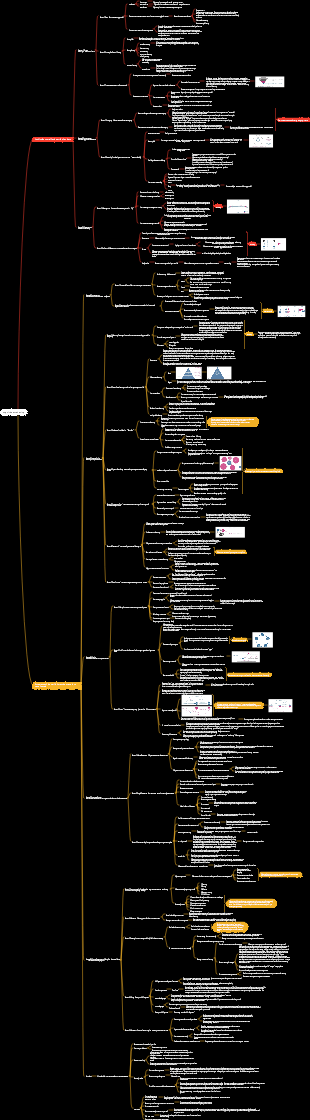

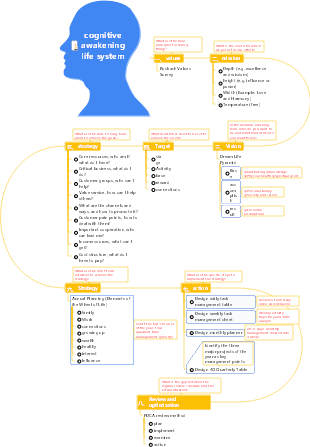
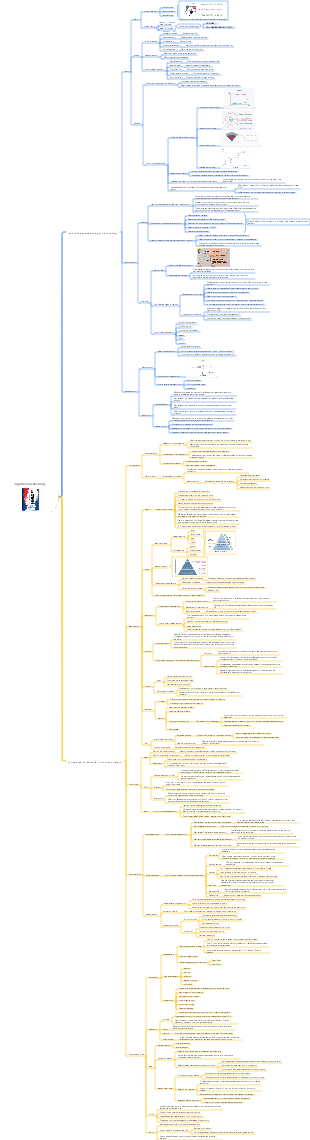

Notes on reading "Cognitive Awakening" Zhou Ling·First Edition 2020 Wei Xiaoxiao·20240313
The brain - the origin of all problems
Brain: Rediscover yourself
Triple brain: instinctive brain (low-level, powerful), emotional brain (centered), rational brain (high-level, weak)
Understand that if you want to use your rational brain to act, it is not to let the rational and instinctive brains and the emotional brain be rigid (willpower), but to cultivate the rational brain to dominate and promote the instinctive and emotional brains to act. Example: young manager and older employee.
Anxiety: The Roots of Anxiety
Anxiety category
completion anxiety
The schedule is too full, there are too many tasks, and both time and emotion are tight. So act according to your own feasible measurement capabilities, and gradually iterate appropriately and appropriately.
location anxiety
Find your own position, and do not aim upwards at targets that are too far behind, which is meaningless and will only increase worries; do not aim downwards at targets that are too easy or have already been surpassed. No progress.
choice anxiety
Too many choices can easily cause people to fall into anxiety and worry about gains and losses. A good approach is to take out a pen and paper instead of daydreaming and list all the relevant parties, pros and cons, and clarify your thoughts as you sort through the paper. It's not necessarily about choosing the "best" solution, but choosing the "most appropriate" solution (that can be achieved with force). Then, put yourself in the position of "no more choice", cut off the hesitation, and execute.
environmental anxiety
The external environment will uncontrollably disrupt the plan at any time when you are not prepared. [Flexible Space], [Plan B] or even [Plan C] are very important. (I experienced this at a recent psychology salon)
difficulty anxiety
It is normal for the upward path to encounter bottlenecks. This is usually the key node when quantitative changes turn into qualitative changes. It would be good to sit down, stay calm, and break down the task. Reduce other tasks in this phase in an orderly and planned manner. Allow yourself to spend enough time and energy on overcoming difficulties. Of course, the "combination of work and rest" in the process can also allow you to "change your brain" to better inspire and find suitable solutions.
sources of anxiety
list in book
Restrain desires and don’t let yourself do many things at the same time
Face the display and see clearly your true ability level
Prioritize first things and find ways to only do the most important things
Accept the environment and do what you can within the limitations
Face the core and force yourself to break through it
My summary
Think too much, do too little
Doing too much without using your brain
Understand the brain, there is no method (for example, not deep enough; for example, too stubborn)
Used methods, eager for success
There is a bandwidth between "thinking" and "doing" and "getting". Therefore, the solution is to analyze the situation, identify the goal, and decompose the action guide. Keep a calm mind.
Patience: The world of those who have patience
Understand that impatience is natural and there is no need to worry about it
The training to understand the [edge of the comfort zone - stretching zone] is very effective. Choose the appropriate area so that the time and energy you put in will not [fall to the ground]
Recognize [amount of change (internalization)>amount of action (output)>amount of thinking (output)>amount of learning (input)]
Lack of patience is usually reflected in the amount of learning in the outer circle, where giving up is most likely to occur and where significant gains are least likely to be achieved.
Patiently cross the input into the output, qualitative changes usually follow, and the compound interest effect occurs
Patience is not the result of perseverance, but the result of having clear long-term goals
Subconscious - the easter egg that life leaves us
Ambiguity: Life is a race to eliminate ambiguity
Methods to improve thinking ability - constantly clarify core difficulties and insights, and focus on them
[Unclear content] affects [thinking ability]; [ambiguous selection] affects [action ability]
The methods of [self-interview] and [asking questions based on the problem] can very well help [eliminate ambiguity]; be sure to use [pen and paper] during this period; [clear goals and evidence-based decision-making]
[Facing ambiguity] and [Eliminating ambiguity] are inherently a challenge to [courage]
Sensibility: Top-level growth turns out to be “based on feeling”
[Rely on feeling for big things; rely on reason for small things]; Don’t look at things that you are resistant to from the bottom of your heart and you won’t like no matter how hard you try. Maybe that's a waste and internal friction.
Let your life goals and the things you practice be what you feel willing to do and accept. There is no need to [screw it] with yourself.
It is necessary to cultivate the ability of awareness to [perceive] the subconscious mind, and also to cultivate [examination] and [control] of subconscious reactions.
【Awareness】Be aware of your feelings and record them. Will form a clear picture of yourself.
The point that touches you “the most”
Ideas that “always” come up unintentionally
The first thought (subconscious reaction/command) when something happens without thinking about it
Dreams: What happens in dreams? How is the scene? How do I feel?
Body: Things you subconsciously don’t like will make you “sick” to resist
Intuition: The inexplicable sixth sense, you have to believe it
Metacognition - the ultimate human ability
Metacognition: Growth is slow because you can’t “fly”
Metacognition = reflective cognition: The ability of an individual to [think] and [monitor] one's own cognitive [process] from [God's perspective]; try to take into account the time dimension and the depth dimension. [Analysis] is the decisive means; [Concentration] is the prerequisite for action.
The ability of metacognition is: self-examination, active control, and the ability to prevent being influenced by the subconscious
Self-control: We are born to be thought masters
We are naturally influenced by our subconscious mind
Be aware first, then you can examine and control
Growth is about active control
Spend more "meta time" on the selected nodes, fully examine them, and have zero tolerance for ambiguity. [Paper and pen] is always a good idea
When your mobility is weak, your mind will definitely be vague about future detention operations.
Become the thinking helmsman of your own life
Stay aware of the present moment, examine your first reaction, and formulate a clear opinion
Stay awake throughout the day and always know what to do next
Keep thinking about long-term goals and figure out the long-term meaning and intrinsic motivation
Look inside yourself get rid of anxiety
Mindfulness - the intersection of emotion and intelligence
Emotional Focus: One trick to boost your focus
Take back your feelings and return to the present moment
Feel the body. Feel the differences and changes in every joint and every inch of skin.
Feel the emotions, feel the fear, happiness, anger, sorrow and joy
Feel your thoughts. Feel your thoughts drifting away for no reason. Are you attracted to something and why?
Feel yourself, pay attention to yourself, care for yourself
Concentration can be trained, or it can be wasted; the more you train it, the more focused and sharp it will be; the more it is wasted, the duller it will be and the more insensitive it will be.
Learning to focus: Deep immersion is the safe hilt of evolutionary double-edged sword
Relying solely on willpower and "working hard" may result in getting half the result with half the effort. Effortless, time-consuming, energy-consuming and confidence-consuming
Join the method to find [Deep Immersion] to help get twice the result with half the effort
Bring [attention] to tasks done or required to be completed
[Clear, specific, and effective] small goals (invalid or vague means useless)
[Extreme concentration] during practice; the time can be short, but try to keep the concentration as deep as possible; it helps to activate the divergence of the subconscious mind
[Obtain effective feedback] That is, self-examination or communication to [transform] and [output], and compare with [input]
【Always in the stretching area】Practice and always give yourself an environment where you can make progress and enjoy pleasure.
About【Review】
Examine your own [attention]. Is it passive attraction or active choice?
Examine your own [immersion level]. Is it distraction or extreme concentration? (If there is no way to bring it back, just let yourself do something else, change your mind, and then change it back in a controlled manner)
Look at your own [practice amount]. Is it just a little bit of practice or is it a lot of investment? (Not everything requires heavy investment, so [choose carefully])
Learning ability - learning is not just hard work
Matching: The edge of the comfort zone, a methodology that works for everything
If you encounter "too high difficulty", you can try "dismantling the target" to always stay in the "stretch zone" but not too far away from it, which is difficult to practice.
Depth: Deep learning is one of the few good ways out in life
The path from passive learning to active learning, [listen → read → demonstrate → discuss → practice → teach to others → reflect and polish]
[Selection of high-quality content] and [Sewing together knowledge fragments] are equally important; first-hand knowledge > second-hand knowledge
Choose different methods of "deep learning" and "shallow learning" for different contents and scopes
Related: The master’s “black box”
Establish an association
Information to information relationship
Information related to what is known
Relevance of information to life/practice/problems
Information is internalized and serves as a link to action
How to obtain related abilities
There is something to think about
The input reaches a certain level (too little content is more difficult to correlate)
Be curious (care about [what] [why])
Always ask yourself [what else could be done]
System: It is actually very simple to establish a personal cognitive system
【Know】≠【Cognition】
The purpose of personal growth is not [knowing and understanding], but [judgment and choice]
There is no "best", "most certain" or "most authoritative", there is only "most suitable at this stage"
Grasp the big ones and let go the small ones, and only learn [what touches you]
[Touch learning method]
Sense of touch
Record touches and leave traces
Can explain clearly in own language
It can be extracted when needed (touches that cannot be extracted are pseudo-touches)
Frequently contacted or used in life, practice produces strong correlation = internalization
Expand the edge of your comfort zone little by little
Punch in: Don’t be obsessed with punching in. Punch in will not predict your future.
Checking in is not a task, it is a record to help you examine yourself
Feedback: It’s time to tell you what real learning is
Always seek feedback. Use [feedback] to promote learning
Rest: You didn’t succeed, maybe because you worked too hard.
When you encounter bottlenecks and lack of concentration, change your mind!
Extreme concentration, active rest, and repetition (not "passive rest" when you are too tired)
Find your own rhythm
Action - Without action, the world is just a concept
Clarity: A concept that restructures your ability to act
Initial choices influence the direction of automatic reinforcement of behavior - a clear understanding: First things first!
Write it down in advance to guide action
Refine and concrete goals - support actions
Before thinking clearly, most of them cannot be executed and it consumes time.
"Fool": The world will reward those "fools" who do not care about gains and losses.
If the distance is too far, you can't see the target clearly; if you get closer, you can see the target clearly.
Action: How to solve the problem of "I understand everything, but I just don't do it"
It’s easy to stop when you “know”
Between "knowing" and "doing", you only need to "sort out" and "output" to build
"Principles" are all "empty promises", "change" is the "real money"
Emotional Power - Emotions are the wisdom of seeing problems from multiple perspectives
Mental Bandwidth: Only abundance can relieve worries
Mental bandwidth crisis emerges
When the pressure of a major task arises, it will attract attention
When multiple tasks become overwhelming, people lose mobility and self-control.
Tips for staying sane
Stay aware of the environment and choose wisely Change to the third perspective and God’s perspective to look at the problem
Stay goal aware, less is more Find out what is most important and concentrate your superior resources and concentration
Stay aware of desires and review decisions Just like clearing the memory of your mobile phone, regularly clear your brain of unnecessary desires that occupy emotional and thinking memory.
Stay emotionally aware and make careful decisions Avoid getting hot-headed during times of great mood swings
Maintain idle awareness and set limits on yourself Appropriately set up appropriate space for yourself with leisure and restrictions, and create an orderly (emotional, state, financial, time...) environment
Single perspective: Your bad mood comes from a single perspective
We only have one pair of eyes, and the world is multi-dimensional. Change your perspective and find a new perspective...
I believe that in any situation, there is always a better angle of interpretation.
On the way to find perspective, you can: move frequently, learn well, be open-minded, seek help, exercise more, and reflect often
Game mentality: Happy people are always doing something else
Key Factors in General Happiness
love and respect
value
option
When you "don't want to do it but must do it", try changing to a "do it for yourself"/"do it for fun" mentality
Doing it for yourself can free your emotions
Doing it for fun frees up attention
Morning Reading and Writing Run, five-piece life set - the lowest-cost way to grow
Getting up early: How do I insist on getting up early without an alarm clock, joining a group, or clocking in?
Give up the alarm clock; seize the peak of your brain
What to do: Planning, running, reflecting, reading and writing, difficult work
Things to note: the painful adaptation period in the initial stage; gradual progress and difficulty matching; state is also important; a short lunch break to recover quickly; do not disturb others; prepare in advance; make exceptions clear
Meditation: One day, you will unlock this hidden track
Sit quietly with your eyes closed and focus on breathing as a kind of brain exercise
Cultivate and control the brain to focus all the attention of the seven small balls on the same thing at the same time
Reading: How to make yourself fall in love with reading
Reading enables people to have high-density thinking
reading techniques
Choosing books is more important than reading
Clearly read for change, thinking and output > reading itself
Pay attention to the connections you make when reading; reading and writing should not be separated.
Writing: Thank you, Mr. Feynman
Feynman Technique: Use the simplest sentence to explain something clearly so that laypeople can understand it.
Movement: For the soul to go far, the body must be on the road
Physically, exercise can regenerate "neurons" in people and make them smarter
A good model is "exercise learning". It is best to conduct high-intensity and difficult mental activities 1 to 2 hours after exercise.
Good exercise = aerobic exercise, complex exercise
Aerobic exercise → Grow more brain nerve cells
Complex movements → tighter synaptic connections
A first-class life is not about wealth, but about awareness