MindMap Gallery epithelial tissue
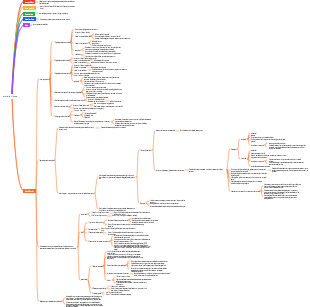
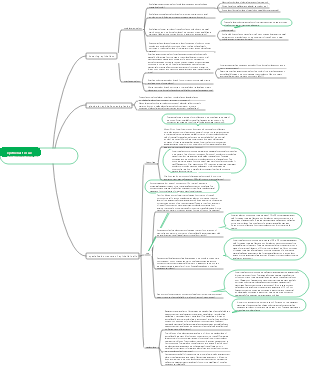
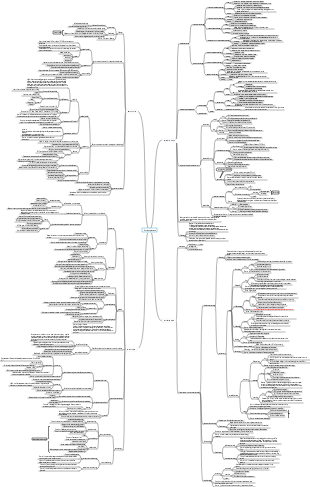
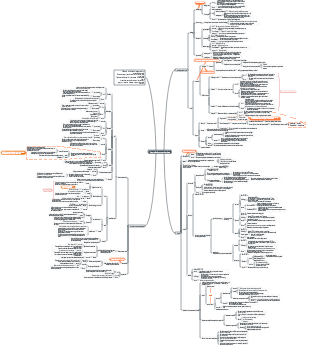
23 years of clinical medicine "Histology and Embryology" mind map of the content of epithelial tissue. Epithelial tissue is referred to as epithelium. It is composed of a large number of regular, densely arranged epithelial cells and a very small amount of extracellular matrix.
Edited at 2023-10-14 13:16:56This is a mind map about bacteria, and its main contents include: overview, morphology, types, structure, reproduction, distribution, application, and expansion. The summary is comprehensive and meticulous, suitable as review materials.

This is a mind map about plant asexual reproduction, and its main contents include: concept, spore reproduction, vegetative reproduction, tissue culture, and buds. The summary is comprehensive and meticulous, suitable as review materials.
This is a mind map about the reproductive development of animals, and its main contents include: insects, frogs, birds, sexual reproduction, and asexual reproduction. The summary is comprehensive and meticulous, suitable as review materials.
This is a mind map about bacteria, and its main contents include: overview, morphology, types, structure, reproduction, distribution, application, and expansion. The summary is comprehensive and meticulous, suitable as review materials.
This is a mind map about plant asexual reproduction, and its main contents include: concept, spore reproduction, vegetative reproduction, tissue culture, and buds. The summary is comprehensive and meticulous, suitable as review materials.
This is a mind map about the reproductive development of animals, and its main contents include: insects, frogs, birds, sexual reproduction, and asexual reproduction. The summary is comprehensive and meticulous, suitable as review materials.
Epithelial tissue (epithelium)
definition:
Referred to as epithelium, it is composed of a large number of regular and densely arranged epithelial cells and a very small amount of extracellular matrix.
Distribution: Covering the surface of the body and the cavity surface of cavity organs
Structural features
Many cells, tightly arranged, little extracellular matrix
There is polarity
Free surface: toward the surface of the body or the cavity surface with cavities
side
Basal surface: the side opposite the free surface, attached to the basement membrane
Avascular
Rich in nerve endings
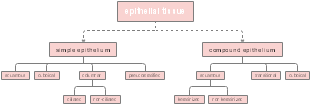
Classification
Covering epithelium
single layer
single layer squamous epithelium
Also known as single layer squamous epithelium
observe
surface view
Cells are irregular or polygonal
The nucleus is oval and located in the center of the cell
The edges of the cells are jagged or wavy, and they are chimeric with each other.
cross-sectional view
flat cells
The core-containing part is slightly thicker
Distribution and functionality
endothelium
Heart, blood vessels and lymphatic lumen
Function: Facilitates the flow of substances through blood and lymph
Mesothelium
Pleura, peritoneum, pericardium surface
Function: Conducive to visceral movement
other
Kidney cyst wall, alveoli, etc.
Features:
Smooth, reduces friction, facilitates material exchange, and has strong permeability
single layer cuboidal epithelium
observe
surface view
Cells are hexagonal or polygonal
cross-sectional view
Cells are cuboidal
The nuclear circle is centered
Distribution and functionality
Thyroid follicles, renal tubules, etc.
Function: secretion and absorption
Features:
A layer of approximately cubic cells
simple columnar epithelium
observe
surface view
Cells are hexagonal or polygonal
cross-sectional view
Cells are columnar
Nuclear ellipse, close to the base
Distribution and functionality
Gastrointestinal, gallbladder and uterus, etc.
Function: secretion and absorption
goblet cells
top
enlarge
filled with clay particles
Contains mucin, which combines with water to form mucus after secretion
Lubricates and protects the epithelium
bottom
narrow
The nucleus is deeply stained and appears as an inverted triangle.
Function: secretion and lubrication
Features: A layer of prismatic cells
pseudostratified ciliated columnar epithelium
observe
cross-sectional view
Looks like a multi-layer but is actually a single layer
Distribution and functionality
respiratory tract mucosa
Function: secretion, protection
composition
columnar cells:
At most, there are a large number of cilia on the free surface
spindle cells
cone cells
goblet cells
Features
The nuclei are not at the same level, but the bases are all attached to the basement membrane
basement membrane thickness
Multilayer
Stratified squamous epithelium
stratified squamous epithelium
distributed
Keratinized stratified squamous epithelium
skin epidermis
The nuclei of superficial cells disappear, the cytoplasm is filled with keratin, and the cells become hard and fall off.
Unkeratinized stratified squamous epithelium
Mouth, esophagus and anus
Superficial cells have nuclei and contain little keratin
Function
Friction-resistant; prevents the intrusion of foreign matter (protective effect); strong regeneration and repair ability
composition
surface layer
flat scaly
multilayered flat cells
basal layer
Basal cells:
One layer, short columnar shape, with the ability to proliferate
middle layer
polygon cells
spindle cells
Flat cells:
Superficial layer, exfoliated and keratinized
Features:
Rough basal surface
The basal surface and the free surface are not parallel
Stratified columnar epithelium
distributed:
Conjunctiva, male urethra and large ducts of some glands
Features:
Made up of several layers of cells
The deep part is one or several layers of polygonal cells
The shallow part is a layer of neatly arranged short columnar cells.
metastatic epithelium
distributed:
urinary tract
composition
Basal cells (layer 1):
cubic or dwarf columnar
Middle layer cells:
polygon, inverted pear shape
Surface cells (1 layer of cover cells):
large cube
Cover cells: one surface cell can cover several middle cells
Function:
protective
Features:
Epithelial thickness changes with physiological conditions
When the bladder is empty, the epithelium becomes thicker, the number of cell layers increases, and the cover cells become large cuboids.
When the bladder is full and expanded, the epithelium becomes thinner, the number of cell layers decreases, and the cover cells become flat.
The basal surface and the free surface are parallel
glandular epithelium
definition
Glandular epithelium:
Epithelium composed of glandular cells with mainly secretory function
Glands:
Organs mainly composed of glandular epithelium
Classification
endocrine glands
Secretions (hormones) released directly into the blood
No ducts, such as: thyroid gland, adrenal gland, pituitary gland, etc.
exocrine glands
Single cell gland:
Microstructures, such as goblet cells
multicellular gland
secretory department
shape
tubular glands
alveolar gland
tubuloalveolar glands
secretory part called acinus
composition
serous gonads
composed of serous acini
(Serous acini are composed of serous cells)
serous cells
Features
Generally cone-shaped or columnar
The nucleus is round, close to the base of the cell
Strong basophilic staining of the basal cytoplasm
The top cytoplasm contains more eosinophilic secretory granules, called zymogen granules.
Electron microscopy
Dense rough endoplasmic reticulum at the base
There are well-developed Golgi complex and secretory granules above the nucleus.
Function
Secretion of serous fluid, thin
Distribution: Parotid gland
mucous gonads
Made of mucinous acini
(Mucinous acini are composed of mucinous cells)
mucous cells
Features
Generally cone-shaped
The nucleus is flat and oval, located at the base
A small amount of perinuclear cytoplasm showed basophilic staining
Most of the cytoplasm is almost colorless and appears as foam or vacuoles.
(Light cytoplasmic staining)
The top cytoplasm is filled with a large number of mucin granules
Electron microscopy
There is a certain amount of rough endoplasmic reticulum in the basal cytoplasm
There is a well-developed Golgi complex and extremely abundant coarse clay particles above the nucleus.
Function
secretion of mucus, thick
Distribution: duodenal glands
mixed gonads
Composed of three types of acini
mixed acini
Composed of serous cells and mucinous cells
The common form is: the acinus is mainly composed of mucinous cells, and the serous cells are located at the bottom or end of the acinus. They are arranged in a half-moon shape on the section, so it is called serous half-moon.
Distribution: sublingual gland, submandibular gland
Catheter Department
Directly connected to the secretory part and surrounded by single or stratified epithelium
Function:
Discharge secretions, some of which secrete or absorb water and electrolytes
With or without branching into simple complex glands
Secretions are discharged through ducts to the body surface or into organ cavities
Acinar ducts, such as sweat glands, salivary glands, gastric glands, etc.
The acini are alveolar or tubular, composed of a single layer of cuboidal or cone-shaped cells, with epimyoblasts
special structure
free surface
microvilli
About 0.1 μm in diameter, tiny finger-like protrusions extending from the free surface of epithelial cells;
Cytoplasm inside, cell membrane outside
Electron Microscope (EM)
Surface: cell membrane
Central axis (in the cytoplasm): longitudinal microfilaments
(Microfilaments are actin filaments, and microfilament contraction can make microvilli elongate or shorten)
Light microscope (LM)
A large number of microvilli are densely arranged to form
Striatal border (the surface of the columnar epithelial cells of the small intestinal mucosa) or brush border (the renal tubular epithelium)
Function:
Increase surface area for better absorption
cilia
Thick and long protrusions extending from the free surface of epithelial cells,
5~10μm long, 0.3~0.5μm diameter;
Cytoplasm inside, cell membrane outside
Electron Microscope (EM)
Surface: cell membrane
Center axis: Visible 9 2 structure
There are 2 single microtubules in the center and 9 groups of doublet microtubules around them.
Light microscope (LM)
visible
Function:
Rhythmic directional swing
matrix
The base of the cilium has basically the same structure as the centriole
Its microtubules are connected to the microtubules of cilia
side
(cell connection)
The intercellular space is very narrow, strengthening the mechanical connection between cells,
Maintain the integrity and coordination of the organizational structure
The formation and maintenance of cell junctions are dependent on calcium ions
It is composed of local cell membrane, cytoplasm and intercellular space between adjacent cells.
When two or more connections exist at the same time, it is called a connection complex
Tight junction/closed junction (occlusive zonules)
located at the top of the side of the cell
Electron microscopy
Adjacent cell membranes form approximately 2 to 4 point-like fusions
The intercellular space disappears at the fusion point
There is a very narrow gap at the non-fusion point
Function:
Block substances from passing through intercellular spaces
(barrier effect)
Intermediate connection/adhesive tape (adhesive tape)
Located beneath tight junctions and surrounding the top of the cell
Electron microscopy
transmembrane cadherin
The gap between adjacent cells is 15~20nm and contains dense filaments.
The cytoplasmic inner surface of the membrane contains a thin layer of dense material and microfilaments.
Microfilaments form a terminal network in the cytoplasm
Function:
intercellular adhesion,
Maintain cell shape and transmit cell contractility
Desmosomes (focal adhesions)
Spot-like or button-like, varying in size, located deep in the adhesive zonules
In areas prone to friction such as skin and esophagus
Especially developed in stratified squamous epithelium
Electron microscopy
wide intercellular space
There is a middle line, made of interwoven filaments
Cytoplasmic surface: thicker dense material forming the attachment plate
Attachment plate: There are intermediate filaments (keratin filaments) attached in the form of loops
Function:
Strong mechanical connection, supporting and fixing
Gap junction/communication connection (communication connection)
Widespread, deep surface of columnar cells
Electron microscopy:
Adjacent cell membranes are highly parallel,
The intercellular space is about 3 nm, and there are many junctions at approximately equal intervals.
There are many regularly distributed connectosomes in the cell membrane
Columnar particles, aggregated into spots of varying sizes
There are many roughly equally spaced connection points within the
Diameter 7~9nm,
Surrounded by 6 rod-shaped connexins, with a small tube with a diameter of 2 nm in the center
Adjacent cells are connected through small tubes, which serve as communication channels between cells.
Function:
Transmit chemical information and electrical impulses
basal surface
basement membrane
A thin film formed between the basal surface of epithelial cells and deep connective tissue
The basement membrane of pseudostratified ciliated columnar epithelium and stratified squamous epithelium is thicker and pink.
Generally cannot be distinguished in HE stained sections
Silver-plated dyeing, the base film is black
Under the capillary endothelium, around muscle cells and some glial cells,
The base film consists only of the substrate
Electron microscopy
substrate
close to epithelium
Produced by epithelial cells,
Thick 50~100nm
two floors
transparent layer
A thin layer with low electron density close to the basal surface of epithelial cells
Dense layer
High electron density and thicker
composition
Laminin, fibronectin and type IV collagen, etc.
stencil
Connected to connective tissue
Produced by fibroblasts of connective tissue
Mainly composed of reticular fibers and matrix, sometimes with a few collagen fibers
Function:
Support, connect, and fixate; semipermeable membrane, conducive to material exchange;
Also guides epithelial cell movement, affecting proliferation and differentiation
plasma membrane infolding
structure
Electron Microscope (EM)
Infolding of the basal cell membrane into the cytoplasm
Perpendicular to the basal surface of the cell
The inner folds contain many parallel long rod-shaped mitochondria.
(Longitudinal mitochondria)
Light microscope (LM)
Vertical lines
Distribution: Mainly in renal tubules
Function:
Expand the basal area of cells to facilitate the movement of water and electrolytes
hemidesmosome
Located on the basal surface of epithelial cells
half of the desmosome structure
There are also attachment plates on the inside of the cell membrane.
Tension filaments attach to it, fold into loops and return to the cytoplasm
Function:
anchor epithelial cells to the basement membrane