MindMap Gallery mathematical analysis
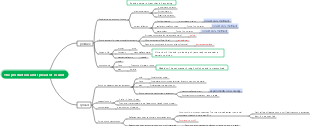
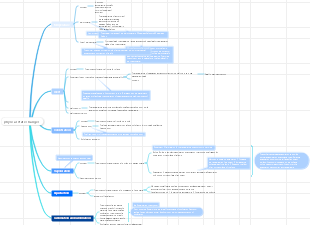
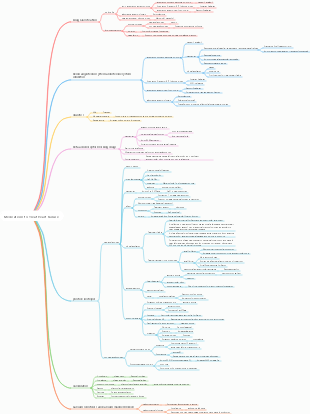
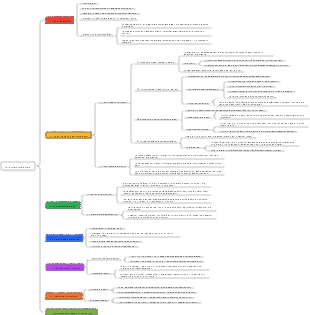
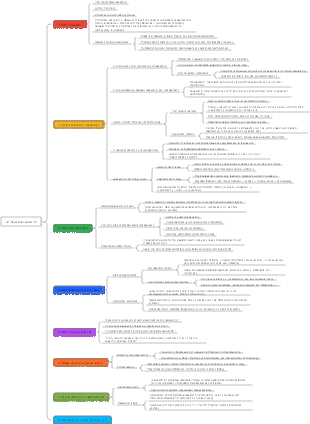
The main research content of mathematical analysis is functions, limits, calculus, series, etc. Among them, calculus is the collective name for Differential Calculus and Integral Calculus. The theoretical basis of calculus is limit theory, and the theoretical basis of limit theory is real number theory.
Edited at 2024-11-03 21:00:54Rumi: 10 dimensiones del despertar espiritual. Cuando dejes de buscarte, encontrarás todo el universo porque lo que estás buscando también te está buscando. Cualquier cosa que haga perseverar todos los días puede abrir una puerta a las profundidades de su espíritu. En silencio, me metí en el reino secreto, y disfruté todo para observar la magia que me rodea y no hice ningún ruido. ¿Por qué te gusta gatear cuando naces con alas? El alma tiene sus propios oídos y puede escuchar cosas que la mente no puede entender. Busque hacia adentro para la respuesta a todo, todo en el universo está en ti. Los amantes no terminan reuniéndose en algún lugar, y no hay separación en este mundo. Una herida es donde la luz entra en tu corazón.
¡La insuficiencia cardíaca crónica no es solo un problema de la velocidad de la frecuencia cardíaca! Es causado por la disminución de la contracción miocárdica y la función diastólica, lo que conduce al gasto cardíaco insuficiente, lo que a su vez causa congestión en la circulación pulmonar y la congestión en la circulación sistémica. Desde causas, inducción a mecanismos de compensación, los procesos fisiopatológicos de insuficiencia cardíaca son complejos y diversos. Al controlar el edema, reducir el frente y la poscarga del corazón, mejorar la función de comodidad cardíaca y prevenir y tratar causas básicas, podemos responder efectivamente a este desafío. Solo al comprender los mecanismos y las manifestaciones clínicas de la insuficiencia cardíaca y el dominio de las estrategias de prevención y tratamiento podemos proteger mejor la salud del corazón.
La lesión por isquemia-reperfusión es un fenómeno que la función celular y los trastornos metabólicos y el daño estructural empeorarán después de que los órganos o tejidos restauren el suministro de sangre. Sus principales mecanismos incluyen una mayor generación de radicales libres, sobrecarga de calcio y el papel de los leucocitos microvasculares y. El corazón y el cerebro son órganos dañados comunes, manifestados como cambios en el metabolismo del miocardio y los cambios ultraestructurales, disminución de la función cardíaca, etc. Las medidas de prevención y control incluyen eliminar los radicales libres, reducir la sobrecarga de calcio, mejorar el metabolismo y controlar las condiciones de reperfusión, como baja sodio, baja temperatura, baja presión, etc. Comprender estos mecanismos puede ayudar a desarrollar opciones de tratamiento efectivas y aliviar las lesiones isquémicas.
Rumi: 10 dimensiones del despertar espiritual. Cuando dejes de buscarte, encontrarás todo el universo porque lo que estás buscando también te está buscando. Cualquier cosa que haga perseverar todos los días puede abrir una puerta a las profundidades de su espíritu. En silencio, me metí en el reino secreto, y disfruté todo para observar la magia que me rodea y no hice ningún ruido. ¿Por qué te gusta gatear cuando naces con alas? El alma tiene sus propios oídos y puede escuchar cosas que la mente no puede entender. Busque hacia adentro para la respuesta a todo, todo en el universo está en ti. Los amantes no terminan reuniéndose en algún lugar, y no hay separación en este mundo. Una herida es donde la luz entra en tu corazón.
¡La insuficiencia cardíaca crónica no es solo un problema de la velocidad de la frecuencia cardíaca! Es causado por la disminución de la contracción miocárdica y la función diastólica, lo que conduce al gasto cardíaco insuficiente, lo que a su vez causa congestión en la circulación pulmonar y la congestión en la circulación sistémica. Desde causas, inducción a mecanismos de compensación, los procesos fisiopatológicos de insuficiencia cardíaca son complejos y diversos. Al controlar el edema, reducir el frente y la poscarga del corazón, mejorar la función de comodidad cardíaca y prevenir y tratar causas básicas, podemos responder efectivamente a este desafío. Solo al comprender los mecanismos y las manifestaciones clínicas de la insuficiencia cardíaca y el dominio de las estrategias de prevención y tratamiento podemos proteger mejor la salud del corazón.
La lesión por isquemia-reperfusión es un fenómeno que la función celular y los trastornos metabólicos y el daño estructural empeorarán después de que los órganos o tejidos restauren el suministro de sangre. Sus principales mecanismos incluyen una mayor generación de radicales libres, sobrecarga de calcio y el papel de los leucocitos microvasculares y. El corazón y el cerebro son órganos dañados comunes, manifestados como cambios en el metabolismo del miocardio y los cambios ultraestructurales, disminución de la función cardíaca, etc. Las medidas de prevención y control incluyen eliminar los radicales libres, reducir la sobrecarga de calcio, mejorar el metabolismo y controlar las condiciones de reperfusión, como baja sodio, baja temperatura, baja presión, etc. Comprender estos mecanismos puede ayudar a desarrollar opciones de tratamiento efectivas y aliviar las lesiones isquémicas.
mathematical analysis
other
Define maximum/minimum values
Theorem pinch theorem
Proof of the Fundamental Theorem of Completeness of Real Numbers
real number theory
abnormal integral
Applications of definite integrals
definite integral
Eight indefinite integrals
Concept of indefinite integral and basic integral formula
Define original function
Theorem: If the function is continuous on the interval , then the original function exists on , that is
Theorem Suppose {F}(x) is a primitive function of {f}(x) on the interval I, then all primitive functions of F(x) on the interval I can be expressed as F(x) {\color{red } C ,C \in R}
Define indefinite integral
Points number
Accumulating function
integrand expression
quantity
Basic points table
Integration by Substitution and Integration by Parts
Theorem substitution method
1
2
Integration by parts
Rational functions can be reduced to indefinite integrals of rational functions
Indefinite integrals of rational functions
rational function
Definition rational function
Define true fraction/improper fraction
Definition triangular rational expression
Half-width substitution
Indefinite integrals of some simple irrational expressions
6. Differential Mean Value Theorem and Its Applications
Lagrange's theorem and monotonicity of functions
Rolle's theorem and Lagrange's theorem
Theorem Rolle's theorem
Theorem Lagrange's mean value theorem
Geometric meaning
Equivalent expression
{f} (b) -{f} (a) = {f} ' ( a \theta (b - a)) (b- a) , 0< \theta <1
{f} (a -h) -{f} (a) = {f} ' (a \theta h) h , 0< \theta <1
{f} (b) - {f} (a)= {f} ' ( \xi) (b - a) , a < \xi <b
monotonic function
Judgment of monotonicity of differentiable functions theorem
Let {f}(x) be differentiable on the interval I
{f}' (x) \ge 0 ( \le 0)
Judgment of strict monotonicity of differentiable functions theorem
Let {f} (x) be differentiable on the interval \left ( a,b \right)
For all x \in \left ( a,b \right ) , there is {f}' (x) \ge 0 ( \le 0)
{f}'(x) e 0 on any self-interval of \left ( a,b \right )
This judgment also holds true if the function is one-sided and continuous on the closed side of the interval.
Corollary Assume that the function {f} is differentiable on the interval I. If {f}' (x) >0 ({f}' (x) < 0) , then {f} strictly increases (decreases) on I
Theorem Darboux theorem (intermediate value theorem of derivative functions)
Corollary Assume that the function {f} (x) satisfies {f}' (x) e 0 on the interval I, then {f} (x) is strictly monotonic on the interval I
Cauchy's Mean Value Theorem and Infinitive Limits
Cauchy's mean value theorem
Geometric meaning
\begin{vmatrix} {f} (a) & {f} (b) & {f} '( \xi) \\ {g} (a) & {g} (b) & {g} '( \xi ) \\ {h}(a) & {h} (b) & {h} '(\xi) \end{vmatrix} =0 if xxxx
infinitive limit
define infinitive
LawLópidaLaw#Imitation
\frac{0}{0} type limit
\frac{a}{\infin} type infinitive limit
Taylor formula
Formula Taylor polynomial with Peano remainder
{T} (x) =\sum_{i=0}^{n} \frac{{f}^{(i)}(x_0)}{n!} (x-x_0)^i o (x^n)
prove
LawLópidaLaw#Imitation
Define derivative
Formula Maclaurin Formula
{f} (x)= \sum_{i=0}^{n} \frac{{f}^{(i)}(0)}{n!} (x)^i
Taylor formula with Lagrange type remainder
Theorem Taylor's theorem
{T} (x) =\sum_{i=0}^{n} \frac{{f}^{(i)}(x_0)}{n!} (x-x_0)^i \frac{f^ {(n 1)}(\xi)}{(n 1)!} (x-x_0)^{n 1}
Applications in approximate calculations
Function extremes and maximum (small) values
Extreme value judgment
Fermat's theorem
The first sufficient condition for the extreme value of the theorem
Let {f} be continuous at point x_0 and differentiable on a certain neighborhood U ^ {\circ} (x_0; \delta)
(i) If {f} '(x) \le 0 when x \in \left ( x_0 - \xi ,x_0 \right ), {f when x \in \left( x_0 , x_0 \xi \right ) }' (x) \ge 0, then {f} obtains the minimum value at x_0
(ii) If when x \in \left ( x_0 - \xi ,x_0 \right ) {f} '(x) \ge 0, when x \in \left( x_0 , x_0 \xi \right ) {f }' (x) \le 0, then {f} obtains the maximum value at x_0
The second sufficient condition for the extreme value of the theorem
Suppose f is first-order differentiable on a certain neighborhood U (x_0; \delta) of x_0, and second-order differentiable at x=x_0, and {f} '(x_0)= 0, {f} '' (x_0) e 0
If {f}''(x_0) < 0, then {f} obtains the maximum value at x_0
If {f}''(x_0) > 0, then {f} obtains the minimum value at x_0
The third sufficient condition for the extreme value of the theorem
Suppose {f} exists in a certain neighborhood of x_0 with derivatives up to order n-1, and is derivable to order n at x_0, and {f} ^ {(k)} (x_0) = 0 (k=1,2,\dots ,n-1), {f}^{(n)} e 0
When n is an even number, {f} takes the extreme value at x_0
Obtain the maximum value when {f}^{(n)}(x_0)<0
Obtain the minimum value when {f}^{(n)}(x_0)>0
When n is an odd number, {f} does not take an extreme value at x_0
⚠️Attention
The three sufficient conditions do not apply to determine all extreme points (even if they are differentiable)
{f}(x)= \begin{cases} e ^{- \frac{1}{x^2}}& \text{if} x e 0 \\ 0 & \text{if} x=0 \ end{cases}
The maximum point may not have a left (right) neighborhood that makes it monotonic.
{f}(x)=2-x^2(2 \sin \frac{1}{x})
Maximum and minimum values
boundedness theorem
stable point
non-derivable point
Interval endpoint
The convex point and inflection point of the function
convex function
Define convex function
Define strictly convex functions
Lemma f is the necessary and sufficient condition for the convex function on I
Theorem Suppose f is a differentiable function on the interval I, then the following statements are equivalent to each other
f is a convex function on I
{f} 'is an increasing function on I
Theorem Suppose f is a second-order differentiable function on the interval I, then the necessary and sufficient condition for f to be a convex function on I is {f} ''(x) \ge 0, x \in I
For any two points x_1, x_2 on I, we have {f}(x_2) \ge {f}(x_1) {f} '(x_1) (x_2-x_1)
inference
The necessary and sufficient condition for the minimum value of a differentiable convex function is that the derivative is zero
If the function {f} is a derivable convex number defined on the open interval \left ( a, b \right )
{f} '(x_0)=0 \Leftrightarrow x_0 \in \left ( a,b \right ) is the minimum point of f
The convex function on the open interval does not take the maximum value
Formula Jensen (Jensen) inequality
If {f} is a convex function on \left [ a, b \right ]
\forall x_i \in \left [ a, b \right ], \lambda _i > 0 (i =1, 2, \dots ,n), \sum _{i=1}^{n} \lambda _i =1
There are {f} (\sum_{i=1}^{n} \lambda _i x_i) \le \sum_{i=1}^{n} \lambda _i {f}(x_i)
A convex function on the open interval I has left and right derivatives at any point on I
There may not be a derivative if there are left and right derivatives
{f} is a convex function on the open interval I, then {f} is bounded on any closed subinterval \left [ a, b \right ] of I
concave function
Define concave function
Define a strictly concave function
Properties similar to convex functions
turning point #unfinished
Define inflection point
theorem
theorem
Discussion of function graphs
General procedure for constructing graphs of functions
1. Find the domain of the function;
2. Examine the parity and periodicity of the function;
3. Find some special points of the function, such as intersection points with two coordinate axes, discontinuous points, non-differentiable points, etc.;
4. Determine the monotonous interval of the function, extreme point, convex interval, and inflection point;
5. Examine asymptotes;
6. Based on the above discussion results, draw the function graph.
Approximate solution to Eq.
1. Sets of real numbers and functions
real numbers
nature
About the closure of four arithmetic operations
Orderliness
Convert rational numbers to infinite decimals for comparison
Finite decimal expressed as infinite decimal
size
x=y
x>y
x<y
Specifies that any non-negative real number is greater than a negative real number
Geometric meaning
size is transitive
satisfy the Archimedean property
density
continuity
Number set*definite bound principle
Intervals and Neighborhoods
interval
finite interval
infinite interval
∞
-∞
Define upper bound/next bound
Define supremum/infinite bound
far away
7. Completeness of Real Numbers
Fundamental theorem about the completeness theorem of real numbers
principle of certainty
finite interval
infinite interval
monotonic bounded theorem
Closed interval theorem
finite covering theorem
Gathering Point Theorem\Compactness Theorem
Cauchy Convergence Criterion
The real number completeness theorems are equivalent to each other
upper limit and lower limit
Define the gathering point of a sequence
Theorem The bounded point sequence (sequence)\left \{ x_n \right \} has at least one gathering point, and there is a maximum gathering point and a minimum gathering point
Define upper and lower limits
Theorem\forall \left \{ x_n \right \} is bounded, there are \underline{\lim} _{x \to \infty} x_n \le \overline{\lim} _{x \to \infty} x_n
Theorem\lim _{x \to \infty} x_n =A \Longleftrightarrow \overline{\lim} _{x \to \infty} x_n = \underline{\lim} _{x \to \infty} x_n= A
Theorem If \{x_n\} is a bounded sequence
Preservation of inequality in the upper and lower limits of the theorem
Theorem If \{x_n\} is a bounded sequence
Function concept
definition
Notation
Four arithmetic operations
complex
inverse function
elementary functions
functions with certain properties
Boundedness
Monotonicity
Strange
cyclical
2 Sequence Limits
The concept of sequence limits
Definition 1
Definition 1’
infinitesimal sequence
infinite sequence
nature
uniqueness
Boundedness
Number retention
Preserve inequality
compulsion
four arithmetic rules
subcolumn
definition
Necessary and sufficient conditions for sequence convergence
Conditions for the existence of the limit of a sequence
Principle Monotonic Bounded Principle
principle of reduction
compactness theorem
Theorem Cauchy Convergence Criterion
Three function limits
Define function limits
nature
uniqueness
local boundedness
Number retention
guaranteed inequality
compulsion
four arithmetic rules
Conditions for the existence of function limits
principle of reduction
3.9
Monotone bounded
Cauchy criterion
Infinitely large and infinitely small quantities
infinitesimal amount
nature
The sum and difference product of two infinitesimal quantities is still an infinitesimal quantity
The product of an infinitesimal quantity and a bounded quantity is an infinitesimal quantity
Compare
High level/low level
Same level
equivalence
replace
infinite amount
definition
Compare
relation
asymptote of curve
definition
Determining method
4. Function continuity
concept of continuity
Continuity of a function at a point
Define the function to be continuous at one point
Left (right) continuous
necessary and sufficient conditions
discontinuity
Define break points
Classification
Discontinuities of the first kind
Can remove discontinuities
jump break point
Type II discontinuities
Continuous functions on intervals
Define continuous functions on intervals
piecewise continuous
Properties of continuous functions
Local properties of continuous functions
local boundedness
Local number preservation
Four arithmetic operations
complex
Basic properties of continuous functions on closed intervals
Maximum and minimum value theorems
boundedness theorem
Theorem Intermediateness Theorem
Existence Theorem of Theorem Roots
Continuity of inverse functions
consistent continuity
Define consistent continuity
Principle boils down to principle
consistent continuity theorem
Continuity of elementary functions
Continuity of exponential functions
Continuity of elementary functions
Theorem: All basic elementary functions are continuous functions on their domain.
Theorem: Any elementary function is a continuous function on its defined interval.
5 Derivatives and Differentials
The concept of derivative
Definition of guidance
Definition guide
{f}'( x_{0} ) =\lim _ { x \to x _ { 0 } } \frac { f ( x ) - f ( x _ { 0 } ) } { x - x _ { 0 } } =\lim_{\Delta x \to 0} \frac{\Delta y}{\Delta x}=\lim_{\Delta x\to 0} \frac{f(x_{0} \Delta x)-f(x_{0})}{\Delta x}
Definition is not derivable
formula finite increment formula
Theorem is differentiable\Rightarrow continuous (but not vice versa)
Define one-sided derivative
Conditions for the existence of theorem {f}'(x_0)
derivative function
Define derivative functions/derivatives
The geometric meaning of derivatives
Tangent equation y-y_0= {f}'(x_{0})(x-x_0)
Define extreme values
Define stable point
Fermat's theorem
Corollary If the function {f} is differentiable on the interval I, and {f}' (x) = 0, x \in I, then {f} is a constant function on I
Corollary If the functions {f} and {g} are both differentiable on the interval I, and {f} ' (x) = {g} ' (x) , x \in I, then on the interval I, {f} ( x) ={g} (x) c (c is a constant)
Corollary Theorem Derivative Limit Theorem
Formula derivation rule
Basic derivation rules
Four arithmetic operations
(u \pm v) '=u ' \pm v '
(uv) '=u 'v v 'u
(\frac{u}{v}) '=\frac{u 'v-v 'u}{v^2}
( \frac{1}{v}) '=- \frac{v '}{v^2}
derivative of inverse function
f '(x_0)=\frac{1}{f^{-1}(y_0)}
\frac{\mathrm{d} y}{\mathrm{d} x} =\frac{1}{\frac{\mathrm{d} y}{\mathrm{d} x} }
Derivatives of composite functions
({f}\circ {\varphi}) '(x_0)={f '}(u_0){\varphi} '(x_0)
\frac{\mathrm{d} y}{\mathrm{d} x} = \frac{\mathrm{d} y}{\mathrm{d} u}\cdot \frac{\mathrm{d} u}{ \mathrm{d} x}
Direction formula for basic primary functions
(c) ' =0
(x^a) '=ax^{a-1}
\Delta
(\sin x) '=\cos x
(\cos x) '=-\sin x
(\tan x) '=\sec^2 x
(\cot x)'=-\csc ^2 x
(\sec x) '=\sec x \tan x
(\csc x) '=-\csc x \cot x
(a^x) '=a^x\ln a
(e^x) '=e^x
(\log_{a}{x}) '=\frac{1}{x\ln a}
(\ln x) '=\frac{1}{x}
Skill
Logarithmic derivation
Derivatives of parametric functions
Parametric equation of plane curve C
smooth curve
\frac{\mathrm{d}x}{\mathrm{d}y} =\frac{\mathrm{d}y}{\mathrm{d}t} \cdot \frac{\mathrm{d}t}{ \mathrm{d}x}
higher order derivatives
Define the second derivative {f}''
Define second-order differentiability
Define higher order derivatives
{f}^{(n)}(x_0) {f}^{(n)}
{y}^{(n)}|_{x=x_0} {y}^{(n)}
\frac{\mathrm{d}^{n}y}{\mathrm{d}x^n}|_{x=x_0} \frac{\mathrm{d} ^n y}{\mathrm{d}x^ n}
Higher order derivatives after operation
Addition and subtraction
[{u} \pm {v} ]^{(n)}={u}^{(n)} \pm {v}^{(n)}
multiplication
Formula Leibniz formula
({u}{v})^{(n)}= \sum_{k=0}^{n} {C_{n}^{k} {u}^{(n-k)}{v}V^{ (k)}}
where {u}^{(0)}={u},{v}^{(0)}={v}
differential
Differential concept
Define differential \mathrm{d}y|_{x=x_0}=A\Delta x or \mathrm{d}{f}(x)|_{x=x_0}=A \Delta x
Geometric Interpretation of Differentials
Define differentiable functions
nature
Invariance of first-order differential forms
Arithmetic rules of formula differentiation
\mathrm{d}[{u}(x) \pm {v}(x)] = \mathrm{d} {u}(x) \pm \mathrm{d} {v}(x)
\mathrm{d}[{u}(x) {v}(x)] ={v}(x) \mathrm{d}{u}(x) {u}(x) \mathrm{d} {v }(x)
\mathrm{d} \frac{{u}(x)}{{v}(x)}= \frac{{v}(x) \mathrm{d} {u}(x) - {u} (x ) \mathrm{d} {v} (x)}{{v} ^2 (x)}
\mathrm{d} ({f }\circ {g} (x))= {f} '(u) g '(x) \mathrm{d} x ={f} ' ({u}) \mathrm{ d}{u}
Higher order differentials
Define the second-order differential \mathrm{d} ^2 y ={f} ''(x) \mathrm{d} {x^2}
Define higher order differential \mathrm{d}^n y = {f} ^{(n)} (x) \mathrm{d} x^n
no longer has formal invariance
Application of Differential Calculation in Approximate Calculations
Approximate calculation of functions
To replace the song directly
{f} (x_0 \Delta x) \approx {f} (x_0) {f} ' (x_0) \Delta x , \Delta x is very small
{f} (x) ={f} (x_0) {f} '(x_0) (x-x_0) ,x \approx x_0
error estimate
Error limit of measured value x_0\delta _x \ge |x-x_0|=|\Delta x|
| \ Delta y | = | {f} (x) -{f} (x_0) | \ approx | {f} '(x_0) \ delta x | \ le | {f}' (x_0) | \ delta_x
Relative error limit\frac{ \delta_y}{|y_0|}=|\frac{{f} '(x_0)}{{f}(x_0)}| \delta_x
Symbol notation
\mathrm{d} ^2 x= \mathrm{d} (\mathrm{d} x)
\mathrm{d} x^2= (\mathrm{d} x)^2