MindMap Gallery photosynthesis
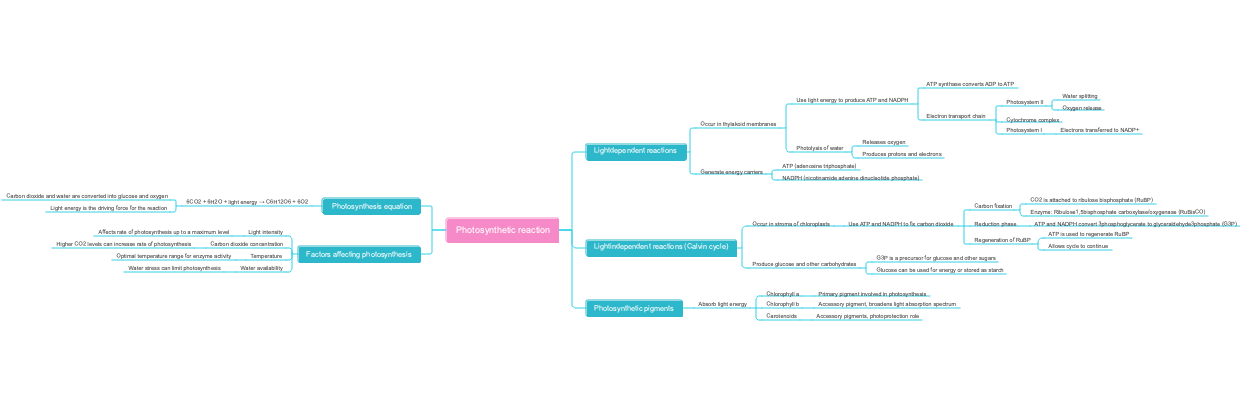
An introduction to photosynthesis. Photosynthesis is a process in which green plants (including algae) absorb light energy, synthesize carbon dioxide and water into energy-rich organic matter, and release oxygen at the same time.
Edited at 2024-03-07 16:44:28This is a mind map about bacteria, and its main contents include: overview, morphology, types, structure, reproduction, distribution, application, and expansion. The summary is comprehensive and meticulous, suitable as review materials.

This is a mind map about plant asexual reproduction, and its main contents include: concept, spore reproduction, vegetative reproduction, tissue culture, and buds. The summary is comprehensive and meticulous, suitable as review materials.
This is a mind map about the reproductive development of animals, and its main contents include: insects, frogs, birds, sexual reproduction, and asexual reproduction. The summary is comprehensive and meticulous, suitable as review materials.
This is a mind map about bacteria, and its main contents include: overview, morphology, types, structure, reproduction, distribution, application, and expansion. The summary is comprehensive and meticulous, suitable as review materials.
This is a mind map about plant asexual reproduction, and its main contents include: concept, spore reproduction, vegetative reproduction, tissue culture, and buds. The summary is comprehensive and meticulous, suitable as review materials.
This is a mind map about the reproductive development of animals, and its main contents include: insects, frogs, birds, sexual reproduction, and asexual reproduction. The summary is comprehensive and meticulous, suitable as review materials.
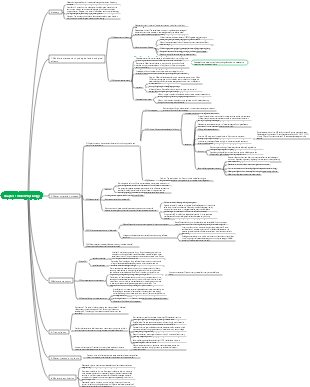
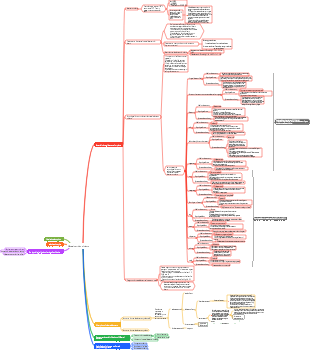
photosynthesis
photosynthetic pigments
Optical properties
radiant energy
fluorescence phenomenon
First singlet state → ground state
Phosphorescence
First triplet state → ground state
type
Chlorophyll
type
Chlorophyll a
blue-green
Chlorophyll b
yellow-green
constitute
metalloporphyrin ring
4 pyrrole ring 1 magnesium ion
Phytol
Diterpenes composed of 4 isoprene units
effect
Absorb red light blue violet light
carotenoids
type
carotene alpha
beta carotene
carotene gamma
Lutein
effect
Absorb blue light blue violet light
Protective effects
Phycobilin
Phycocyanin
Absorb red-orange light
Phycoerythrin
absorb green light
Synthesis and degradation of chlorophyll
synthesis
process
Glu→Porphyrinogen (Porphobilinogen)→Protoporphyrin IX→Monovinyl protochlorophyll ester a→Chlorophyll ester a→Chlorophyll a
Influencing factors
Light (main factor)
Temperature (affects enzyme activity)
nutrient
Moisture
O₂
degradation
Chlorophyllase removes phytol
Magnesium dechelatase removes magnesium ions
Oxygenase opens the porphyrin structure
Tetrapyrrole forms a water-soluble colorless product
Principles of photosynthesis
light reaction
Primary reaction (light energy → electrical energy)
photochemical reaction center complex
PSⅠ
The particles are smaller and mainly distributed in the non-stacked areas of the thylakoid membrane.
Transfer electrons from PC to Fd (ferredoxin) to reduce NADP⁺
PSⅡ
The particles are larger and mainly distributed in the stacking area of the thylakoid membrane.
Photolysis of water releases oxygen and protons and transfers electrons to quinone
Composed of D₁, D₂, CP₄₃, CP₄₇ protein and P₆₈₀ pigment molecules
QA (PQA) is a plastoquinone that is firmly bound to D₂. QB (PQB) is a plastoquinone that is firmly bound to D₁. After gaining two electrons, it forms PQH₂ and is released into the membrane lipids.
red drop effect
When the light wave is >680nm (far red light), the quantum yield drops sharply
Emerson effect (double light gain effect)
When far-red light (710nm) is supplemented with red light (650nm), the quantum yield is greatly increased (more than the sum of the two lights alone)
Electron transfer and photophosphorylation (electrical energy → active chemical energy)
Z chain electron transfer model
Cyt b₆f complex
composition
2 Cytb, 1 Cytc (formerly Cytf), 1 Fe-S protein, 2 quinone redox sites
Electron transfer and proton transmembrane mechanisms of the quinone cycle Cytb₆f complex
photophosphorylation
Photosynthetic electron transfer pathways and photophosphorylation types
Cyclic photosynthetic electron transport pathway and photophosphorylation (main pathway)
Non-cyclic photosynthetic electron transport pathway and photophosphorylation
Only PSI is activated, enhanced under adversity, and regulates photosynthesis.
Pseudocyclic photosynthetic electron transfer pathway and photophosphorylation
Occurs when NADP⁺ supply is insufficient under strong light
Carbon reaction (dark reaction)
Assimilation of carbon (active chemical energy → stable chemical energy)
way
Calvin cycle (C₃ cycle)
carboxylation→reduction→update
CO₂ receptor is ribulose diphosphate
regulating factors
autocatalysis
Make the RuBP content appropriate and the cycle stable
Regulation of light (activation of various target enzymes)
Rubisco
fructose bisphosphatase
sedum heptanolase
glyceraldehyde phosphate dehydrogenase
phosphoribulokinase
photosynthetic product transport
The photosynthetic rate is directly proportional to the amount of photosynthetic product TP transported (the amount of sucrose synthesized)
C₃Plants: rice, wheat, etc.
C₄ cycle
The CO₂ receptor is phosphoenolpyruvate (PEP)
Fix HCO₃⁻ to form oxaloacetate (OAA) catalyzed by phosphoenolpyruvate carboxylase (PEPC)
C₄ plants: sorghum, sucrose, corn, etc.
Mainly distributed in tropical and subtropical areas
Crassulacean acid metabolism pathway (CAM)
At night, the stomata open to absorb CO₂, which combines with PEPC to form OAA and is further reduced to malic acid.
Sedum plants: sedum, ground rooting, etc.
Function
Fix and transport CO₂ (C₃ cycle can form photosynthetic products such as starch)
photosynthetic products
Sugars: monosaccharides (G, F), disaccharides (sucrose*←cytoplasm), polysaccharides (starch*←chloroplast)
Organic acids (glycolic acid, pyruvic acid, malic acid)
AA(Ala,Gly)
Fatty acids (palmitic acid, oleic acid, linoleic acid)
protein
photorespiration
Relying on light to absorb O₂ and release CO₂
Consumes ATP and reducing power (Fd), releasing CO₂
Function (guess)
Protection against damage from strong light
Maintain C₃ pathway
CO₂Loss Remediation
Eliminate glycolic acid poisoning
Nitrogen Metabolism Supplement
Influencing factors
Light
CO₂
temperature
mineral elements