MindMap Gallery Sartre's Philosophical Thoughts
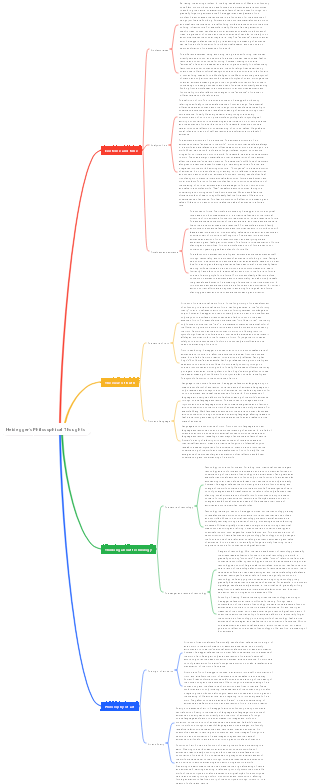
This is a mind map about Sartre's philosophical thoughts, the main contents include: literature and philosophy, others and society, freedom and responsibility, and the foundation of existentialism.
Edited at 2025-02-11 18:08:05In order to help everyone use DeepSeek more efficiently, a collection of DeepSeek guide mind map was specially compiled! This mind map summarizes the main contents: Yitu related links, DS profile analysis, comparison of DeepSeek and ChatGPT technology routes, DeepSeek and Qwen model deployment guide, how to make more money with DeepSeek, how to play DeepSeek, DeepSeek scientific research Application, how to import text from DeepSeek into MindMaster, the official recommendation of DeepSeek Wait, allowing you to quickly grasp the essence of AI interaction. Whether it is content creation, plan planning, code generation, or learning improvement, DeepSeek can help you achieve twice the result with half the effort!
This is a mind map about DeepSeek's 30 feeding-level instructions. The main contents include: professional field enhancement instructions, interaction enhancement instructions, content production instructions, decision support instructions, information processing instructions, and basic instructions.
This is a mind map about a commercial solution for task speech recognition. The main content includes: text file content format:, providing text files according to the same file name as the voice file.
In order to help everyone use DeepSeek more efficiently, a collection of DeepSeek guide mind map was specially compiled! This mind map summarizes the main contents: Yitu related links, DS profile analysis, comparison of DeepSeek and ChatGPT technology routes, DeepSeek and Qwen model deployment guide, how to make more money with DeepSeek, how to play DeepSeek, DeepSeek scientific research Application, how to import text from DeepSeek into MindMaster, the official recommendation of DeepSeek Wait, allowing you to quickly grasp the essence of AI interaction. Whether it is content creation, plan planning, code generation, or learning improvement, DeepSeek can help you achieve twice the result with half the effort!
This is a mind map about DeepSeek's 30 feeding-level instructions. The main contents include: professional field enhancement instructions, interaction enhancement instructions, content production instructions, decision support instructions, information processing instructions, and basic instructions.
This is a mind map about a commercial solution for task speech recognition. The main content includes: text file content format:, providing text files according to the same file name as the voice file.
Sartre's Philosophical Thoughts
Existentialist foundation
Existence precedes essence
Conceptual explanation: In the process of philosophical development, traditional philosophy often believes that the essence of things precedes existence, for example, Christian philosophy believes that God presets the essence of human beings. Sartre did the opposite, advocating that people first came to the world in a pure state of existence, and then gradually shaped their unique essence through their own continuous actions. Taking craftsmen making utensils as an example, before craftsmen started making it, they already had the established essence of the shape and function of the utensils in their minds, and built the utensils according to this blueprint. But when a person is born, there is no a priori fixed essence. Just like a famous painter, he was not born with the essence of a painter, but during his growth, he developed a strong interest in painting, devoted a lot of time to learn painting skills, constantly practiced creatively, participated in various art exhibitions, and in this long time. During the process, he gradually formed his unique style, skills and artistic concepts as a painter, thus shaping the essence of "painter".
Philosophical significance: This view completely denies the transcendental theory of human nature and determinism. The transcendental theory of human nature believes that human beings have a fixed and unchanging nature, and the determinism advocates that human behavior and destiny are determined by external law of cause and effect. Sartre emphasizes the subjective initiative of an individual. People are no longer puppets controlled by some mysterious force or established rules, but have absolute power to shape and define themselves. This lays a solid theoretical foundation for free choice, which means that people must be responsible for their lives, because it is their choices and actions that determine their own essence.
Free existence and self-existence
Free existence: It refers to those existences in the objective world that are completely untouched by human will. Natural things like towering mountains and rivers, rushing rivers, etc. exist only according to their own physical laws, "what they are", without consciousness, without purpose, and their form is pure and accidental. Taking stone as an example, its physical properties, such as hardness, color, chemical composition, etc., as well as its position and way of existence in nature, are not changed by human consciousness. Whether humans observe it or not, it exists in their own way.
Self-existence: This refers specifically to the existence of human consciousness. People have unique transcendence and negativity, and are always in a state of "what they are not, not what they are." People are never satisfied with the current established status quo, always constantly denying and transcending themselves, and creating themselves through practical actions. For example, if a student is not satisfied with his current grades, he will not be content with the status quo, but will formulate a study plan, get up early and go to bed late every day, study hard, participate in various extracurricular tutoring classes, and improve his grades through these actions and achieve Self-transcendence is the vivid manifestation of self-existence.
The relationship between the two: self-existence cannot exist separately from free existence, and human consciousness activities must be unfolded in the objective world. For example, when a painter creates, he must rely on paints, canvas and other freely existing material materials. At the same time, self-existence gives meaning to free existence. Through consciousness and action, people can give natural things a new value and meaning. A piece of ordinary stone is carefully carved into a work of art. The stone that originally had only physical attributes was given aesthetic value and became the object of appreciation and appreciation for people.
Freedom and responsibility
Absolute freedom
Definition of freedom: Sartre firmly believes that people have absolute freedom, and no matter what difficult situations they are in, they always have the freedom to choose. Even if there are many restrictions in the external environment, people can freely choose how to deal with it. In the cruel war, a soldier faces a life-and-death choice. He can choose to rush to the battlefield bravely and fearlessly and fight for the country and honor; he can also choose to retreat under the drive of fear. This freedom of choice is not absolutely restricted by any external factors and depends entirely on the soldier's own will.
Breakthrough to the traditional view of freedom: The traditional view of freedom often believes that freedom is strictly restricted by the law of cause and effect and necessity, and believes that human behavior is determined by factors such as past experience, environment and internal physiological and psychological mechanisms. Sartre boldly broke this concept and emphasized that freedom is the essential attribute of human beings. Human beings are not passive existences mechanically determined by external factors, but subjects who can independently determine their own behavior and life direction.
Responsibility and freedom
The emergence of responsibility: Because people have the power to make free choices, they inevitably have to be responsible for every choice and action of their own. This is because every choice is not only about itself, but also like ripples, having a wide range of influence in society, affecting others and the entire society. For example, a decision maker of an enterprise chooses to expand production scale. This decision will not only directly affect the company's own capital flow, personnel allocation, market share and other aspects, but will also have an impact on the work intensity and salary of the company's employees. Influence the competitive landscape of similar products in the market, as well as consumers' purchasing choices and consumption experience. Therefore, decision makers must be responsible for a range of consequences of this choice.
The infiniteness of responsibility: Because freedom is absolute, the corresponding responsibility is also infinite. People should not only be responsible for their current behavior, but also for the long-term impact they may have in the future. Moreover, people are not only responsible for themselves, but also shoulder the important task of being responsible for all mankind. Because every individual choice reflects to some extent human judgment of the human right state. For example, a scientist chooses to develop a new technology that may change human life. He not only needs to consider the risks and benefits of the current technology research and development process, but also needs to consider the technology to human society in the next few decades or even hundreds of years. The possible far-reaching impacts of ethics, ecological environment, etc.
Others and society
Others are hell
Concept explanation: Sartre’s “others are hell” does not mean that the essence of others is evil, but emphasizes that in the process of interpersonal communication, the gaze and judgment of others will put huge pressure on oneself, thereby limiting personal freedom. For example, at an important social dinner, when everyone's eyes are focused on themselves, they will unconsciously start to care whether their words and deeds are appropriate, whether their clothes are appropriate, and every move and every sentence must be considered repeatedly. Natural behavior is extremely restricted and partial freedom is deprived of.
Deep meaning: This sentence reminds people to deeply reflect on the dilemma faced by freedom in the relationship between themselves and others, and prompts people to think about how to achieve their own freedom cleverly while respecting others' freedom, and avoid over-reliance on others' evaluations to define themselves. Excessive care of others' opinions will cause you to fall into a dilemma of unfreedom. Only by getting rid of this excessive dependence can you truly achieve freedom.
Society and Individual
The impact of society on individuals: the social environment and historical and cultural background are like an invisible mold, profoundly shaping individual values and cognitive methods, and to a certain extent limiting individual choice ranges. Under different cultural backgrounds, people have huge differences in their choices and concepts about marriage, career, etc. In some traditional societies, family traditions and social customs have strict restrictions on career choices. The phenomenon of sons inheriting the father's business is relatively common, and it is difficult for individuals to break through this traditional constraint and choose a career they are truly interested in.
The reaction of individuals to society: Individuals do not completely passively accept the shaping of society, and individuals’ free choices and actions can also promote social change. Individuals can promote continuous progress in society by bravely resisting unreasonable social systems and concepts. Martin Luther King launched a series of protests to fight for equal rights for blacks. With his firm belief and unremitting efforts, he aroused the public's attention and pursuit of racial equality in the society, and ultimately promoted the process of racial equality in the American society. Take an important step.
Literature and Philosophy
Literary intervention
The mission of literature: Sartre believes that literature should not be just a word game for people to enjoy, but should actively intervene in social reality. By creating works, writers keenly reveal various problems in society and boldly express their unique views on the world, thereby inspiring readers to think deeply and prompting them to take practical actions. Many realistic literary works have caused widespread attention and profound reflection on the gap between the rich and the poor and social fairness of the people at the bottom of society by delicately depicting the difficult living difficulties of the people at the bottom of society, such as poverty, disease, oppression, etc.
The integration of literature and philosophy: Literature is a vivid carrier of philosophical thought. It can use rich literary images and exciting plots to cleverly convey abstract and obscure philosophical concepts to the public, making philosophy easier to be understood and accepted. Sartre's novel "Disgusting" is a typical example. Through the protagonist's various experiences in daily life and his inner monologue, it vividly shows the absurdity emphasized by existentialism and the profound thinking about the essence of the world, allowing readers to In the process of reading stories, we naturally contact and think about philosophical issues.
Literary creation and freedom
Creation is a free expression: when writing literary creation, writers have absolute freedom and can freely choose the creative theme, whether it is to explore the complexity of human nature, social changes, or depict the beauty of nature; they can freely choose unique forms, For example, if you adopt different genres such as poetry, novels, dramas, etc.; you can also freely choose expression methods, use various writing techniques such as stream of consciousness, symbolism, and realism to build an imaginative ideal world through words, and fully express your own opinions. The unremitting pursuit of freedom. Stream of consciousness novel writers freely break the traditional narrative structure, using the characters' inner flow of consciousness as clues, to show the characters' complex and changeable inner world.
Inspire readers' freedom: Excellent literary works are highly infectious and inspiring, which can stimulate readers' awareness of freedom deep in their hearts, prompt readers to reflect deeply on their own lives, and then make free choices. When readers read a work with profound ideological connotations, they may be moved by the fate of the characters and the development of plots in the work, and thus re-examine and think about their life direction and values, and ultimately make the freedom to change their lives. choose.