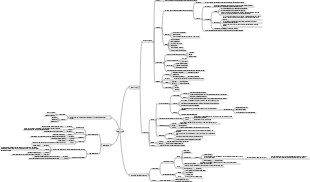
MindMap Gallery Urinary system mind map
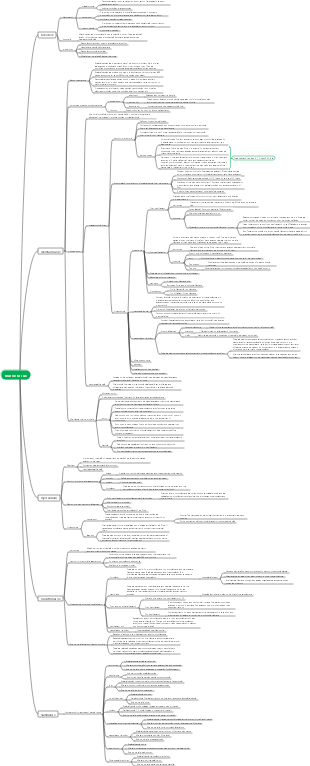
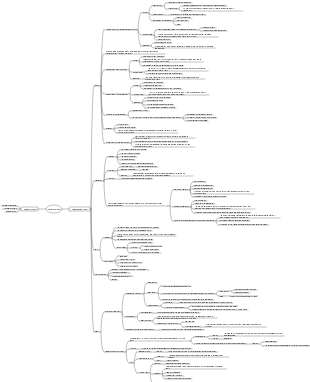
The urinary system consists of the kidneys, ureters, bladder and urethra. Its main function is excretion. Excretion refers to the physiological process in which various substances produced during the body's metabolic process that are not used by the body or are harmful are transported outside the body.
Edited at 2023-11-09 12:00:00This is a mind map about bacteria, and its main contents include: overview, morphology, types, structure, reproduction, distribution, application, and expansion. The summary is comprehensive and meticulous, suitable as review materials.

This is a mind map about plant asexual reproduction, and its main contents include: concept, spore reproduction, vegetative reproduction, tissue culture, and buds. The summary is comprehensive and meticulous, suitable as review materials.
This is a mind map about the reproductive development of animals, and its main contents include: insects, frogs, birds, sexual reproduction, and asexual reproduction. The summary is comprehensive and meticulous, suitable as review materials.
This is a mind map about bacteria, and its main contents include: overview, morphology, types, structure, reproduction, distribution, application, and expansion. The summary is comprehensive and meticulous, suitable as review materials.
This is a mind map about plant asexual reproduction, and its main contents include: concept, spore reproduction, vegetative reproduction, tissue culture, and buds. The summary is comprehensive and meticulous, suitable as review materials.
This is a mind map about the reproductive development of animals, and its main contents include: insects, frogs, birds, sexual reproduction, and asexual reproduction. The summary is comprehensive and meticulous, suitable as review materials.
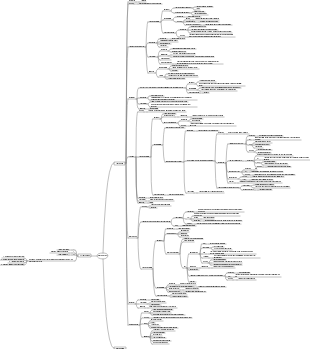
urinary system
store urine, urinate
ureter
bladder
urethra
kidney
Function
produce urine
Excrete metabolic waste, regulate water and salt, and ion balance (maintain the stability of the body's internal environment)
endocrine
Renin, erythropoietin, prostaglandins
General structure
membrane
Fibrous membrane (dense connective tissue)
substance
cortex
cortical labyrinth
medullary rays
renal column
medulla
renal pyramids
kidney lobe
renal lobules
organizational structure
substance
Classification
superficial nephron
85%, renal corpuscles are located in the superficial and middle layers of the cortex, are smaller in size, and have shorter medullary loops
urine formation
paramedullary nephron
15%, the renal corpuscle is located deep in the cortex, is larger in size, and has a longer marrow.
Concentrated urine
Renal corpuscle (spherical)
composition
renal capsule
dirty layer
Podocytes
wall layer
single layer squamous epithelium
renal cystic cavity
glomus
composition
afferent arteriole
capillary half
efferent arteriole
feature:
(1) Porous capillaries without septa. There is a basement membrane outside most of the endothelium, except for the areas adjacent to the vascular mesangium.
vascular basement membrane
Three layers of inner, middle and outer layers under electron microscope
Thin and sparse - Thick and dense - Thin and sparse
Molecular sieves (filtration of blood substances)
(2) Diameter: afferent arteriole > efferent arteriole
(3) There is intrabulbar mesangium (vascular mesangium) between the loops
Mesangial cells (specialized smooth muscle cells)
structure
Cell shape is irregular, with protrusions extending between the endothelium and basement membrane
The nucleus is deeply stained, and the cytoplasm contains rough endoplasmic reticulum, Golgi complex, lysosomes and phagosomes
There are microtubules, microfilaments and intermediate filaments in the cell body and processes.
Function
Synthetic basement membrane and mesangial matrix components
Phagocytosis and degradation of immune complexes deposited on the basement membrane to maintain its permeability
Participate in the renewal and repair of basement membrane
matrix
filter barrier
composition
fenestrated capillary endothelium
endothelial basement membrane
podocyte slit membrane
Function
filter blood
Produce original urine
(Actually, 1 to 2L of urine is urinated every day, which is 1% of the original urine)
two levels
vascular pole
Urine grade
renal tubule
structure
single layer epithelium
The proximal end is connected to the renal capsule and the distal end is connected to the collecting duct
Function
Reabsorb and excrete most of the components in the original urine
composition
Proximal tubule (longest, thickest)
song
LM
Cells cuboidal or pyramidal
Nuclear round near base
Free surface brush border, vertical lines at the base, unclear boundaries between cells
Cytoplasmic eosinophilia
EM:
Microvilli, infoldings of plasma membrane, lateral processes
basal plasma membrane sodium pump
straight
The structure is similar to that of the curvature, with only microvilli, infoldings of the plasma membrane, and reduced lateral processes.
Function (main site for reabsorption of original urine)
Reabsorption: glucose, amino acids, proteins and most water, ions, urea
Secretion: hydrogen ions, ammonia, creatinine, hippuric acid, etc.
Transport and elimination: phenol red, penicillin and other drugs
fine section
structure
The lumen is small and the wall is single-layered and flat.
Function
Concentrated urine (thin wall, conducive to water and ion permeability)
Distal tubule (large lumen)
straight
The cells are small, the nucleus is round and central, the boundaries are clear, and the single layer is cubic.
LM: no brush border, clear longitudinal striations on the base, and lighter cytoplasmic staining
EM: Microvilli are short and small, with few lateral processes, well-developed inner folds of the plasma membrane, and sodium-potassium ATPase.
song
The structure is similar to that of the pars recta, except that the infoldings of the plasma membrane are not as developed as the pars recti.
Function
Important parts of ion exchange: Under the influence of aldosterone and antidiuretic hormone, it regulates acid-base balance, absorbs H2O and Na, and excretes K, H, NH3, etc.
collecting tube
Parabulbar complex (vascular pole)
composition
juxtaglomerular cells
Smooth muscle cells → epithelioid cells
LM: Large, cuboidal, round nucleus, weakly basophilic cytoplasm
EM: Few myofilaments, rough endoplasmic reticulum and Golgi apparatus, secretory granules (renin (proteolytic enzyme): increases blood pressure)
macula densa
Oval-shaped spots formed by epithelial cells on the side of the distal tubule close to the renal corpuscle
structure
LM: The cells are columnar, tightly arranged, the nucleus is oval near the cell top, and the cytoplasm is light in color.
Function
Ion receptor (sodium ion)
extraglomerular mesangial cells
Continuous with the intrabulbar mesentery
There are gap junctions between juxtaglomerular cells and intraglomerular mesangial cells
Function
Device to regulate blood pressure, water, and electrolyte balance
Interstitial
Connective tissue, blood vessels and nerves
Leydig cells (fibroblasts within the medulla)
secrete prostaglandins
Synthetic fibers and matrix within the stroma
Produce erythropoietin